
Self-Priming Fuel Dispenser: Working Principle, Structure & Components
News 2026年 7月 26日 43
Among various types of fuel dispensing equipment, the self-priming fuel dispenser is widely used in gas station projects due to its integrated pumping system, stable performance, and flexible installation advantages.
But how does a fuel dispenser transfer fuel from an underground storage tank to a vehicle’s fuel tank?
In this article, we will explain the structure, working principle, and key components of a self-priming fuel dispenser, helping you better understand how modern fuel dispensing systems operate.
1.What Is a Self-Priming Fuel Dispenser?
A self-priming fuel dispenser is an integrated fuel delivery system designed to combine fuel pumping, filtration, measurement, control, and dispensing functions in one machine.
The main components include:
- Pump system
- Filtration system
- Flow measurement system
- Control valve
- Electronic control system
- Fuel nozzle
Unlike systems that rely on an external submersible pump, a self-priming fuel dispenser uses a built-in motor-driven pump to generate suction and transfer fuel from the underground storage tank to the vehicle.
For gas station projects using this type of fuel dispenser, the integrated pumping structure can provide greater installation flexibility and reliable operationy and reliable operation, making it suitable for a wide range of gas station applications.
2.Main Components of a Self-Priming Fuel Dispenser
2.1 Motor and Fuel Pump System
The motor is the power source of the entire fuel delivery process.
When a customer starts fueling, the motor begins operating and drives the fuel pump to rotate.
The pump creates negative pressure, allowing fuel to be drawn from the underground storage tank into the dispenser system.
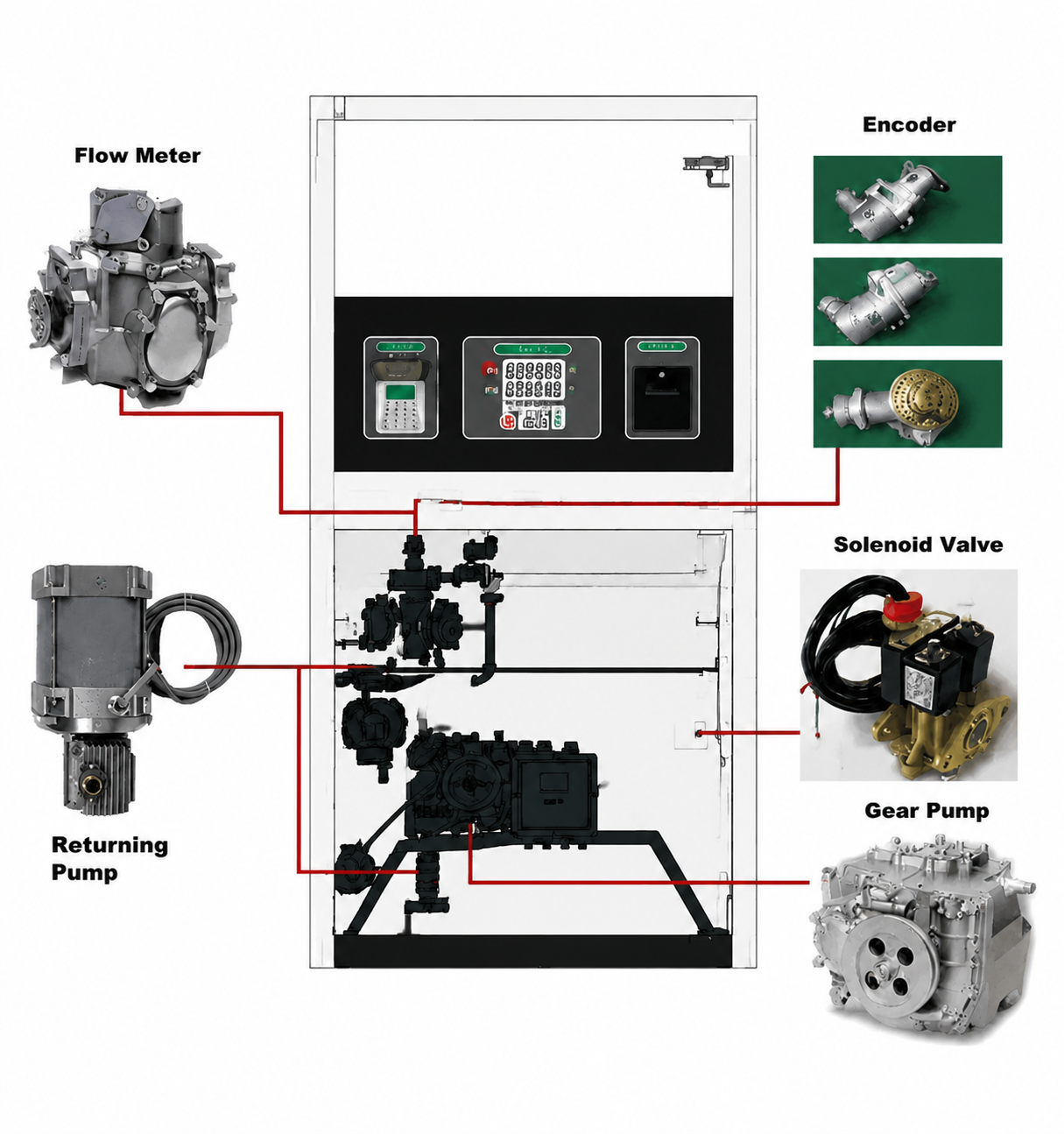
The fuel dispenser gear pump is one of the key mechanical components involved in fuel delivery.
Main functions:
- Generate suction power
- Transfer fuel continuously
- Maintain stable fuel flow
As the core mechanical component, the fuel pump plays an important role in determining the overall fuel supply performance of the dispenser.
2.2 Oil-Gas Separation System
During the fuel transfer process, small amounts of air and fuel vapor may enter the system.
The oil-gas separator separates gas from liquid fuel before the fuel enters the measurement system.
The separated gas is discharged through the ventilation system, while the fuel continues flowing through the dispenser.
Advantages:
- Improves measurement accuracy
- Reduces fuel flow fluctuations
- Ensures stable operation
2.3 Filtration System
Before entering the measurement system, fuel passes through a filtration unit.
The filter removes impurities and particles that may affect internal components.
Main benefits:
- Protects the flow meter
- Extends equipment service life
- Maintains fuel quality
A reliable filtration system helps ensure long-term stable operation of the fuel dispenser.
3.Self-Priming Fuel Dispenser Working Principle
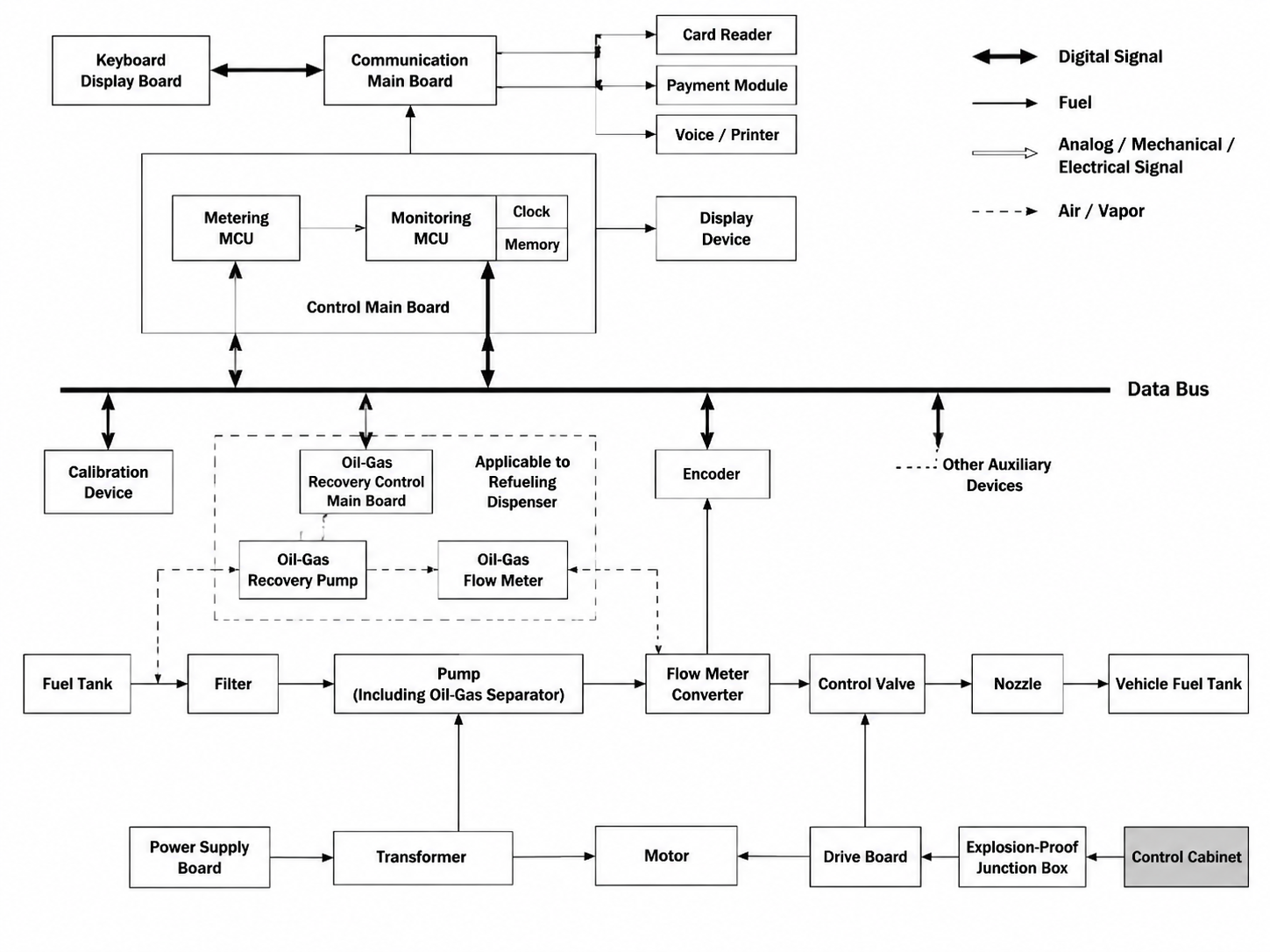
The self-priming fuel dispenser working principle can be understood through several key stages, from fuel suction and filtration to accurate measurement and final delivery.
Step 1: Fueling Starts
When the customer lifts the nozzle and presses the handle:
- The control system receives the fueling command
- The motor starts running
- The fuel pump begins operating
The dispenser enters the fuel delivery mode.
Step 2: Fuel Is Drawn From the Underground Storage Tank
The rotating pump creates suction pressure, allowing fuel to flow from the underground tank.
The fuel passes through the following path:
Underground storage tank
↓
Double bottom valve
↓
Underground oil pipeline
↓
Metering system
↓
Solenoid valve
↓
Solenoid valve
↓
Self-sealing fuel nozzle
During this stage, air and impurities are removed to ensure stable fuel delivery.
Note: If the two consecutive solenoid valves in the flow path represent different components in your actual dispenser system, keep both. Otherwise, verify the technical diagram before publishing.
Step 3: Accurate Fuel Measurement
After filtration, the fuel enters the flow measurement system, where the fuel dispenser flow meter measures the amount of fuel passing through the system.
The flow meter detects the amount of fuel passing through and converts mechanical movement into electronic signals through an encoder.
The control system processes the data and calculates:
- Fuel volume
- Fuel price
- Transaction information
This ensures accurate measurement and reliable fuel transactions.
Step 4: Fuel Delivery to the Vehicle
After measurement, the fuel passes through the control valve and fuel hose.
Finally, the fuel nozzle delivers the fuel into the vehicle’s tank.
The entire process is automatically controlled by the system, ensuring safe, efficient, and accurate fueling.
4. Electronic Control and Data Processing System
Modern fuel dispensers are not only mechanical devices but also intelligent fuel management systems.
The electronic control system includes:
- Main control board
- Metering MCU
- Monitoring MCU
- Encoder
- Display unit
- Communication module
The system collects and processes real-time operating data, including:
- Fuel volume management
- Price calculation
- Payment information
- Equipment status monitoring
This helps gas station operators improve management efficiency and monitor equipment performance more effectively.
Need a self-priming fuel dispenser or other fuel station equipment for your project? Contact Us to discuss your requirements.
5. Advantages of Self-Priming Fuel Dispensers
5.1 Flexible Installation
Since the pumping system is integrated inside the dispenser, no additional external pump equipment is required.
This simplifies installation and provides more flexibility for different station layouts.
5.2 Stable Fuel Supply
The built-in pump provides continuous fuel delivery and ensures reliable operation during daily fueling activities.
5.3 Accurate Measurement
The combination of a precision flow meter and electronic control system improves measurement accuracy and transaction reliability.
5.4 Easy Maintenance
The integrated structure makes inspection, troubleshooting, and routine maintenance more convenient.
For projects requiring different fuel dispenser components, selecting the appropriate pump, flow meter, valve, and control system is important for long-term operation.
6. Applications of Self-Priming Fuel Dispensers
Self-priming fuel dispensers are widely used in:
- Commercial gas stations
- Fleet fueling systems
- Industrial fuel supply facilities
- Remote fueling locations
Because the pumping system is integrated into the dispenser, this type of fuel dispensing system can be applied to different station layouts and fueling requirements.
7. Self-Priming Fuel Dispenser Maintenance
To ensure long-term and stable operation, regular maintenance is recommended.
Check the Fuel Filter Regularly
Clean or replace the filter to prevent blockage and maintain smooth fuel flow.
Regular inspection of the pump, flow measurement system, valves, and other key components can also help identify potential problems before they affect normal fueling operations.
Need help selecting fuel dispenser components for a gas station project? Contact Us for equipment sourcing and project support.
8. Conclusion
A self-priming fuel dispenser combines mechanical transmission technology, precision measurement systems, and intelligent electronic control.
From fuel suction and filtration to accurate measurement and final delivery, every component plays an important role in ensuring efficient and reliable fueling operations.
Understanding how a self-priming fuel dispenser works helps gas station operators select suitable equipment, improve maintenance efficiency, and achieve safer, more stable, and more efficient station operations.
If you are planning a gas station project and need fuel dispensers, dispenser components, pumps, valves, or other equipment, Contact Us to discuss your requirements.