
Stainless Steel Corrugated Hose for Fuel Tanks: Selection & Installation Guide
News 2026年 10月 2日 36
A rigid fuel pipeline does not always tolerate movement, vibration or installation misalignment.
In a gas station or fuel depot, underground storage tanks and connected piping can experience limited movement caused by foundation settlement, thermal expansion and installation tolerances. Fuel pumps can also transmit vibration through rigid pipework. If these forces are transferred directly to pipe joints, welds or tank connections, they may increase mechanical stress and contribute to leakage or connection damage.
A properly selected stainless steel corrugated hose provides a controlled flexible connection between fuel tank outlets, pumps and fixed piping.
One common configuration is a flange-to-male-thread corrugated hose, with a stainless steel flange on one end and a male threaded connector on the other. This configuration can be manufactured in different diameters, lengths and connection standards according to project requirements.
Important: The actual pressure rating, allowable movement, temperature range, connection dimensions and installation suitability should always be confirmed according to the specific hose assembly and project requirements.
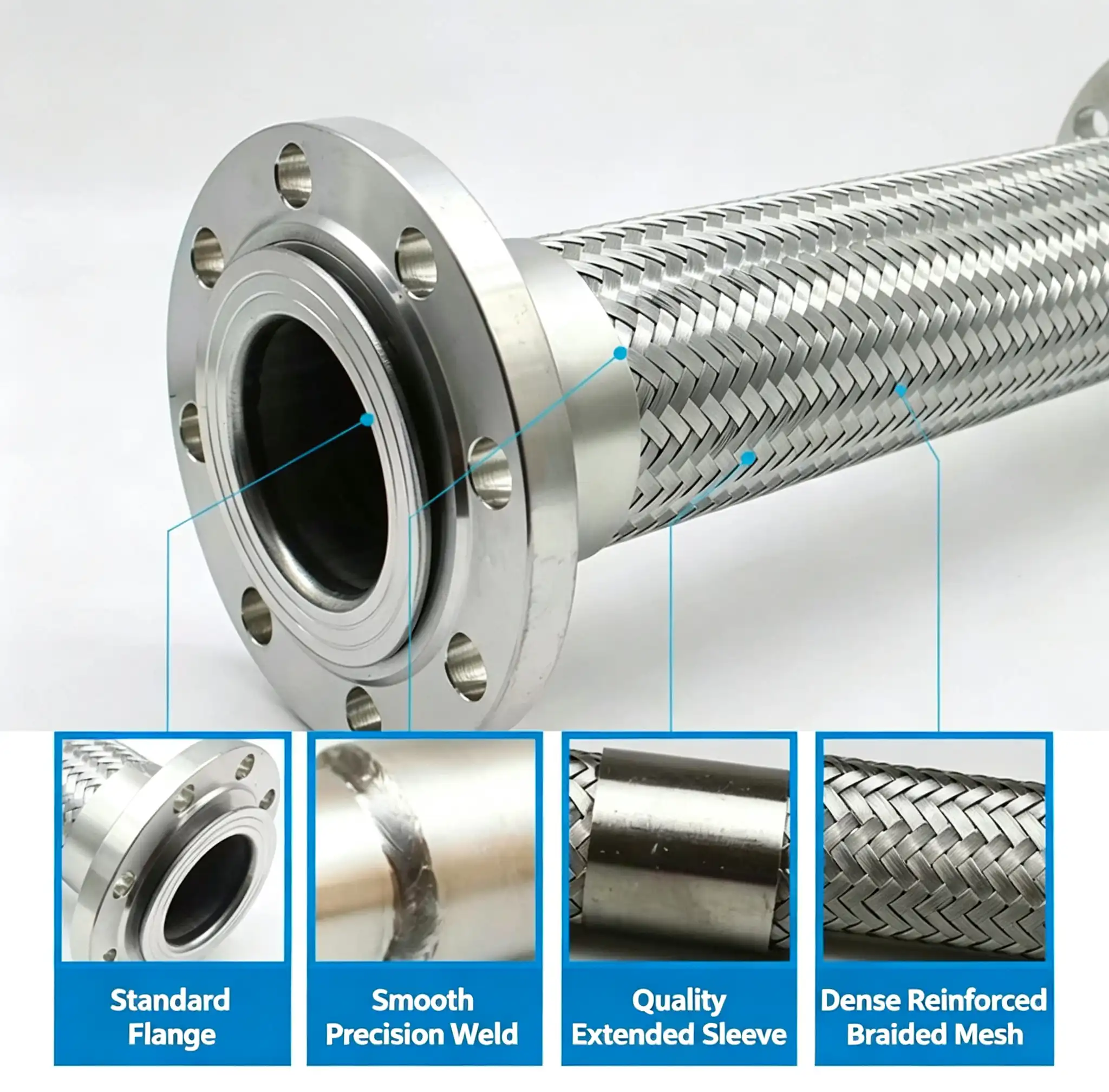
1. What Is a Stainless Steel Corrugated Hose?
A stainless steel corrugated hose is a flexible metal hose made with a corrugated stainless steel tube.
The corrugated structure allows the tube to accommodate controlled movement while maintaining a continuous flow passage for the fuel or other compatible medium.
A typical assembly can include four main parts:
1.1 Corrugated Stainless Steel Tube
The inner corrugated tube is commonly manufactured from stainless steel such as 304 stainless steel.
The corrugations provide flexibility and allow the hose to accommodate limited axial, lateral or angular movement within its designed operating range.
The fuel or other medium flows through the inner tube.
1.2 Stainless Steel Braided Mesh
A stainless steel wire braid is installed around the corrugated tube on many high-pressure metal hose assemblies.
The braid helps protect the corrugated tube against external mechanical damage and contributes to the pressure-bearing capability of the complete assembly.
It can also provide electrical continuity between the end fittings when properly designed and installed.
However, a stainless steel braid by itself does not mean that the complete hose is an explosion-proof certified product. Electrical bonding, grounding and hazardous-area requirements should be verified according to the applicable project standards.
1.3 End Connections
The end connections determine how the corrugated hose is installed into the fuel pipeline.
For a flange-to-male-thread configuration:
- One end uses a drilled flange for bolted connection.
- The other end uses a male threaded connector.
- NPT or BSPT thread configurations can be supplied according to project requirements.
- Flange dimensions and bolt-hole patterns should be confirmed before production.
This configuration is useful when the connected equipment uses different connection methods.
1.4 Welding and Assembly
The corrugated tube, braid and end fittings must be properly assembled to maintain mechanical integrity and sealing performance.
Welding quality is particularly important because the connection between the corrugated tube and fittings is a critical part of the complete assembly.
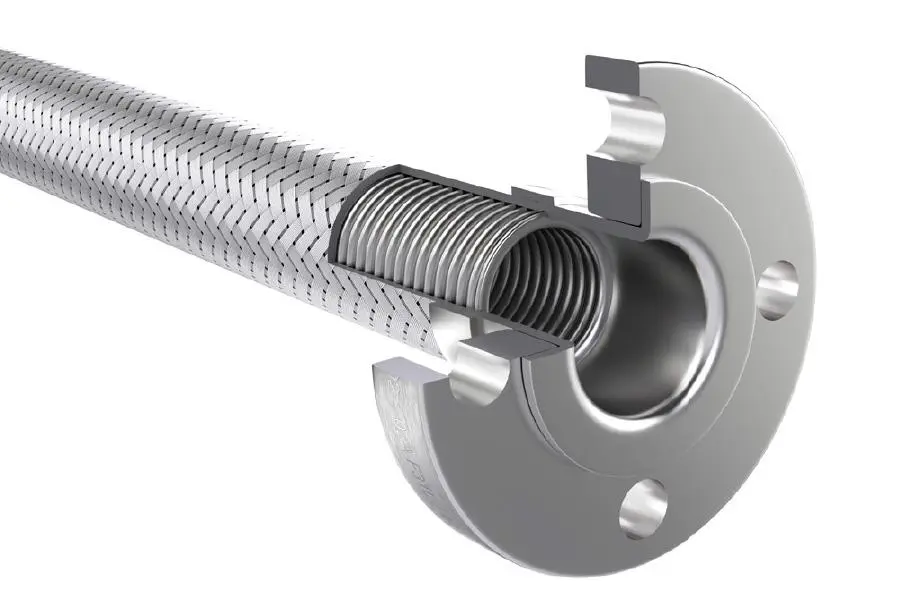
2.How Does a Stainless Steel Corrugated Hose Work?
The main purpose of a corrugated metal hose is to provide controlled flexibility in a piping system.
It is not intended to replace rigid piping throughout the entire fuel system.
Movement Compensation
Underground tanks and connected pipelines can experience limited movement due to settlement, thermal expansion and installation tolerances.
The corrugated structure allows the hose to absorb a defined amount of movement and reduce stress transferred to rigid pipe connections.
The actual allowable movement depends on the hose construction, length, pressure, installation configuration and manufacturer specifications.
For this reason, hose selection should be based on the expected movement rather than simply choosing a longer hose.
Vibration Reduction
Fuel pumps and other rotating equipment can generate mechanical vibration.
Installing a suitable stainless steel corrugated hose between equipment and rigid piping can help reduce the direct transmission of vibration through the pipeline.
This can help reduce mechanical stress on connected pipe joints, valves and other components.
However, the hose should not be treated as a universal vibration isolator. Its performance depends on the complete installation configuration.
For related fuel dispenser components, you can also read our guide to fuel dispenser flow meter structure and working principle
Electrical Continuity
The stainless steel braid can provide electrical continuity between the hose ends when the complete assembly is properly designed and installed.
For fuel station applications, grounding and bonding should follow the applicable electrical and hazardous-area requirements.
Where a project requires an additional bonding conductor, it should be installed according to the applicable standards.
3. Where Is a Stainless Steel Corrugated Hose Used?
A fuel tank corrugated hose can be used where a rigid pipeline requires controlled flexibility.
Common applications include fuel tanks, pumps and other fixed pipeline connections.
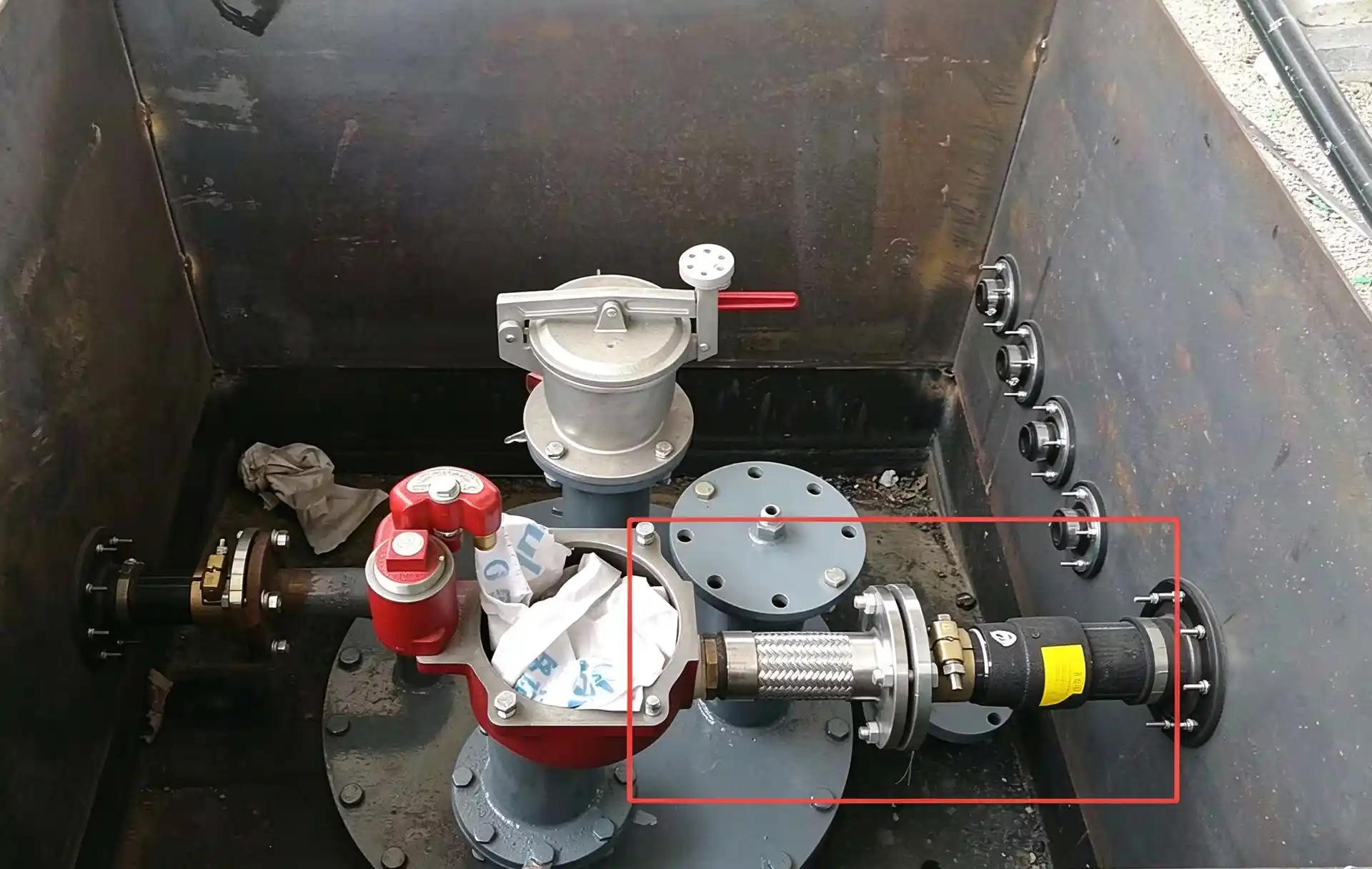
Underground Fuel Tank Connections
One important application is connecting an underground storage tank outlet with the connected fuel pipeline.
A corrugated hose can provide a flexible section between the tank connection and rigid piping, helping accommodate limited movement and installation tolerances.
However, direct underground burial should not be assumed suitable for every hose.
Before burying a corrugated hose, confirm the product’s suitability for underground service, including external corrosion protection, mechanical protection and applicable project requirements.
For a broader view of equipment used in complete station projects, see our global fuel dispenser projects.
Fuel Transfer Pump Connections
Fuel transfer pumps can generate continuous vibration during operation.
A properly selected corrugated metal hose for gas station applications can provide a flexible connection between the pump and rigid pipework.
The hose length, diameter, pressure rating and connection type should be selected according to the pump and pipeline requirements.
Pipeline Misalignment
During construction, the actual position of a tank outlet or equipment connection may differ slightly from the original design.
A corrugated hose can accommodate limited installation misalignment without forcing rigid pipes into position.
It should not, however, be used to correct excessive or uncontrolled misalignment.
Important: A corrugated hose is designed for controlled movement. It should not be treated as a freely bendable hose or repeatedly bent beyond its specified limits.
4. How to Choose the Right Stainless Steel Corrugated Hose
Selecting the correct stainless steel corrugated hose for fuel tanks requires more than checking the nominal diameter.
Several parameters should be confirmed before ordering.
4.1 Nominal Diameter
Common project sizes may include:
- DN25
- DN32
- DN40
- DN50
The selected diameter should match the pipeline design and actual connection dimensions.
4.2 Hose Length
Common lengths may include:
- 200 mm
- 300 mm
- 400 mm
- 500 mm
- 600 mm
Custom lengths can also be supplied according to project requirements.
The hose should not simply be made as long as possible.
The required length should be determined according to the installation distance, expected movement and manufacturer’s specifications.
4.3 Connection Type
For a flange-to-male-thread configuration, confirm:
- Flange nominal size
- Flange standard
- Bolt-hole pattern
- Male thread standard
- Thread size
- Sealing method
NPT and BSPT are commonly used for international projects, but the exact thread size and connection dimensions must be confirmed before production.
4.4 Stainless Steel Material
304 stainless steel is a common material for this type of corrugated hose.
316L stainless steel can be considered when higher corrosion resistance is required.
Material selection should consider the fuel medium, surrounding environment, soil conditions and other project requirements.
4.5 Working Pressure
The pressure rating should be based on the complete hose assembly, not simply the material of the corrugated tube.
For example, a project may specify PN16 or another pressure class, but the actual allowable working pressure depends on the bellows, braid, fittings, welding and connection design.
Always confirm the manufacturer’s rated pressure for the selected model.
4.6 Operating Temperature
The operating temperature should also be confirmed according to the complete assembly.
Do not select a hose based only on the temperature capability of stainless steel itself. The fittings, seals, welding and other components may have different limits.
5. Stainless Steel Corrugated Hose Installation Guide
Correct installation is essential for maintaining the service life of a stainless steel corrugated hose.
5.1 Inspect Before Installation
Check the hose carefully before installation.
Look for:
- Broken braid wires
- Dents
- Deep scratches
- Deformation
- Damaged threads
- Damaged flange surfaces
Do not install a hose that has been damaged during transportation or handling.
5.2 Never Twist the Hose
Never rotate or twist the corrugated hose while connecting the threaded end.
Twisting can place torsional stress on the corrugated tube and may reduce service life.
If the connection does not align correctly, adjust the pipe or equipment position instead of forcing the hose into alignment.
5.3 Install the Flange Correctly
Place the correct gasket between the flange surfaces.
Tighten the bolts evenly, preferably using a diagonal or cross pattern to distribute the sealing load.
The gasket and bolt specifications should follow the project requirements.
5.4 Install the Threaded Connection Correctly
The male thread must match the female connection.
Use an appropriate sealing method compatible with the thread type and fuel service.
Do not use excessive tightening force to compensate for incorrect or damaged threads.
5.5 Avoid Excessive Tension
Do not install the hose fully stretched.
Provide sufficient length for the expected movement while keeping the hose within its allowable operating range.
5.6 Do Not Use the Hose as Pipe Support
A stainless steel corrugated hose for fuel pipeline applications should not carry the weight of the connected pipework.
Independent pipe supports should be installed near the hose connection.
The hose should provide flexibility, not structural support.
5.7 Check Grounding and Bonding
Where electrical continuity is required, verify the continuity of the complete hose assembly.
Follow the applicable grounding and bonding requirements for the fuel installation.
Do not assume that the metal braid alone satisfies every project’s electrical requirements.
6. Stainless Steel Corrugated Hose vs. Rubber Fuel Hose
Both metal and rubber hoses can be used in fuel-related applications, but their construction and intended applications are different.
| Feature | Stainless Steel Corrugated Hose | Rubber Fuel Hose |
|---|---|---|
| Main construction | Corrugated stainless steel tube | Reinforced rubber tube |
| Flexibility | Controlled movement | Generally highly flexible |
| Temperature resistance | Depends on complete assembly | Depends on rubber compound |
| Oil resistance | Depends on material and seals | Depends on rubber compound |
| Vibration application | Suitable for controlled vibration | Suitable for flexible connections |
| Connection options | Flange, thread and custom fittings | Various hose fittings |
| Typical application | Fixed pipeline connections | Fuel transfer and flexible connections |
| Movement limitation | Must follow manufacturer specifications | Must follow manufacturer specifications |
The right choice depends on the actual application.
A metal corrugated hose can be considered when a fixed fuel pipeline requires controlled movement compensation, vibration reduction or a customized connection between different connection types.
A suitable fuel-rated rubber hose may be preferable when the application requires greater flexibility or frequent movement.
7. Can a Stainless Steel Corrugated Hose Be Buried Underground?
This question should be evaluated carefully.
A standard stainless steel corrugated hose with a braided layer should not automatically be considered suitable for direct underground burial.
Before using a corrugated hose for underground fuel tank applications, confirm:
- External corrosion protection
- Soil conditions
- Groundwater exposure
- Mechanical protection
- Backfill conditions
- Product manufacturer’s requirements
- Applicable fuel station regulations
If the specific assembly has not been approved or designed for direct burial, a protected installation method should be considered.
For highly corrosive environments, 316L stainless steel may be considered, but the material alone does not determine whether the complete hose assembly is suitable for underground installation.
8. Why Does a Stainless Steel Corrugated Hose Leak?
If a corrugated hose develops leakage, several possible causes should be investigated.
Common causes include:
- Twisting during installation
- Excessive bending
- Exceeding the rated working pressure
- Operating outside the specified temperature range
- Damage to the corrugated tube
- Welding or assembly problems
- Incorrect gasket selection
- Loose or incorrectly installed connections
- Excessive vibration
- Incorrect pipe support
Simply tightening the connection may not solve the problem.
The actual cause should be identified before the hose is repaired or replaced.
9. Frequently Asked Questions
Is a stainless steel corrugated hose suitable for gasoline and diesel?
It can be suitable for gasoline, diesel and other compatible fuel media when the complete hose assembly, fittings and sealing materials are selected for the specific application.
Material compatibility should always be confirmed before use.
Is a stainless steel corrugated hose explosion-proof?
A stainless steel corrugated hose should not be described as explosion-proof solely because it has a stainless steel braid.
The braid may provide electrical continuity when properly designed and installed, but the complete fuel system must meet the applicable grounding, bonding and hazardous-area requirements.
Can a corrugated hose compensate for fuel tank settlement?
A properly selected corrugated hose can accommodate limited movement within its specified displacement range.
The expected movement should be evaluated before selecting the hose length and configuration.
It should not be used to compensate for large or uncontrolled structural settlement.
Should I choose a longer corrugated hose for better compensation?
Not necessarily.
The hose length should be selected according to the required movement, installation geometry, pressure, support arrangement and manufacturer specifications.
A longer hose does not automatically provide better performance.
Can DN40 replace DN50?
Not automatically.
The correct diameter depends on the pipeline design, required flow rate and connection dimensions.
The nominal diameter should be selected according to the actual project requirements.
Can the flange and male thread be customized?
Depending on the production requirements, flange dimensions, bolt-hole patterns, thread standards, hose lengths and other connection details can be customized.
For quotation, provide drawings, dimensions or clear photos of the existing connections whenever possible.
10. What Information Should You Provide When Ordering?
If you are sourcing a 304 stainless steel corrugated hose for a fuel station or fuel depot project, providing complete technical information can help avoid connection problems.
Please provide:
- Nominal diameter
- Required hose length
- Flange size
- Flange standard
- Bolt-hole pattern
- Male thread type
- Male thread size
- Fuel medium
- Working pressure
- Operating temperature
- Installation location
- Expected movement
- Required quantity
A product drawing or clear connection photo is also helpful when the existing dimensions are uncertain.
11. Need a Stainless Steel Corrugated Hose for Your Fuel Project?
Choosing the right corrugated hose is not simply a matter of selecting DN size.
The connection type, hose length, expected movement, pressure, fuel medium, installation environment and pipe support all affect the final configuration.
We supply stainless steel corrugated hose assemblies for fuel station and fuel depot applications, including flange-to-male-thread configurations and customized dimensions.
Share your project requirements, drawings or connection photos with us, and we can help coordinate a suitable configuration for your application.
Contact Us for product specifications and quotation.