Working principle and common problems of automatic fuel cut-off nozzles on fuel dispensers
News 2026年 7月 8日 74
How Do Automatic Fuel Dispensers Work?
This guide will explain the working principle of automatic fuel dispensers, including their internal structure, automatic shut-off mechanism, common malfunctions, and gas station maintenance solutions. Explore professional fuel dispenser equipment solutions.
Automated fuel dispensers are one of the most important components of modern refueling systems. They control fuel flow and ensure safe refueling operations.
For gas station suppliers and maintenance professionals, understanding the structure and working principle of fuel nozzles can help reduce downtime, improve equipment maintenance efficiency, and extend service life.
This guide will introduce you to:
- What is an automatic fuel dispenser?
- Main components of a fuel dispenser
- How the automatic shut-off mechanism works
- Common fuel dispenser malfunctions and solutions
- Maintenance recommendations for gas station operators
What is an automatic fuel dispenser?
An automatic fuel dispenser (also known as a self-service fuel dispenser or an automatic shut-off fuel dispenser) is a device installed at the end of a fuel hose.It is primarily used to dispense the following fuels: gasoline, diesel, and other liquid fuels.
Automatic fuel dispensers are used in conjunction with other equipment at gas stations, including fuel pumps, fuel hoses, underground storage tanks, submersible pumps, fuel management systems, and level gauges.
The main functions of an automatic fuel dispenser include:
- Controlling fuel flow: Valves inside the dispenser regulate the amount of fuel delivered during refueling.
- Providing automatic shut-off protection: The dispenser automatically stops supplying fuel when it reaches the tank opening to prevent spillage.
- proving refueling safety: The automatic shut-off system reduces fuel spillage, thereby improving the operational safety of the gas station.
ructure of an Automatic Fuel Dispenser
Although the fuel dispenser appears simple, it contains several sophisticated components that work together.
The main components include:
- Dispenser Body: The dispenser body is the main outer shell supporting all internal mechanical structures. It protects the internal valves and connects the fuel hose to the outlet pipe.
- Outlet Pipe: The outlet pipe is the metal tube that inserts into the vehicle’s fuel tank. Its design ensures smooth fuel flow and incorporates a sensor system for the automatic shut-off function.
- Main Valve Assembly: The main valve controls the fuel flow through the refueling nozzle. When the operating handle is activated, the valve opens, allowing fuel to pass through. When the automatic shut-off system is triggered, the valve immediately closes.
- Vacuum Negative Pressure Principle: The Venturi system is the key component for achieving the automatic shut-off function. When fuel flows through the refueling nozzle, a pressure difference is generated, creating a vacuum effect.
- Diaphragm and Shut-off Mechanism: The diaphragm responds to pressure changes. When the sensing orifice is covered by fuel, the vacuum state changes, thereby activating the shut-off mechanism.
- ver and Handle Assembly: The handle allows the operator to start and control the refueling process. Different locking positions control the fuel flow rate during refueling.
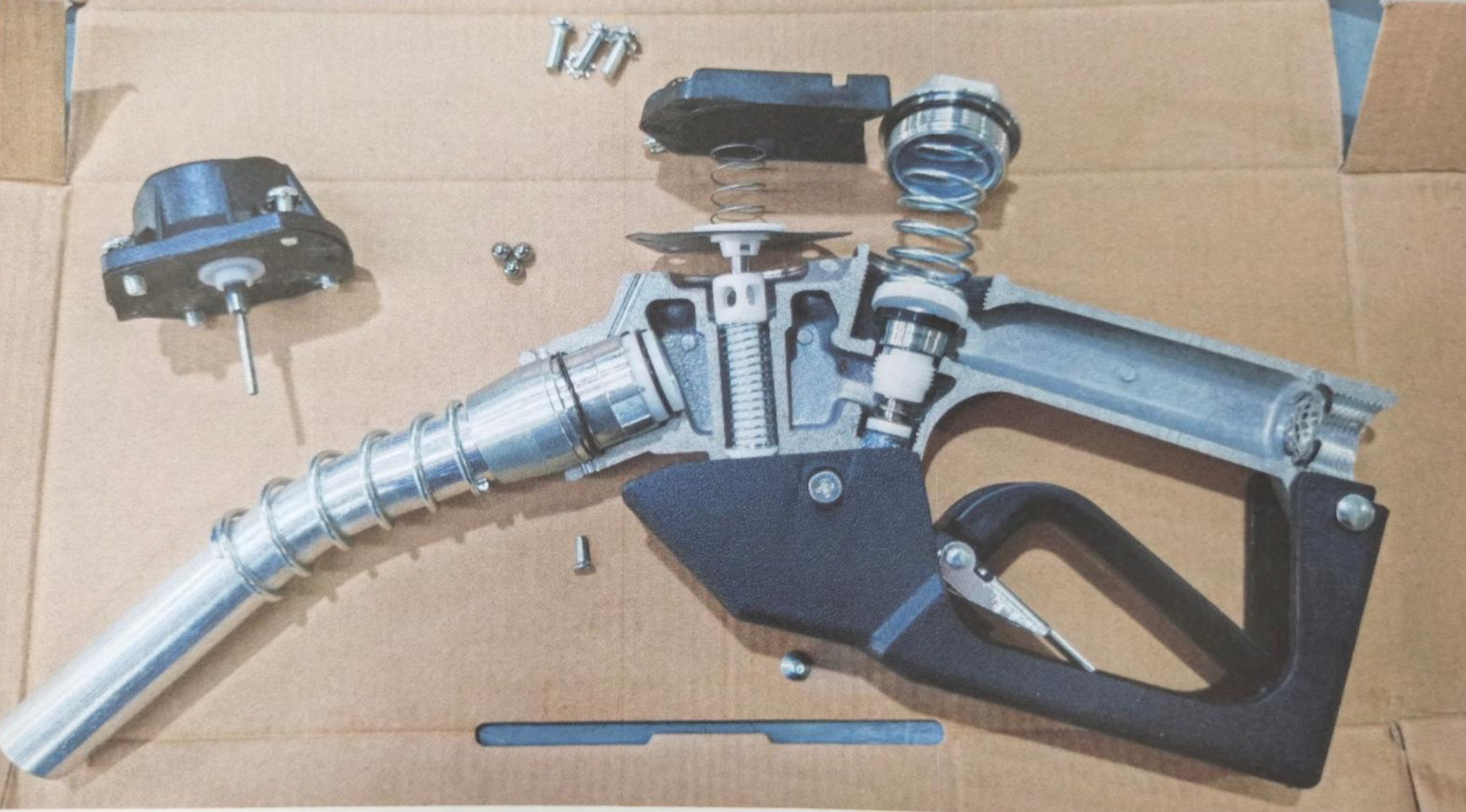
How Does an Automatic Fuel Nozzle Work?
The automatic shut-off function is based on the Venturi vacuum negative pressure principle.
Its working process can be divided into several steps.
Step 1: Fuel Flow Begins: When the operator pulls the nozzle handle, the main valve opens, and fuel flows from the fuel dispenser hose into the nozzle body and out through the nozzle tip.
Step 2: Venturi Effect Creates Vacuum: As fuel flows through the internal Venturi tube, the high-speed flow creates a low-pressure zone. This vacuum is transmitted to the diaphragm chamber via the sensing channel.
Step 3: Fuel Level Detection via Sensing Orifice: During normal refueling, air enters through the sensing orifice located near the nozzle tip, maintaining a stable vacuum, and the nozzle continues to deliver fuel.
Step 4: Automatic Cut-off Function Triggered: When the fuel level touches the sensing orifice, airflow is obstructed, the vacuum pressure changes, causing the diaphragm to move. The cut-off mechanism releases the internal valve, causing the main valve to automatically close.
Step 5: Fuel Flow Stops: After the valve closes, fuel delivery stops, the handle resets, and the nozzle is ready for the next operation.
Automatic Fuel Nozzle Faults and Solutions
ring daily use, fuel nozzles may experience the following common faults
| Fault | Possible Cause | Solution |
| Frequent nozzle shut-off | Clogged sensor or dirty venturi channel | Clean sensor channel and internal air passage |
| No fuel dispensing | Damaged internal valve or diaphragm | Check and replace damaged parts |
| Slow fuel dispensing | Clogged filter or blocked fuel passage | Clean or replace relevant parts |
| Fuel leakage | Worn valve seal | Replace valve assembly |
| Handle cannot lock | Internal mechanical wear of fuel nozzle | Check handle linkage mechanism |
Why does the fuel nozzle frequently shut off automatically?
One of the most common problems at gas stations is that the fuel nozzle frequently shuts off automatically (stops fuel supply).
Possible causes include:
- ogged air sensor: Dust, fuel residue, or foreign objects may clog the sensor, causing the fuel nozzle to fail to detect airflow correctly.
- nturi Channel Contamination: Venturi vacuum systems require clean internal channels; contaminants can affect vacuum generation.
- nternal Component Damage: Prolonged use can lead to diaphragm wear, valve seal damage, and spring failure.
Regular inspections help prevent unexpected downtime.
How to Maintain the Fuel Dispenser?
Proper maintenance can significantly extend the lifespan of the fuel dispenser.
Recommended Maintenance Measures:
- egular Cleaning: Regularly clean the nozzle and sensing area, avoiding the use of damaged or contaminated equipment.
- spect Internal Components: Inspect the valve assembly, diaphragm, spring, and seals; replace damaged parts immediately.
Fuel dispenser damage can lead to: fuel leaks, safety hazards, and reduced refueling efficiency.
ofessional Gas Station Equipment Solutions:
Reliable refueling systems rely on high-quality components, including: fuel dispensers, automatic fuel nozzles, fuel hoses, underground storage tank equipment, submersible pumps, and level gauges.
Fuel Dispenser Pro is committed to providing comprehensive gas station equipment solutions to global customers, covering equipment supply, technical support, and customized solutions.
ether you are building a new gas station or upgrading existing equipment, our team can assist you in selecting the most suitable refueling equipment products.
Contact us for gas station equipment solutions
equently Asked Questions
How does the automatic fuel nozzle automatically stop refueling?
The automatic fuel nozzle uses a Venturi vacuum system to achieve automatic stopping. When fuel or foam submerges the nozzle, a negative pressure is created in the upper chamber of the self-regulating diaphragm, causing the diaphragm to move upwards and the steel ball to slide down. The self-sealing rod slides downwards under the pressure of the main valve, simultaneously driving the switch to disengage the support plate, closing the main valve, and self-sealing the nozzle.
Why does the fuel nozzle stop refueling when the tank is not full?
Common causes include clogged sensor holes, buildup in internal channels, or improper placement of the fuel nozzle.
Can fuel nozzles be repaired?
Some problems (such as blocked air passages) are repairable; however, if the valve or diaphragm is damaged, replacement is usually necessary.
What is the typical lifespan of a fuel nozzle?
Its lifespan depends on the type of fuel, frequency of use, maintenance quality, and operating environment.
What equipment is a fuel nozzle typically used with?
Fuel nozzles are typically used with fuel dispensers, fuel hoses, fuel pumps, underground storage tanks, and fuel management systems.