
Standard Metal Prover: Complete Guide for Fuel Dispenser Calibration (Seraphin Prover Can)
News 2026年 9月 18日 73
A fuel dispenser that meters outside the legal tolerance can expose a gas station to heavy fines, license suspension, and a damaged reputation with customers and metrology authorities. The standard metal prover, widely known as a Seraphin prover can in the industry, is the primary reference standard used to verify whether a fuel pump is dispensing accurately.
This guide covers what you need to know before purchasing a standard metal prover, including accuracy classes, stainless steel vs. carbon steel, temperature correction, on-site fuel dispenser testing, certification, maintenance, and available specifications.
1. What Is a Standard Metal Prover?
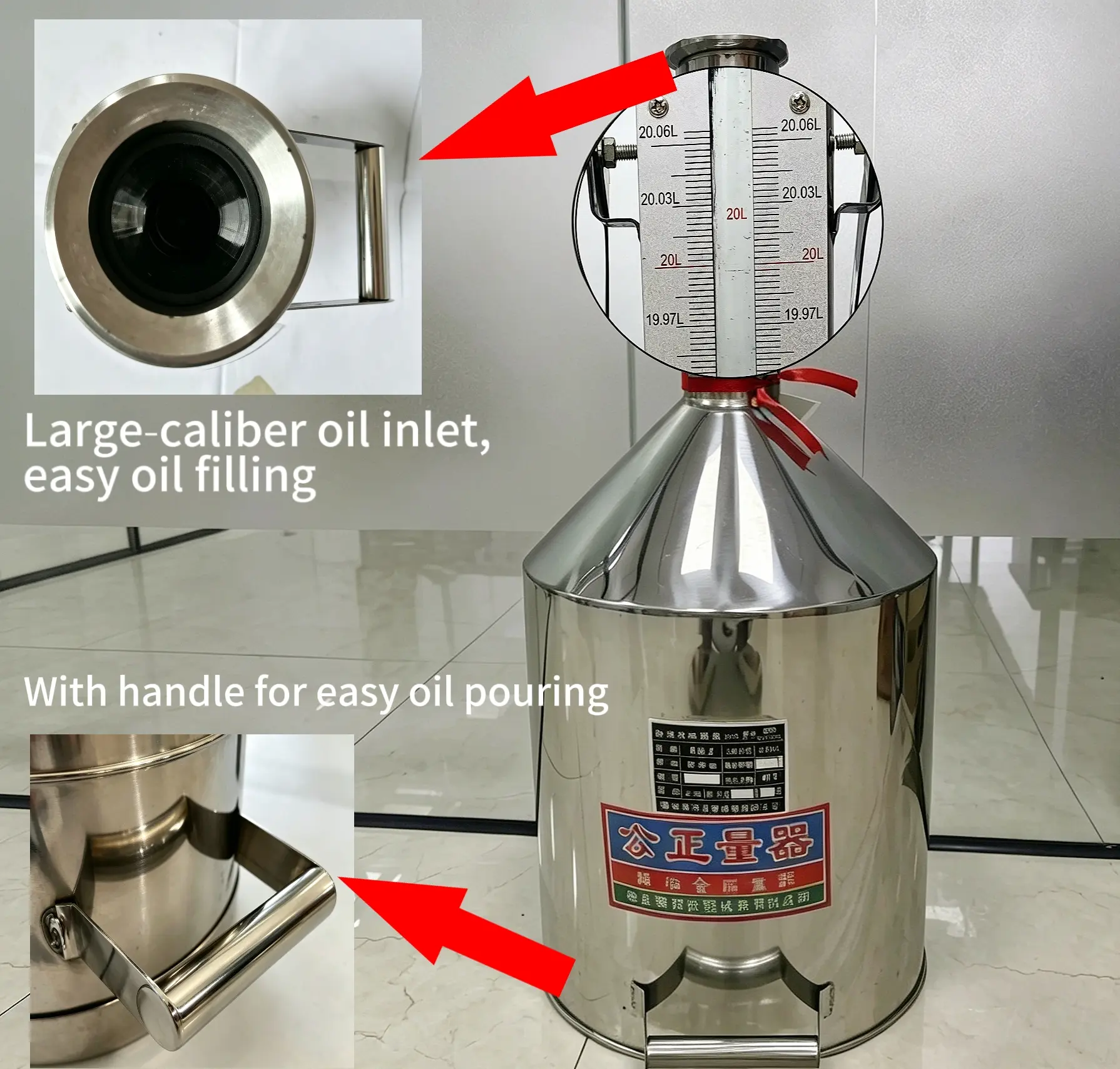
A standard metal prover is a precision volumetric measuring vessel used to verify the accuracy of fuel dispensers for petrol/gasoline and diesel. It works on a simple principle: you pump a known volume of fuel into the prover can, read the level on the graduated neck scale, and compare it against the dispensed volume to calculate the dispenser’s error.
Provers are classified into two accuracy classes:
| Class | Uncertainty | Typical Use |
|---|---|---|
| Class 2 | 2.5 × 10⁻⁴ | Laboratory standard; used to verify other provers |
| Class 3 | ±(0.5–1) × 10⁻³ | Portable prover for on-site fuel dispenser self-verification |
For a gas station, the Class 3 portable prover is the workhorse. Available sizes range from 5 L, 10 L, 20 L, 50 L, 100 L, 200 L, 500 L, 1000 L up to 2000 L.
For stations that also need other fuel station equipment, a standard metal prover can be used as part of a broader fuel dispenser verification and maintenance setup.
Contact us if you need help selecting the prover capacity, accuracy class, or configuration for your station.
2. Stainless Steel vs. Carbon Steel: Which Prover Should You Choose?
This is one of the most common questions buyers ask. The short answer depends on the fuels you handle.
- Stainless steel prover — Resistant to corrosion from both gasoline and diesel. Best for stations that handle petrol. Longer service life, easier to clean, and the preferred choice when the prover will be subject to strict local metrology inspection.
- Carbon steel prover with protective coating — More cost-effective, but generally recommended for diesel-only applications where corrosion risk is lower.
Buyer tip: If you operate a mixed-fuel station or your local authority inspects prover condition, invest in stainless steel. It holds calibration longer and is far easier to keep clean.
For fuel dispenser maintenance, the prover is only one part of the system. You can also review our fuel dispenser parts and components for related replacement and maintenance requirements.
3. Accuracy & Technical Specifications
Two numbers matter most to a station owner:
- Prover accuracy: Class 3 portable provers hold an uncertainty of ±(0.5–1) × 10⁻³.
- Fuel dispenser tolerance: Most national regulations allow fuel dispensers an error of ±0.3%.
To put this in concrete terms: for a 20 L dispensed volume, the acceptable deviation is ±60 mL.
A certified prover is accurate enough to detect whether the dispenser stays within this limit.
Standard Metal Prover Specifications
| Specification | Available Options |
|---|---|
| Accuracy Class | Class 2 / Class 3 |
| Capacity | 5 L, 10 L, 20 L, 50 L, 100 L, 200 L, 500 L, 1000 L, 2000 L |
| Material | Stainless Steel / Carbon Steel |
| Application | Fuel Dispenser Calibration and Verification |
| Measuring Method | Volumetric Measurement |
| Scale | Graduated Neck Scale |
| Leveling | Spirit Level and Adjustable Feet |
| Certification | Calibration Certificate Available |
| Customization | Capacity and configuration available |
The final capacity, material, accuracy class, and certification should be selected according to the application and applicable local metrology requirements.
4. How to Use a Prover Can to Test a Fuel Dispenser
Step 1 — Wet the Inner Wall
Pour a small amount of fuel into the prover, swirl it to wet the inner surface, then drain it. Wait until flow stops (dripping state) for 2 minutes, then close the drain valve.
Step 2 — Level the Prover
Place it on a hard, flat surface and level it using the spirit level and adjustable feet. An unleveled prover gives a false reading.
Step 3 — Dispense the Fuel
Pump fuel from the dispenser into the prover in a single continuous operation up to the nominal capacity. For example, fill a 20 L prover with exactly 20 L.
Step 4 — Read the Scale
Wait for all foam/bubbles to disappear, then read the liquid level against the graduated neck scale. Record the reading.
Step 5 — Judge the Result
If the measured volume falls within the ±0.3% tolerance, such as 20 L ± 60 mL, the dispenser is accurate. If not, the dispenser needs adjustment.
⚠️ Temperature matters. Never judge accuracy by the raw reading alone.
For complete fuel dispenser maintenance and related equipment, you can also check our fuel dispenser products and components.
5. The Temperature Correction Formula (Critical, and Often Overlooked)
Fuel expands and contracts with temperature. A reading taken at 25°C is not the same as at 20°C. Every measurement must be corrected to the reference temperature of 20°C to be valid.
The correction formula:
V20 = Vt ÷ [1 + β × (t − 20)]Where:
- Vt = volume measured at fuel temperature t
- V20 = corrected volume at 20°C (reference)
- β = thermal expansion coefficient of the prover material
- Stainless steel: 50 × 10⁻⁶ /°C
- Carbon steel: 33 × 10⁻⁶ /°C
- t = fuel temperature at the time of measurement
Worked Example — Stainless Steel 20 L Prover, Fuel Temperature 25°C
V20 = 20 ÷ [1 + 0.000050 × (25 − 20)]
    = 20 ÷ 1.00025
    = 19.995 L
This means the 20 L you dispensed at 25°C is equivalent to 19.995 L at 20°C.
Ignoring temperature correction can push a borderline dispenser past the legal limit and cause a failed inspection.
Important: The formula above is provided for the measurement calculation described in this guide. For legal verification, always follow the correction method and reference temperature specified by the applicable metrology standard or local authority.
6. Calibration Certificate & Re-Verification Interval
When buying a prover for legal/compliance use, certification is not optional.
- Initial certification: within 1 year of manufacture.
- Subsequent re-verification: Class 2 provers every 3 years; Class 3 provers every 2 years.
- Certificate traceability: a valid metrology calibration certificate must be traceable to a recognized national standard, so your local weights & measures authority accepts it during inspection.
Buyer tip: Before purchasing, confirm the supplier can provide a calibration certificate acceptable to your local metrology authority — some regions require an OIML-recognized certificate. Requirements vary by country; verify with your local authority.
Contact us before ordering if you need a prover with a calibration certificate or need to confirm certification requirements for your market.
7. Maintenance & Storage Tips
Proper storage helps protect the measurement accuracy and service life of the prover.
- Store in a dry, vibration-free environment, away from direct sunlight and corrosive materials.
- Rinse with clean fuel or water and dry thoroughly after each use.
- If the shell is dented, deformed, or the scale damaged by impact: do not use it. It must be repaired and re-verified before returning to service.
Always follow the manufacturer’s cleaning and maintenance instructions and the applicable metrology procedure.
8. FAQ
Q1: What size prover do I need for my gas station?
A 20 L or 50 L Class 3 portable prover covers most station verification needs. Larger provers (100 L and up) suit high-flow dispensers and truck fuelling points.
Q2: Stainless steel or carbon steel — which should I choose?
Stainless steel is suitable for petrol/mixed-fuel stations and longer service life; carbon steel is a budget option generally limited to diesel-only use.
Q3: Do I really need temperature correction during proving?
Yes. Fuel volume changes with temperature, and readings must be corrected to 20°C. Skipping this step can cause incorrect measurement results and false failures.
Q4: How often should I re-calibrate my prover?
Class 3 provers typically every 2 years; Class 2 every 3 years. Always follow your local metrology regulations.
Q5: Is the calibration certificate accepted for legal inspection?
A traceable certificate from a qualified calibration lab is generally accepted. Confirm traceability requirements with your local weights & measures office.
9. Need a Standard Metal Prover for Your Station?
Choosing the right prover — correct size, material, and valid certification — helps your station verify dispenser accuracy and maintain reliable measurement performance.
We supply Class 2 and Class 3 standard metal provers from 5 L to 2000 L, with calibration certificates and custom sizing available.
Whether you need a 20 L or 50 L Class 3 portable prover for routine station verification or a larger prover for high-flow applications, contact us with your required capacity, material, accuracy class, and certification requirements.Our petroleum measurement engineers will respond within 24 hours.