
Fuel Dispenser Gear Pump: Structure, Working Principle & Troubleshooting
News 2026年 7月 13日 64
The gear pump is one of the most important power components inside a fuel dispenser. It is mainly responsible for drawing fuel from the underground storage tank into the system and continuously providing stable fuel pressure. At the same time, it also performs air separation, maintains system pressure balance, and ensures accurate fuel measurement through the flow meter.
Once the fuel dispenser gear pump fails, it may cause problems such as slow fueling speed, unstable fuel flow, excessive noise, fuel spraying, or even complete fuel delivery failure. Therefore, understanding the structure, working principle, and troubleshooting methods of gear pumps is very important for maintenance technicians, gas station operators, and service engineers.
Let’s take a closer look at some essential knowledge about fuel dispenser gear pumps!
1.Structure of a Fuel Dispenser Gear Pump
Modern fuel dispensers commonly use a combined internal gear pump, which integrates the gear pump, air separator, and related control components into a single housing.
As an important fuel dispenser part, the gear pump works together with the filter, solenoid valve, flow meter, and other components to maintain stable fuel delivery.
This design not only improves fuel delivery efficiency but also ensures better measurement accuracy and more stable operation.
Understanding the fuel dispenser gear pump structure is important when diagnosing problems because different components can affect fuel flow, pressure, and pump performance.
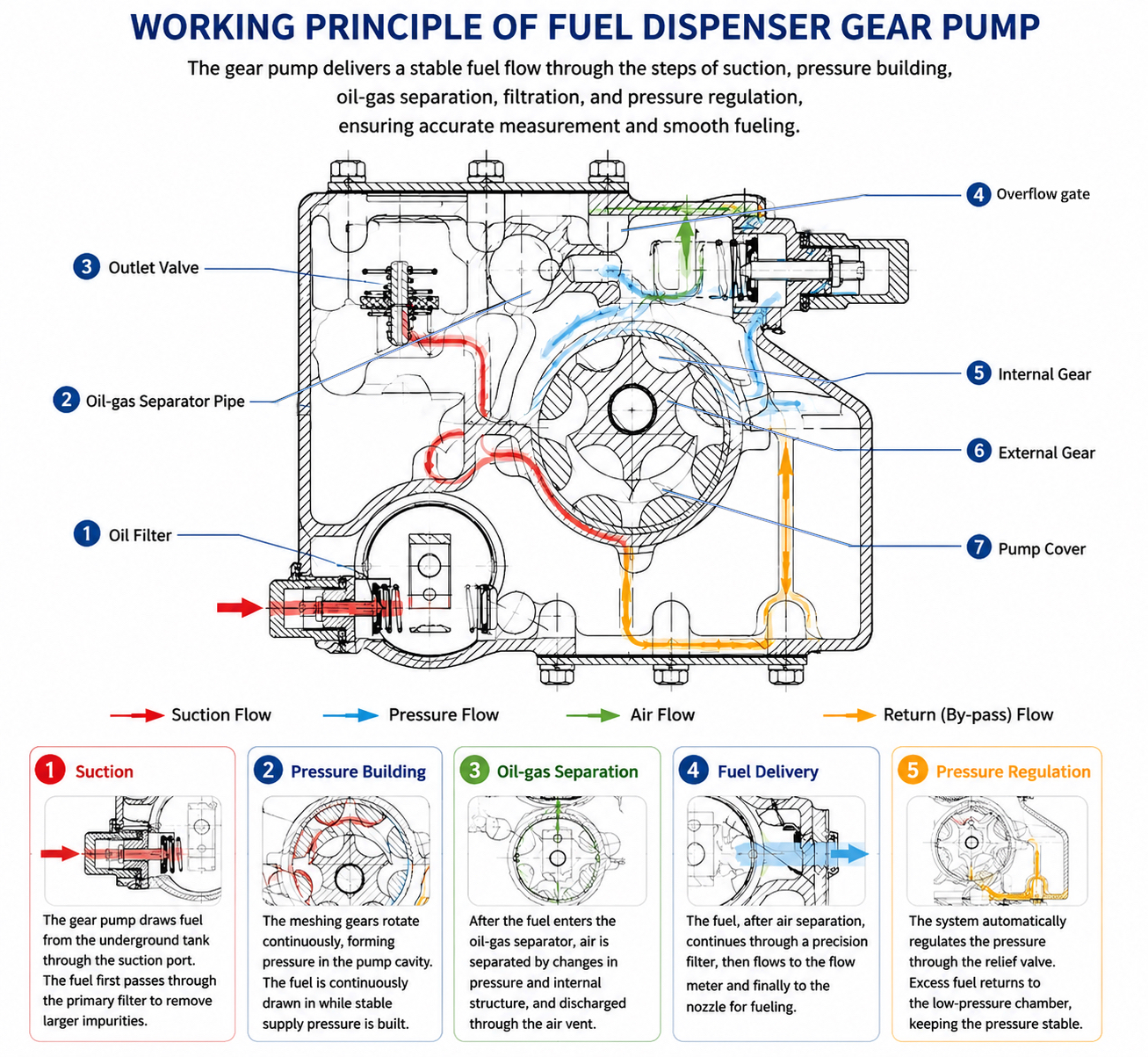
2.Fuel Dispenser Gear Pump Working Principle
The complete fuel delivery process can be divided into five steps.
Step 1: Fuel Suction
The gear pump draws fuel from the underground storage tank through the suction inlet.
The fuel first passes through the primary filter, which removes larger impurities and contaminants.
Step 2: Pressure Generation
As the internal gears continue rotating, a negative pressure area is created inside the pump chamber.
This allows fuel to be continuously drawn into the pump while generating stable fuel pressure for delivery.
Step 3: Air Separation
After entering the air separator, the fuel passes through the internal separation structure.
By using pressure changes and internal flow characteristics, air mixed inside the fuel is separated and released through the vent holes.
This prevents air from entering the flow meter and affecting fuel measurement accuracy.
Step 4: Fuel Delivery
After air separation, the fuel passes through the fine filter and is then delivered to the fuel dispenser flow meter.
Finally, the fuel flows through the nozzle and completes the refueling process.
Step 5: Pressure Regulation
The system automatically regulates working pressure through the relief valve.
Excess fuel returns to the low-pressure chamber through the float return system, helping maintain stable fuel pressure during operation.
3.Common Fuel Dispenser Gear Pump Problems and Solutions
3.1 Low Fuel Flow
Possible Causes
- Filter blockage
- Solenoid valve not fully opened
- Fuel nozzle blockage
- Fuel pipeline blockage
Solutions
Clean or replace the filter, check whether the solenoid valve opens properly, and inspect the fuel nozzle and pipeline to ensure smooth fuel flow.
3.2 Excessive Gear Pump Noise
Possible Causes
- Relief valve pressure adjusted too high
- Belt tension too tight, causing excessive pump load
- Poor fuel suction
- Filter blockage
Solutions
Readjust the relief valve pressure, loosen the belt to the correct tension, and check whether the suction pipeline or filter is blocked.
3.3 Slow Fueling Speed
Possible Causes
- Filter blockage
- Contaminants inside the relief valve
- Pipeline blockage
- Fuel nozzle filter blockage
Solutions
Check the filter, relief valve, fuel pipeline, and nozzle filter step by step. Clean or replace the affected components when necessary.
3.4 Fuel Spraying or Leakage
Possible Causes
- Loose suction inlet connection
- Damaged or missing gasket
- Air leakage in the fuel pipeline
- Loose top cover bolts
- Float assembly not returning properly
Solutions
Inspect the suction inlet, gasket, fuel pipeline, top cover bolts, and float assembly in order.
Identify and repair any issues immediately.
3.5 No Fuel Output
First, it is necessary to determine whether the fuel dispenser gear pump is operating under no-load condition or loaded condition.
If the pulley rotates easily with little resistance, the pump is considered to be running without load.
If the pulley has noticeable resistance when rotating, the pump is considered to be operating under load.
4.Gear Pump Running Under No-Load
Key inspection points:
- Check whether the relief valve is blocked
- Check whether the dust cover has been removed
- Check whether the bottom valve is installed in the correct direction
- Check whether the float assembly returns properly
- Check whether the filter is clogged
If the gear pump continuously releases air but still cannot deliver fuel, the problem is likely caused by air leakage in the fuel pipeline or a faulty bottom valve.
5.When the Pump Is Running Under Load
Key inspection points:
- Check whether the solenoid valve is open
- Check whether the control valve is stuck
- Check whether the fuel nozzle is blocked
- Check whether the flow meter is stuck
6.Fuel Dispenser Gear Pump Troubleshooting
When a fuel dispenser gear pump does not deliver fuel normally, troubleshooting should generally start with the fuel supply path and then move toward individual components.
Check the filter, suction pipeline, bottom valve, float assembly, solenoid valve, control valve, nozzle, and flow meter step by step.
This approach can help maintenance technicians identify whether the problem is caused by insufficient fuel suction, a blocked component, abnormal pressure, or a control-system issue rather than immediately assuming that the gear pump itself is damaged.
7.Conclusion
As the core power component of a fuel dispenser, the operating condition of the fuel dispenser gear pump directly affects fuel delivery efficiency, measurement accuracy, and overall equipment stability.
Understanding the fuel dispenser gear pump structure, working principle, and common troubleshooting methods can help maintenance technicians quickly identify problems, reduce repair costs, and improve the overall operating efficiency of gas stations.
With regular inspection of filters, pipelines, valves, and related components, the gear pump can maintain more stable fuel delivery and support reliable fuel dispenser operation.
8.Frequently Asked Questions
Why Is the Fuel Dispenser Gear Pump Becoming Increasingly Noisy?
Excessive fuel dispenser gear pump noise is usually caused by a clogged filter, excessive belt tension, poor fuel suction, or an improperly adjusted relief valve.
It is recommended to inspect the filter, belt tension, suction pipeline, and relief valve step by step, and make necessary adjustments or cleaning.
Why Is the Fueling Speed Becoming Slower and Slower?
A decrease in fueling speed is usually caused by a clogged filter, blocked fuel pipeline, contaminated nozzle filter, or excessive dirt inside the relief valve.
Regular cleaning of the filtration system and inspection of related components can help restore normal fuel flow.
Why Can’t the Gear Pump Draw Fuel?
If the fuel dispenser gear pump cannot draw fuel, first check whether there is air leakage in the suction pipeline, whether the bottom valve is installed correctly, whether the filter is blocked, and whether the float assembly can return properly.
In many cases, the problem is not caused by a damaged gear pump, but by an issue within the fuel suction system.
Can a Clogged Filter Affect Fuel Dispenser Operation?
Yes.
A clogged filter can reduce fuel supply, decrease flow rate, increase the load on the gear pump, and cause excessive operating noise.
In severe cases, it may shorten the service life of the gear pump.
Therefore, filters should be cleaned or replaced regularly to ensure stable fuel dispenser performance.