
Fuel Dispenser Flow Meter: Structure, Working Principle & Maintenance
News 2026年 7月 17日 45
Gain a comprehensive understanding of the structure, working principle, common faults, maintenance methods, and routine servicing of fuel dispenser flow meters. This guide helps gas station operators, maintenance technicians, and equipment distributors improve equipment reliability and metering accuracy.
The fuel dispenser flow meter is one of the most critical metering components in a fuel dispenser. It directly determines the accuracy of every fueling transaction. Whether used at commercial gas stations, fleet fueling facilities, or industrial fueling systems, a stable and accurate flow meter is essential for ensuring reliable equipment performance.
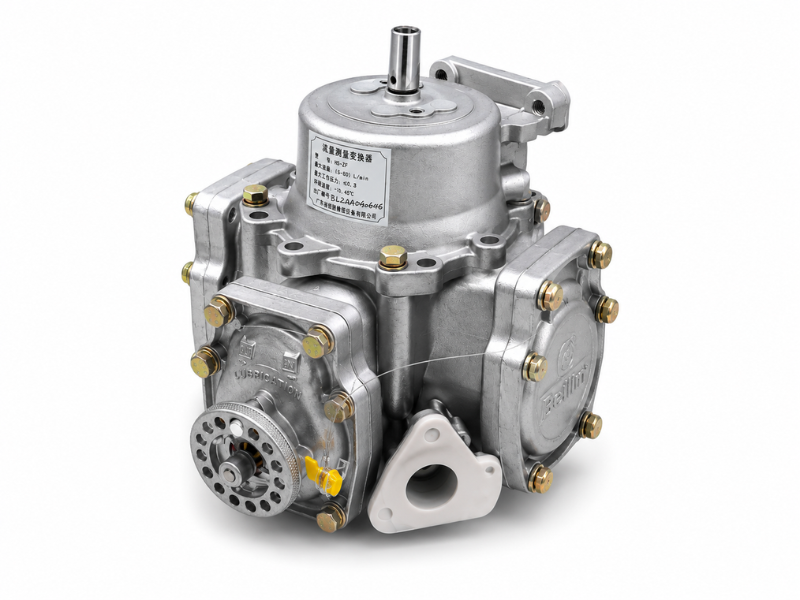
Today, the four-piston positive displacement flow meter is widely used in modern fuel dispensers. Thanks to its high accuracy, stable performance, and long service life, it has become the preferred metering solution for fueling equipment around the world.
In this article, we’ll take a closer look at the structure, working principle, common faults, and maintenance methods of the four-piston fuel dispenser flow meter.
1.What Is a Four-Piston Fuel Dispenser Flow Meter?
A four-piston fuel dispenser flow meter is a positive displacement metering device specifically designed for measuring fuel in fuel dispensers.
Unlike turbine flow meters, it measures fuel by using four pistons that continuously move back and forth. Each complete operating cycle displaces a fixed volume of fuel, ensuring highly accurate measurement.
Compared with other types of flow meters, it offers several advantages:
- High measurement accuracy
- Stable operation
- Excellent repeatability
- Low maintenance costs
- Long service life
For these reasons, the four-piston flow meter has become the most widely used metering system in modern fuel dispensers.
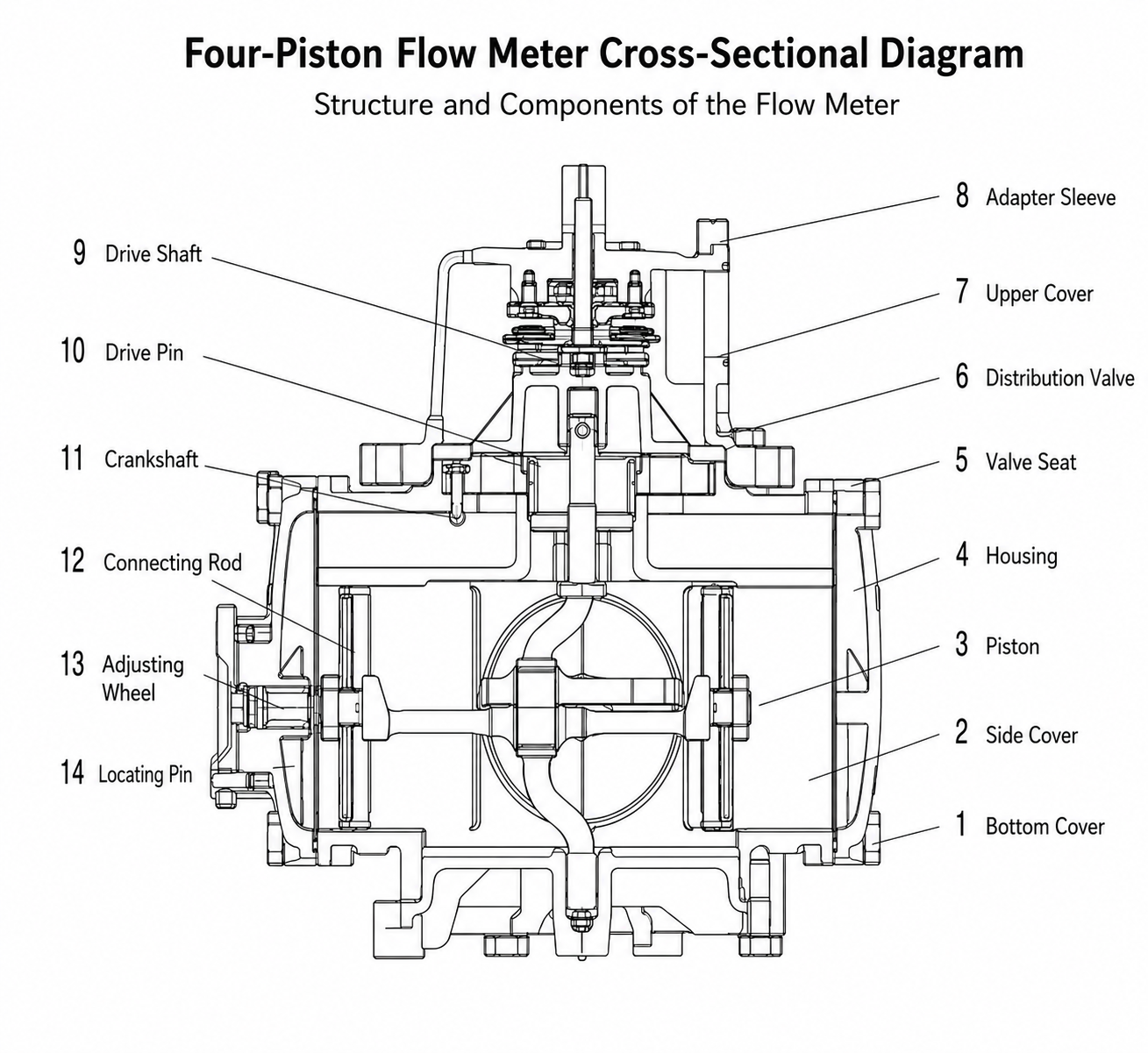
All of these components work together to complete accurate fuel measurement and power transmission.
2.The working principle of the four-piston flow meter is very simple, and the entire metering process can be divided into five steps.
Step 1: Fuel Enters the Flow Meter
Fuel enters the flow meter through the inlet and flows into the metering chamber.
Step 2: Fuel Distribution
The distribution valve directs the fuel into different piston chambers in the correct operating sequence.
Step 3: Four Pistons Operate Alternately
Driven by fuel pressure, the four pistons move back and forth in sequence. Each complete cycle displaces a fixed volume of fuel, ensuring precise measurement.
Step 4: Converting Reciprocating Motion into Rotary Motion
The reciprocating movement of the pistons drives the connecting rods, which rotate the crankshaft. The crankshaft then drives the main shaft.
Step 5: Metering Signal Output
The drive shaft rotates the encoder, which converts mechanical rotation into electronic pulse signals. The controller calculates the fuel volume based on these pulses and displays the final fueling amount on the dispenser screen.
3.Why Is the Four-Piston Flow Meter So Accurate?
The four-piston fuel dispenser flow meter operates on the principle of positive displacement measurement.
Instead of estimating fuel volume based on flow rate, it measures fuel by displacing a fixed volume during each piston stroke. Every complete cycle therefore represents an exact volume of fuel.
This metering method is largely unaffected by:
- Changes in fuel pressure
- Changes in flow rate
- Variations in fuel viscosity
As a result, it delivers long-term stable and accurate measurement, making it one of the most reliable metering technologies used in modern fuel dispensers.
4.Common Fuel Dispenser Flow Meter Problems and Solutions
- Excessive Measurement Error
Possible Causes
- Worn pistons
- Incorrect calibration of the adjusting wheel
- Worn distribution valve
- Fuel contamination
Solution
Inspect the piston assembly, clean the inside of the flow meter, recalibrate the adjusting wheel, and replace worn components if necessary.
- Excessive Operating Noise
Possible Causes
- Loose connecting rods
- Worn crankshaft
- Insufficient lubrication
- Internal component wear
Solution
Inspect all moving parts, tighten any loose components, and replace worn parts when necessary.
- Fuel Leakage
Possible Causes
- Broken parts
- Loose housing bolts
- Damaged oil seal
Solution
Replace damaged seals, tighten the housing bolts, and inspect the oil seal for damage.
- Flow Meter Not Operating Properly
Possible Causes
- Stuck distribution valve
- Foreign material inside the meter
- Encoder failure
Solution
Clean the inside of the flow meter and inspect both the distribution valve and the encoder.
- Unstable Fuel Flow
Possible Causes
- Air trapped inside the fuel pipeline
- Contaminated fuel
- Worn pistons
Solution
Remove air from the pipeline, clean the fuel system, and inspect the piston assembly for wear.
5.Fuel Dispenser Flow Meter Maintenance Tips
Good maintenance practices not only ensure accurate measurement but also significantly extend the service life of the fuel dispenser flow meter.
It is recommended to perform the following inspections regularly:
- Clean the filter and filtration system regularly.
- Check that the pistons move smoothly.
- Inspect the distribution valve.
- Replace aging seals regularly.
- Inspect the crankshaft and drive shaft for wear.
- Check that the encoder is functioning properly.
- Calibrate the flow meter periodically.
- Always use clean fuel that meets quality standards.
Good maintenance practices not only ensure accurate measurement but also significantly extend the service life of the flow meter. Preventive maintenance helps reduce equipment downtime and ensures long-term stable operation.
6.Frequently Asked Questions (FAQ)
Why Is My Fuel Dispenser Flow Meter Becoming Less Accurate?
This is usually caused by worn pistons, improper calibration, or excessive fuel contamination. Inspect the internal components and recalibrate the flow meter when necessary.
Can Contaminated Fuel Damage the Flow Meter?
Yes. Dirt and impurities in the fuel can accelerate wear on precision components such as the pistons and distribution valve, reducing measurement accuracy and shortening the service life of the flow meter.
How Often Should a Flow Meter Be Calibrated?
It is recommended to recalibrate the flow meter after major maintenance or replacement of key components. Regular calibration should also be carried out in accordance with local metrology regulations to ensure long-term measurement accuracy. For applicable international metrology standards, you can also refer to the International Organization of Legal Metrology (OIML).
Why Does the Flow Meter Make Unusual Noise During Operation?
Unusual noise usually indicates wear, looseness, or insufficient lubrication of internal moving components. The connecting rods, crankshaft, and other moving parts should be inspected promptly.
When Should a Flow Meter Be Replaced?
If the housing is damaged, critical internal components are severely worn, or accurate calibration can no longer be achieved after repeated adjustments, replacing the flow meter is recommended.
7.Conclusion
The fuel dispenser flow meter is the core component of a fuel dispenser’s metering system. Its performance directly affects fueling accuracy, equipment reliability, and the overall customer experience.
A thorough understanding of the flow meter’s structure, working principle, and common faults helps maintenance personnel diagnose problems more efficiently while improving equipment performance, reducing maintenance costs, and extending service life.
With proper routine maintenance and regular calibration, the fuel dispenser flow meter can continue to deliver stable and accurate performance, providing safer, more efficient, and more reliable fuel measurement for every fueling operation.