
Skid-Mounted Fuel Station: Critical Technical Specifications & Safety Checklist for Buyers
News 2026年 9月 7日 96
Introduction
A skid-mounted fuel station is only as safe as its weakest specification.
Tank capacity and price are easy to compare. But tank pressure, leak detection, explosion suppression, overfill protection, venting, vapor recovery and containment capacity are what buyers should examine before signing a purchase order.
In this guide, we break down the key technical specifications and safety parameters buyers should verify before placing an order—including tank pressure, 90%/95% level protection, venting pressure, 50 L/min nozzle flow and secondary containment requirements.
What Are the Main Components of a Skid-Mounted Fuel Station?
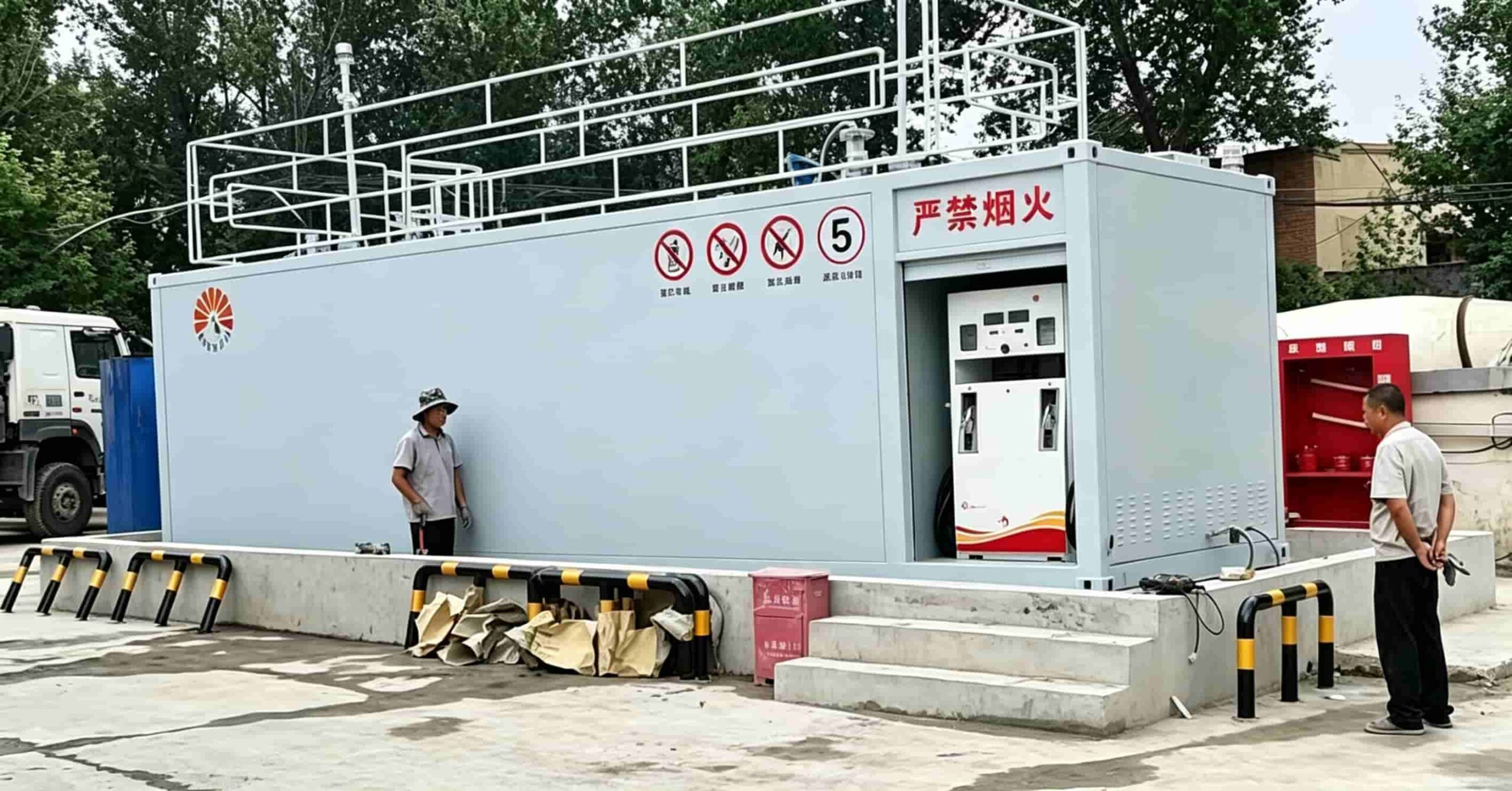
A complete skid-mounted fuel station typically integrates six core systems:
- Double-Wall Explosion-Suppression Fuel Tank – The double-wall construction provides secondary leak protection, while aluminum-alloy honeycomb explosion-suppression material inside the tank helps suppress vapor explosion and limit flame propagation, providing a “fire without explosion” safety concept.
- Fuel Dispenser + Nozzles – Equipped with an integrated fuel metering module for accurate fuel dispensing and measurement.For different fueling demands, see our fuel dispenser configurations and models.
- Safety System – Includes an emergency shut-off valve, automatic fire suppression, overfill protection, leak detection, lightning and static protection, and overpressure relief.
- Vapor Recovery System – Controls fuel vapor emissions during fuel unloading and dispensing to meet applicable environmental requirements.
- Intelligent Fuel Management System – Supports fuel inventory and transaction data management, card/RFID fueling, license plate recognition, and remote monitoring.
- Steel Skid Base – All major equipment is securely mounted on the steel skid, allowing the complete unit to be lifted, transported and relocated as one integrated module.
1. Double-Wall Tank and Leak Detection
The storage tank is the core safety component of a skid-mounted fuel station.
For fuel storage applications, a double-wall steel tank provides an additional barrier between the stored fuel and the surrounding environment. The interstitial space between the inner and outer walls can be equipped with a leak-detection system to identify leakage from either tank wall.
A typical technical configuration may include:
- Double-wall steel tank construction
- Inner tank design pressure: 0.8 MPa
- Outer tank designed for atmospheric-pressure service
- Interstitial leak detection
- Liquid-level monitoring
- Overfill protection
- Pressure relief
The 0.8 MPa inner-tank design pressure should be treated as a project-specific engineering parameter rather than a universal minimum requirement. Tank pressure design must be confirmed according to the tank construction standard, fuel type, operating conditions and local approval requirements.
Leak detection is particularly important because simply having a double-wall tank does not automatically provide active leakage monitoring. The interstitial space should be accessible to an appropriate monitoring device, and the system should provide a clear alarm or shutdown response according to the project design.
2. Explosion-Suppression Protection for Gasoline Tanks
Gasoline presents a higher vapor ignition risk than diesel because gasoline generates flammable vapor under normal ambient conditions.
For skid-mounted gasoline stations, explosion-suppression or flame-propagation-control measures may therefore be incorporated into the tank design.
Where an explosion-suppression material or device is used, the system should be supported by appropriate testing and technical documentation.
For a specific explosion-suppression configuration, the maximum explosion pressure-rise value can be designed not to exceed 0.05 MPa under the specified deflagration test conditions.
The objective is to:
- Restrict flame propagation
- Reduce pressure-rise intensity
- Limit the consequences of vapor ignition
- Improve the overall fire and explosion protection of the tank
3. Tank Fittings, Valves and Piping Safety
Tank accessories are just as important as the tank body itself. A properly designed system should address overfilling, siphoning, excessive pressure, leakage and fuel-transfer risks.
Overfill and Level Protection
A typical configuration may include:
- Emergency pressure relief device
- Overfill protection valve
- Liquid-level gauge
- High-level alarm
- Automatic overfill shut-off
For a specific system design:
- High-level alarm: approximately 90% of tank volume
- Automatic overfill shut-off: approximately 95% of tank capacity
These values can be used as design parameters where permitted by the applicable standard. The final alarm and shut-off levels should be established according to the tank geometry, filling method, fuel properties and local regulations.
Fuel Inlet Pipe
The fuel inlet connection is normally positioned at the upper section of the tank.
For the stated configuration:
- The top point of the inlet pipe remains above the maximum liquid level.
- The pipe end extends to approximately 50–100 mm above the tank bottom.
- Anti-siphon measures are incorporated into the filling system.
Suction Outlet
For a typical suction outlet arrangement:
- The suction outlet nozzle is approximately 0.15 m above the tank bottom.
- The high point of the suction piping remains above the maximum liquid level.
- Anti-siphon measures are incorporated where required.
These arrangements help reduce unwanted siphoning and provide controlled fuel transfer.
Quick Connections and Spill Control
The unloading system can include:
- Self-closing quick-connect coupling
- Fuel unloading hose connection
- Drip collection container
- Flange spill protection
- Leakage collection around quick joints
Drip-leak collection should be provided around flanges and quick-connect joints where leakage could otherwise reach the skid base or surrounding ground.
4. Tank Venting and Pressure Protection
Proper tank venting is essential because temperature changes and fuel transfer can change the pressure inside the tank.
For a specific aboveground skid-mounted configuration, the vent pipe may be designed to:
- Extend 1.5 m above the tank top
- Reach at least 4 m above surrounding ground level
- Include a flame arrester
- Include a breather valve
A typical breather-valve configuration may use:
- Positive working pressure: 2–3 kPa
- Negative working pressure: 1.5–2 kPa
These pressure values are design parameters that must be matched to the tank, venting system and applicable standard.
The purpose of the vent system is to control tank pressure while preventing external flame from propagating into the tank.
5. Thermal Protection for Aboveground Fuel Tanks
Unlike underground tanks, skid-mounted fuel tanks are normally exposed to outdoor environmental conditions.
Direct solar radiation can increase tank temperature and contribute to vapor-pressure buildup.
Therefore, the system should consider:
- Sun-shade canopy
- Thermal insulation
- Reflective surface treatment where appropriate
- Adequate ventilation around the tank
- Pressure-relief and venting provisions
Thermal protection should be considered together with tank venting rather than treated as a separate issue.
6. Fuel Dispenser Safety Specifications
The dispenser is the point where stored fuel is transferred directly to vehicles, making dispenser-side safety critical.
Automatic Fire Suppression
For a specific equipment configuration, an automatic fire-suppression device can be installed above the fuel dispenser.
A typical activation temperature can be specified at:
≤95°C
The final activation temperature and extinguishing system should be selected according to the fire-suppression technology, dispenser configuration and applicable approval requirements.
Fuel Nozzles
Self-sealing fuel nozzles should be used to minimize uncontrolled fuel release.
For gasoline dispensing, a configuration with a maximum nozzle flow rate of:
50 L/min
can be used where required by the applicable design and local regulations.
For more details on how flow rate affects dispenser selection and fueling performance, see our fuel dispenser flow rate guide.
Breakaway Valve
A breakaway safety valve should be installed on the dispensing hose to protect the system if a vehicle pulls away while the nozzle or hose remains connected.
This can help prevent damage to the dispenser and uncontrolled fuel release.
7. Emergency Shutdown and Fire Protection
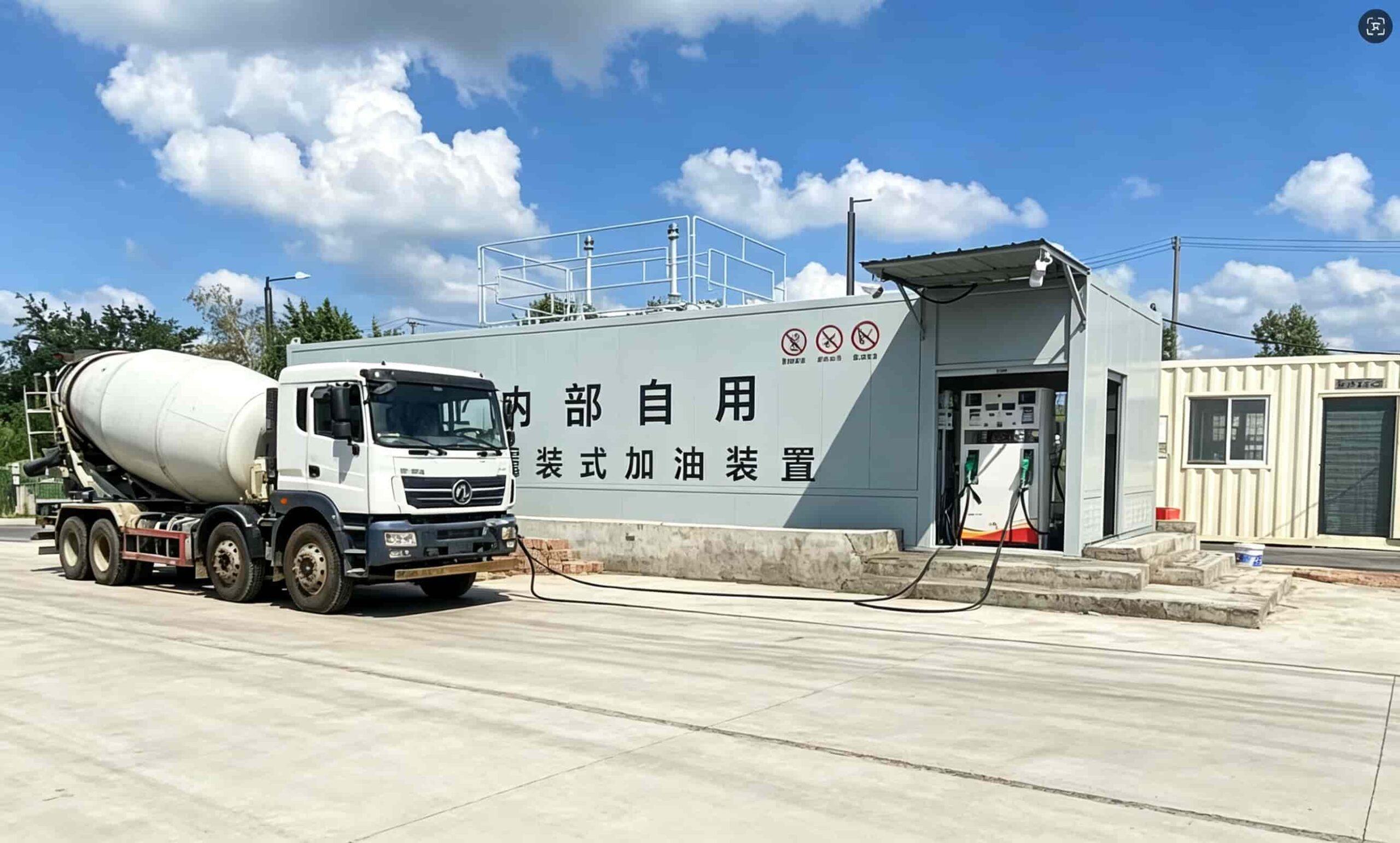
A skid-mounted fuel station should have a clearly accessible emergency shutdown system.
Depending on the project, the safety system may include:
- Emergency stop button
- Emergency fuel shut-off valve
- Automatic fuel shut-off
- High-temperature shut-off
- Automatic fire suppression
- Overfill protection
- Leak detection
- Pressure relief
- Grounding and bonding
- Lightning protection
- Fire extinguishers
NFPA 30A specifically addresses fuel dispensing systems, emergency electrical disconnects, dispensing hoses, delivery nozzles and vapor recovery systems, making it an important reference when developing a motor-fuel dispensing installation.
8. Vapor Recovery for Gasoline Applications
Gasoline storage and dispensing can generate volatile fuel vapors.
For gasoline skid-mounted fuel stations, vapor-control measures may therefore include:
Stage I Vapor Recovery
During tanker unloading, gasoline vapor is transferred back to the delivery vehicle rather than being freely released to the atmosphere.
Stage II Vapor Recovery
During vehicle refueling, displaced vapor can be recovered through the dispensing system.
A gasoline skid-mounted station should therefore be evaluated for both:
- Unloading vapor recovery
- Dispensing vapor recovery
The exact vapor-recovery configuration depends on the fuel type, local environmental requirements and project design.
For a deeper look at Stage I, Stage II and advanced vapor-recovery configurations, see our gas station vapor recovery system guide.
9. Secondary Containment and Spill Protection
A double-wall tank reduces the risk of fuel reaching the environment, but additional secondary containment may still be required by local regulations.
A skid-mounted fuel station can incorporate:
- Bund wall
- Spill containment sump
- Integrated skid containment
- Leak collection area
- Drainage control
For the configuration discussed in this article, the effective secondary-containment capacity can be designed at no less than 50% of total tank storage volume.
For example:
40,000 L tank × 50% = 20,000 L containment capacity
The containment structure should use suitable non-combustible materials and maintain leak-resistant performance.
10. Outdoor Installation and Anti-Collision Protection
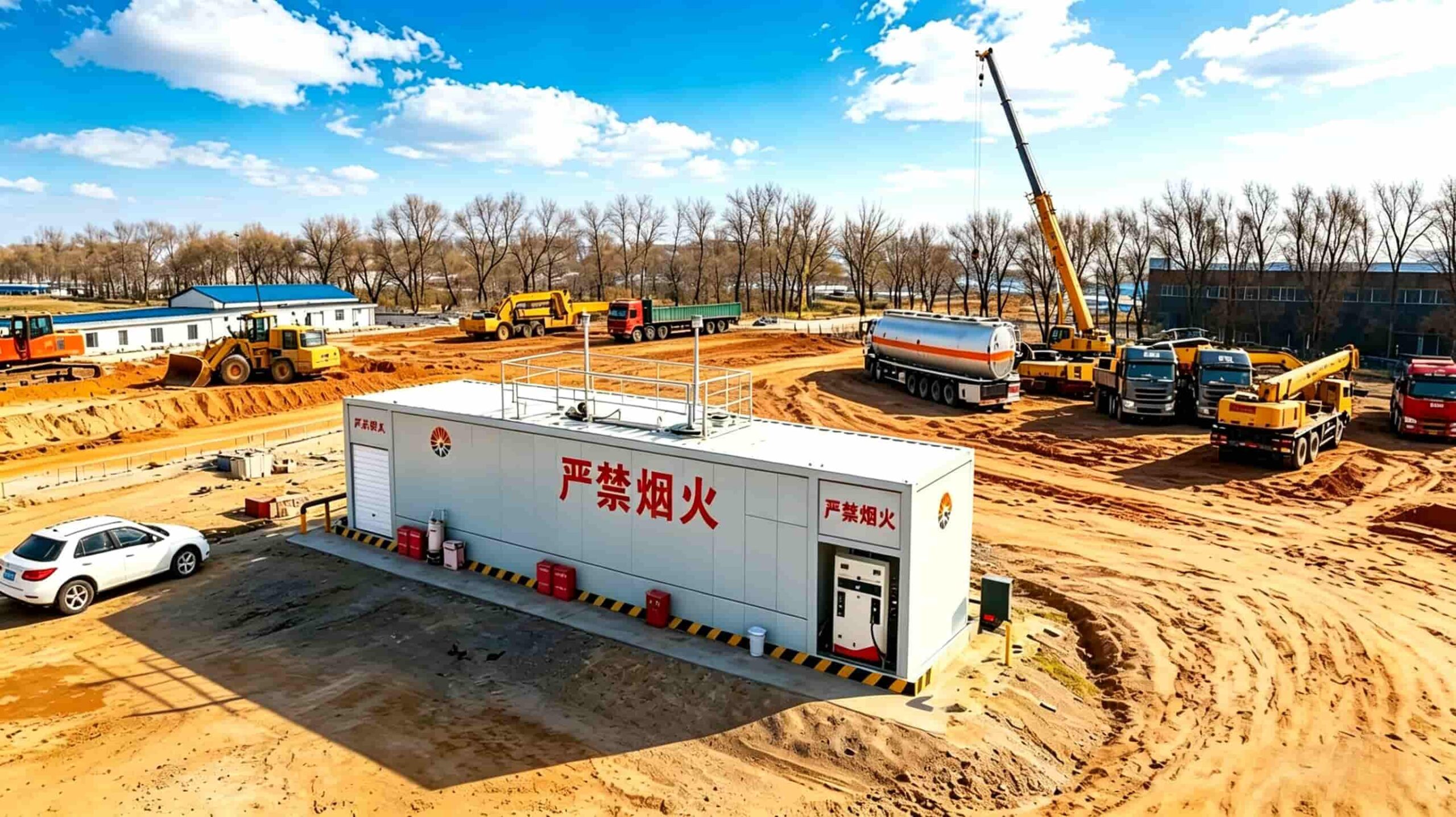
Skid-mounted fuel stations are generally intended for outdoor deployment.
They should not be installed indoors or inside closed enclosures where fuel vapor can accumulate without adequate hazardous-area ventilation and protection.
The installation area should also consider vehicle movement and mechanical impact.
Where the skid is adjacent to vehicle traffic lanes, install:
- Anti-collision barriers
- Protective bollards
- Guard rails
- Clearly defined vehicle paths
These measures help protect the tank, piping, dispenser and other critical components from vehicle impact.
11. Intelligent Fuel Management
Modern skid-mounted fuel stations can integrate fuel management and remote monitoring functions.
Depending on the project, the control system can provide:
- Fuel inventory management
- Tank level monitoring
- Fuel consumption records
- Inbound and outbound fuel records
- Card-based fueling
- RFID fueling
- Vehicle identification
- License plate recognition
- User authorization
- Remote monitoring
- Alarm management
This is particularly useful for mining fleets, logistics companies, construction projects and industrial facilities where fuel consumption needs to be tracked by vehicle, operator or department.
12.Skid-Mounted Fuel Station Buyer Checklist
Before purchasing a skid-mounted fuel station, buyers should verify the following:
| Item | What to Check |
|---|---|
| Tank | Double-wall steel construction |
| Tank Pressure | Project-specific design pressure |
| Leak Detection | Interstitial leak monitoring |
| Explosion Protection | Applicable explosion-suppression design for gasoline |
| Overfill Protection | High-level alarm and automatic shut-off |
| Venting | Correct vent pipe and pressure-relief configuration |
| Piping | Fuel-rated piping, valves and connections |
| Emergency Shutdown | Accessible emergency stop and fuel shut-off |
| Fire Protection | Suitable fire-suppression system |
| Dispenser | Accurate metering and safe dispensing |
| Nozzle | Self-sealing fuel nozzle |
| Breakaway | Hose breakaway protection |
| Vapor Recovery | Required for applicable gasoline projects |
| Containment | Local-compliant secondary containment |
| Grounding | Complete grounding and bonding |
| Electrical | Suitable equipment for hazardous areas |
| Anti-Collision | Protection from vehicle impact |
| Fuel Management | Optional RFID/card/remote monitoring |
| Certification | Applicable local approvals and certifications |
Need a project-specific configuration?
Send us your tank capacity, fuel type, nozzle quantity and required flow rate. Our team can prepare a suitable technical configuration.
13.Frequently Asked Questions
What tank capacity do you offer?
We support customized tank capacities ranging from 5000L to 60000L according to customer requirements.
Is it double‑wall tank? Do you have leak detection?
Equipped with double‑wall steel tank, optional leak detection system for inner‑outer tank interlayer.
Support diesel only or both diesel and petrol?
Available for diesel only, or dual‑use for diesel and petrol based on configuration.
How many dispensing nozzles can be fitted?
Support single‑nozzle, double‑nozzle and multi‑nozzle configuration as your request.
Does it come with fuel management system? Can we do card / RFID refueling?
Fuel management system, card swiping and RFID refueling function are optional accessories.
Conclusion
A skid-mounted fuel station is more than a tank and a dispenser—it is a complete, integrated fuel infrastructure solution.
With capacities ranging from 5,000 L to 60,000 L and configurations supporting up to 50 L/min gasoline dispensing, the real question is not simply “How much fuel can it store?” but:
“Is the system designed for the way we actually use fuel?”
What would change in your project if fuel storage, dispensing, safety protection and intelligent management could all be integrated into one movable system?
That may be the real value of a skid-mounted fuel station: not just moving fuel, but bringing safer and smarter fuel infrastructure wherever it is needed.
If you are planning a mining, construction, fleet-refueling or remote fuel-storage project, provide the fuel type, required tank volume, number of nozzles, required flow rate, power supply and installation country. We can recommend a suitable skid-mounted fuel station configuration and prepare a technical proposal and quotation.