
Fuel Dispenser Flow Rate: How to Choose the Right L/min for Your Gas Station
News 2026年 8月 26日 104
Fuel dispenser flow rate is one of the key specifications to consider when planning or upgrading a gas station. It directly affects fueling speed, customer experience and the matching of the dispenser with the underground fuel delivery system.
Common fuel dispenser flow rates include 40 L/min and 50 L/min, while some equipment is designed for higher flow applications.
However, choosing a fuel dispenser should not be based on flow rate alone. The required flow rate should be considered together with the fuel product, number of nozzles, submersible pump capacity, underground piping and expected fueling demand.
This guide explains how fuel dispenser flow rate works and how to select a suitable configuration for your gas station project.
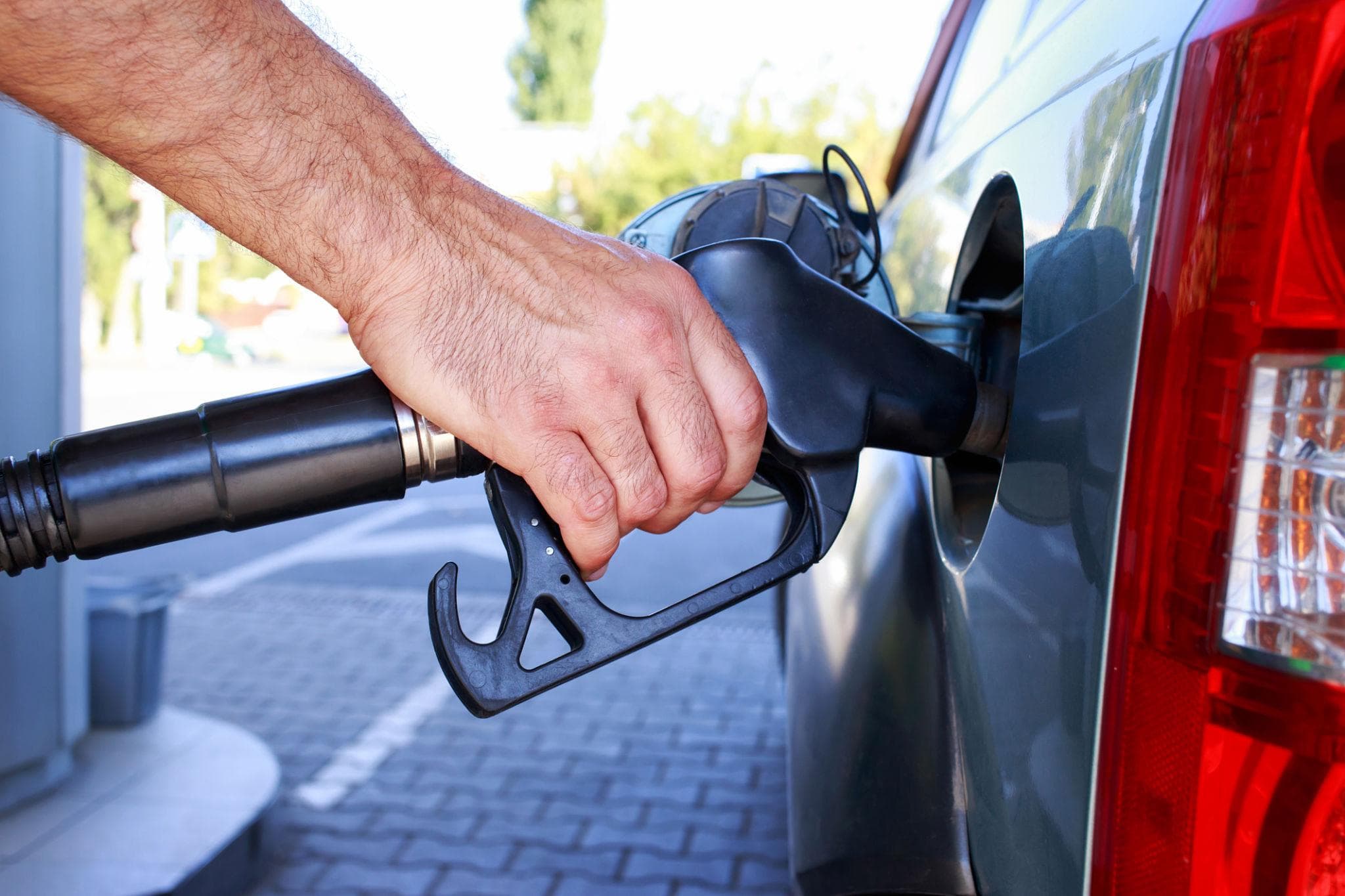
1. What Does Fuel Dispenser Flow Rate Mean?
Fuel dispenser flow rate refers to the volume of fuel that can be delivered through the dispensing system over a specific period.
It is commonly expressed in:
L/min — liters per minute
For example:
- 40 L/min means approximately 40 liters of fuel can be delivered per minute under the specified operating conditions.
- 50 L/min means approximately 50 liters per minute.
- 80 L/min indicates a higher nominal flow capacity.
The actual fueling speed may vary depending on the pump, piping, fuel properties, nozzle, filters, valves and operating conditions.
Therefore, the rated dispenser flow rate should not be interpreted as the guaranteed flow rate under every operating condition.
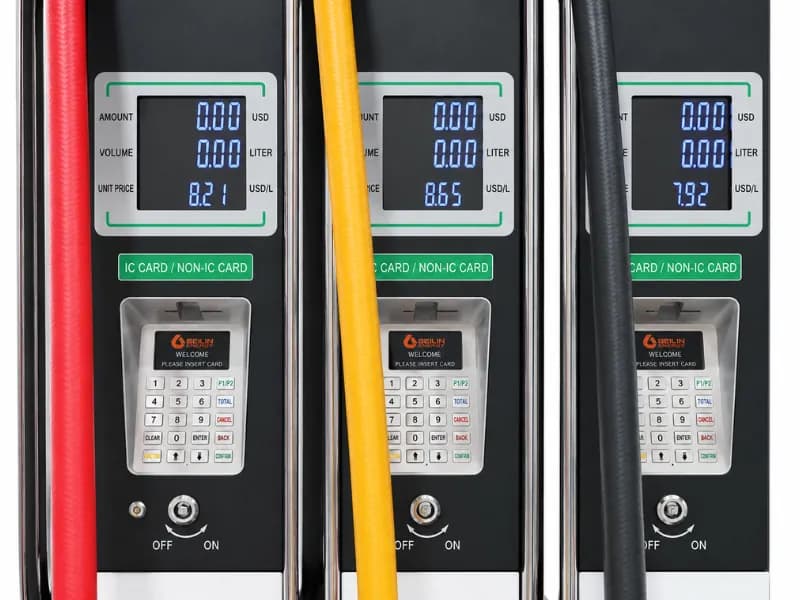
2. 40 L/min vs. 50 L/min Fuel Dispenser
For many conventional gas station applications, 40–50 L/min is a common range to consider.
40 L/min
A 40 L/min configuration may be suitable for:
- Small and medium-sized gas stations
- Standard passenger vehicle fueling
- Stations with moderate traffic
- Applications where extremely fast fueling is not required
50 L/min
A 50 L/min configuration can provide a higher nominal fueling capacity and may be considered for:
- Medium and large gas stations
- Higher traffic locations
- Applications requiring faster fueling
- Stations with higher expected throughput
The right choice depends on the complete fuel dispensing system rather than the dispenser specification alone.
3. Does a Higher Flow Rate Mean Faster Fueling?
Not necessarily.
A fuel dispenser may have a rated flow rate of 50 L/min, but the actual flow at the nozzle can be affected by several factors.
These include:
- Submersible pump capacity
- Underground piping diameter
- Pipe length
- Number of dispensers supplied by the pump
- Filters
- Valves
- Swivel joints and other components
- Nozzle performance
- Fuel temperature and properties
- Pressure losses in the system
For this reason, the dispenser, pump and underground piping should be designed as one complete fuel delivery system.
A higher-rated dispenser connected to an undersized fuel supply system may not achieve its expected performance.
4. How Does the Submersible Pump Affect Fuel Dispenser Flow Rate?
For a gas station using a submersible turbine pump system, the pump is an important part of the fuel delivery process.
A simplified fuel delivery path is:
Underground Storage Tank → Submersible Pump → Underground Fuel Pipe → Dispenser → Nozzle
The pump must provide sufficient flow and pressure for the connected dispensers while overcoming the resistance of the underground piping and other components.
For example, if one submersible pump supplies several fuel dispensers simultaneously, the system needs to be evaluated based on the expected simultaneous fueling demand.
This means that selecting a 50 L/min fuel dispenser does not mean the submersible pump automatically needs to provide 50 L/min for every nozzle at all times.
The pump capacity should be selected according to the complete system design.
5. How Does Underground Piping Affect Flow Rate?
Underground fuel piping creates resistance to fuel flow.
Pressure loss can increase with:
- Longer pipe runs
- Smaller pipe diameter
- More bends and fittings
- More valves
- Filters and other restrictions
- Higher flow rates
Therefore, a high-flow fuel dispenser should be matched with an underground piping system capable of delivering the required fuel volume.
For a new gas station project, it is better to determine the dispenser flow requirement before finalizing the underground piping layout.
This helps avoid a situation where the dispenser has a high rated capacity but the upstream piping cannot provide sufficient flow.
6. How Many Fuel Dispensers Can One Pump Supply?
There is no universal number because the answer depends on the complete system design.
Important factors include:
- Pump flow capacity
- Pump pressure
- Number of nozzles
- Fuel product
- Expected simultaneous fueling
- Underground piping layout
- Pipe diameter and length
- Required dispenser flow rate
For example, a station with several dispensers may use a centralized submersible pump system to supply multiple dispensing positions.
The key question is therefore not simply:
How many dispensers can one pump supply?
Instead, the project should ask:
What is the expected simultaneous fuel demand, and can the pump and piping system deliver it?
7. Choosing Between 40 L/min, 50 L/min and Higher Flow Rates
A simple way to approach flow-rate selection is to consider the station’s operating conditions.
| Application | Possible Flow Range | Typical Consideration |
|---|---|---|
| Small / moderate station | Around 40 L/min | Standard fueling demand |
| Medium / busy station | Around 50 L/min | Higher fueling demand |
| High-throughput application | Above 50 L/min | Requires system-level evaluation |
These values should be treated as selection references rather than universal design limits.
The final flow rate should be confirmed according to the dispenser specifications, pump performance, piping design and applicable local standards.
Not sure which flow rate is suitable for your station? Send us your station size, fuel products and expected demand.
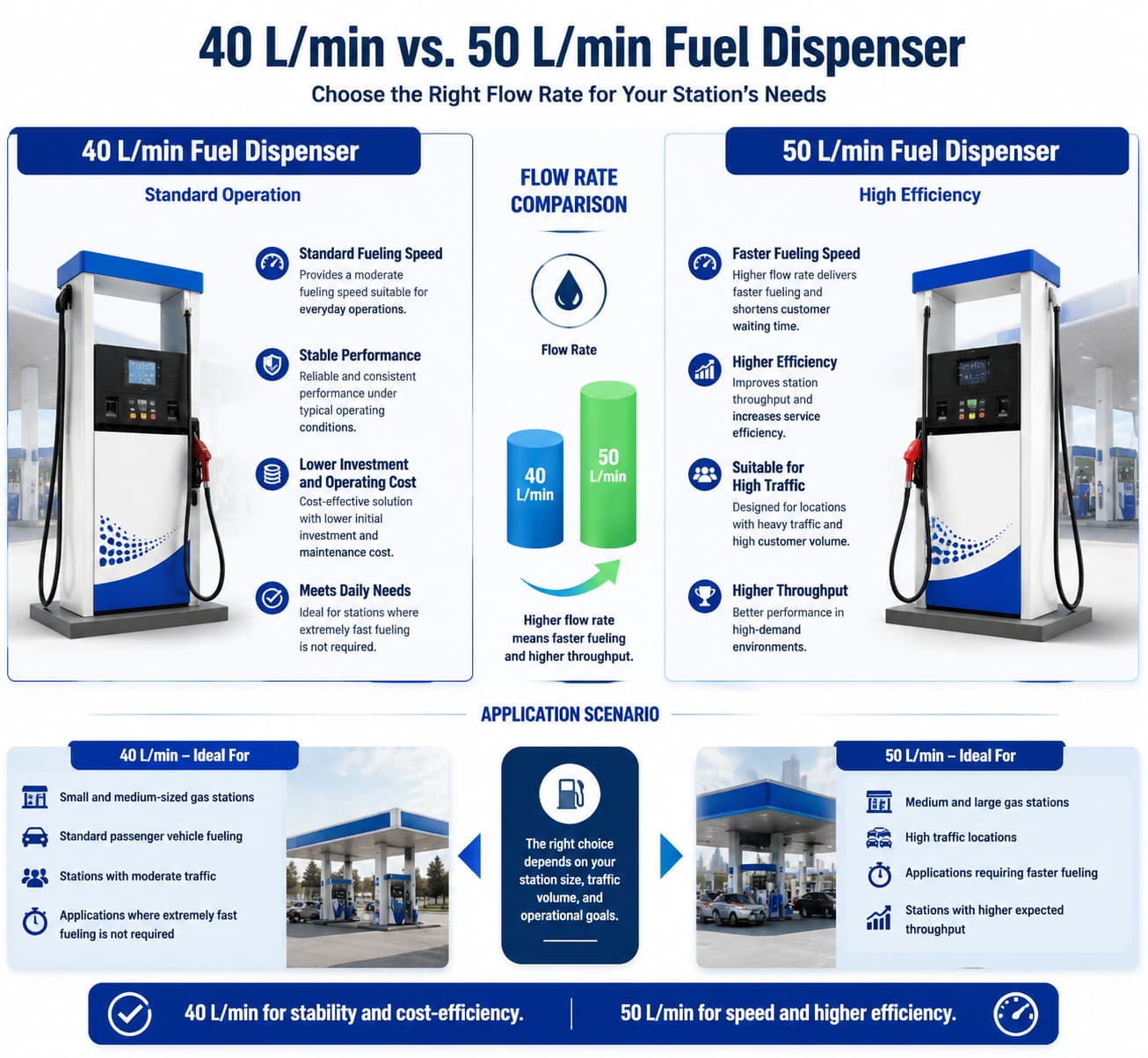
8. Why You Should Not Select a Fuel Dispenser by Flow Rate Alone
Flow rate is important, but it is only one part of the dispenser specification.
Before selecting a fuel dispenser, consider at least:
Fuel Products
How many fuel products will the station sell?
For example:
- Gasoline
- Diesel
- Multiple gasoline grades
Number of Nozzles
Common configurations include:
- 2 nozzles
- 4 nozzles
- 6 nozzles
- 8 nozzles
Flow Rate
Determine the required nominal flow rate according to the station’s expected demand.
Pumping System
Determine whether the station uses:
- Submersible turbine pumps
- Self-priming dispensers
Power Supply
Confirm the required:
- Voltage
- Phase
- Frequency
Vapor Recovery
For gasoline applications, determine whether vapor recovery is required and how the dispenser will connect to the vapor recovery system.
Local Standards
International projects should also consider local requirements for:
- Electrical systems
- Explosion protection
- Metering
- Product certification
- Fuel station safety
9. Fuel Dispenser Flow Rate and Nozzle Configuration
Flow rate should also be considered together with the number of nozzles.
For example, a station with several fuel products may need a dispenser with six or eight nozzles, while a smaller station may use a simpler configuration.
However, increasing the number of nozzles does not automatically increase the actual flow rate.
For gasoline dispensers, GB 50156-2021 specifies that gasoline self-closing nozzles should be used and that the flow rate should not exceed 50 L/min. Always verify the requirements applicable to the specific project location before final equipment selection.
10. Matching Fuel Dispenser Flow Rate With Your Project
Different gas station projects require different dispenser configurations.
For example:
Small station
→ Moderate traffic
→ Fewer fuel products
→ Standard flow requirement
→ Compact dispenser configuration
Medium station
→ More fueling positions
→ More fuel products
→ Higher expected throughput
→ 4–6 nozzle configurations may be considered
High-throughput station
→ Heavy traffic
→ Multiple fuel products
→ Higher simultaneous fueling demand
→ Multiple dispensers and higher-capacity fuel delivery systems may be required
The final configuration should always be confirmed from the project requirements rather than selected from flow rate alone.
11. Fuel Dispenser Flow Rate in Our Product Range
Our fuel dispenser range includes different configurations designed for different gas station applications.
Some of our dispenser configurations provide flow ranges such as 5–50 L/min, while selected models can support higher flow ranges depending on the configuration.
The appropriate model should be selected according to:
- Required flow rate
- Number of nozzles
- Fuel products
- Pumping system
- Power supply
- Vapor recovery requirements
- Destination country
- Applicable standards
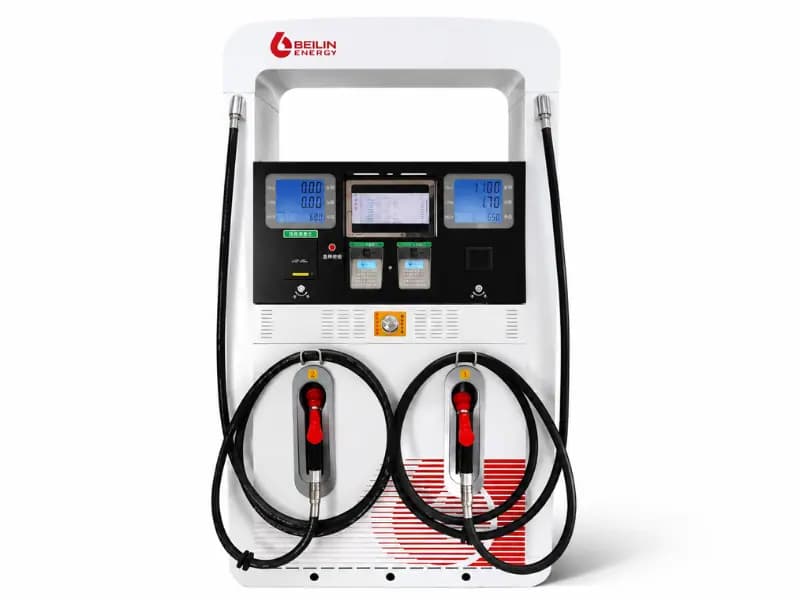
12. What Information Do We Need to Recommend a Fuel Dispenser?
If you are not sure which flow rate or dispenser configuration is suitable for your project, you can send us the following information:
- Number of fuel dispensers
- Number of nozzles per dispenser
- Fuel products
- Required flow rate
- Fuel tank capacity
- Submersible pump model or required pump capacity
- Underground piping information
- Power supply
- Vapor recovery requirements
- Project location
- Project drawings, if available
Based on this information, the dispenser configuration can be evaluated together with the overall fuel delivery system.
Need Help Choosing the Right Fuel Dispenser?
Choosing the right flow rate is not simply a matter of selecting the highest number.
The best configuration should match the fuel products, nozzle quantity, pump capacity, underground piping, expected demand and local requirements.
If you are planning a new gas station or upgrading an existing station, send us your project requirements.
Our team can help you evaluate the suitable fuel dispenser configuration for your project.