
Petroleum Thermometer Cup: Specifications, Operation & Guide
News 2026年 9月 16日 65
In fuel stations, oil depots, and oil measurement and trade transfer operations, temperature is a key factor in determining the standard volume of petroleum products. Gasoline and diesel expand and contract significantly with temperature changes. A 1°C change in oil temperature can cause approximately 0.12% variation in the volume of 1,000 liters of gasoline. During large-volume fuel receiving and storage tank inventory checks, even a small temperature measurement error can result in noticeable product losses or trade disputes.
The petroleum thermometer cup, also commonly known in the industry as a cup-and-case thermometer, is a specialized manual temperature measuring tool for petroleum products and is used for temperature measurement in oil and gas facilities. Many new operators ask: Why can’t a regular thermometer be used directly? What is the purpose of the thermometer cup? This article explains its working principle, structure, specifications, operation procedure, reading precautions, and common problems.
1. What Is a Petroleum Thermometer Cup?
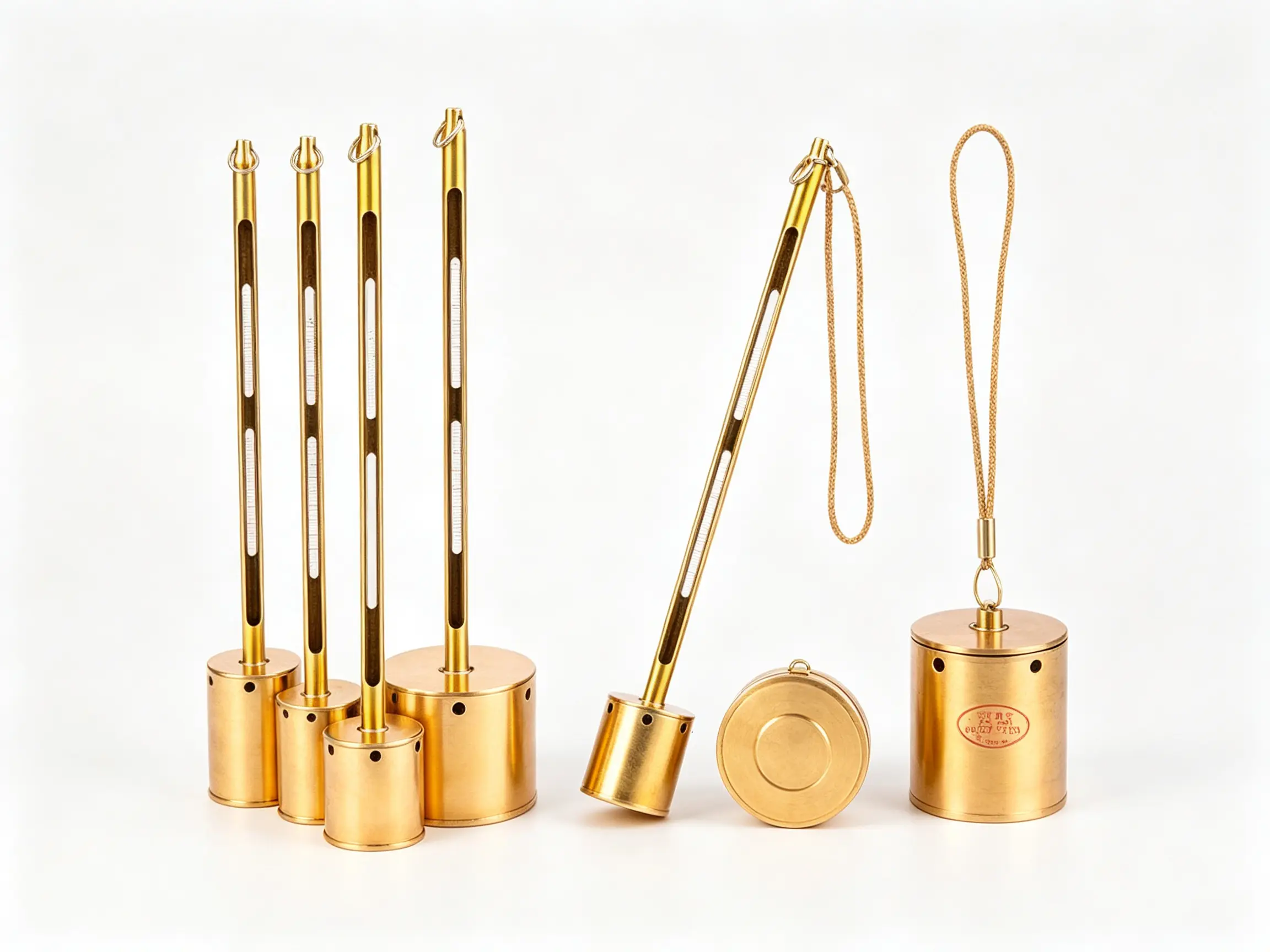
A petroleum thermometer cup is a specialized tool used for manual temperature measurement of petroleum products. It usually consists of a brass measuring cup, slotted metal rod, petroleum glass-stem thermometer, and suspension ring.
During operation, the thermometer is fixed inside the measuring cup. The cup is then lowered to the required measurement position through a metal rod or suspension rope.
After entering the oil, the measuring cup retains a certain amount of oil around the thermometer, allowing the thermometer to maintain relatively stable contact with the product.
Its main functions are therefore to:
- Allow the thermometer to make sufficient contact with the measured oil;
- Reduce temperature changes caused by direct exposure of the thermometer to air;
- Keep a certain amount of oil around the thermometer after the measuring tool is lifted;
- Provide more stable conditions for manual oil temperature measurement.
For manual measurement of oil temperature in fuel tanks, this type of tool provides more stable measurement conditions.
2. Petroleum Thermometer Cup Operation Principle
The petroleum thermometer cup operation can be understood through the following basic process:
Thermometer installation → Measuring cup lowering → Oil entering the cup → Temperature stabilization → Lifting the cup → Quickly reading the temperature
Step 1: Install the Thermometer
Install a petroleum glass-stem thermometer with the appropriate size inside the thermometer cup.
The thermometer should be securely installed to prevent shaking or falling during lowering and lifting.
Step 2: Lower the Thermometer Cup into the Oil Tank
Use a suspension rope, metal rod, or suspension structure to slowly lower the thermometer cup into the oil.
According to the measurement requirements, position the cup at the specified measurement location.
Step 3: Oil Enters the Measuring Cup
After the measuring cup enters the oil, oil enters the cup, allowing the thermometer to maintain direct contact with the measured product.
Step 4: Allow the Temperature to Stabilize
The thermometer needs sufficient contact with the oil under the required conditions so that the temperature reading can become stable.
Step 5: Lift and Read the Temperature
After the measurement requirements are met, slowly lift the thermometer cup and read the temperature promptly according to the required measurement procedure.
Core Function
The core function is to allow the thermometer to remain in contact with a representative oil sample during measurement as much as possible, reducing the influence of the surrounding environment during lifting and reading.
3. Petroleum Thermometer Cup Structure and Components
3.1 Brass Measuring Cup
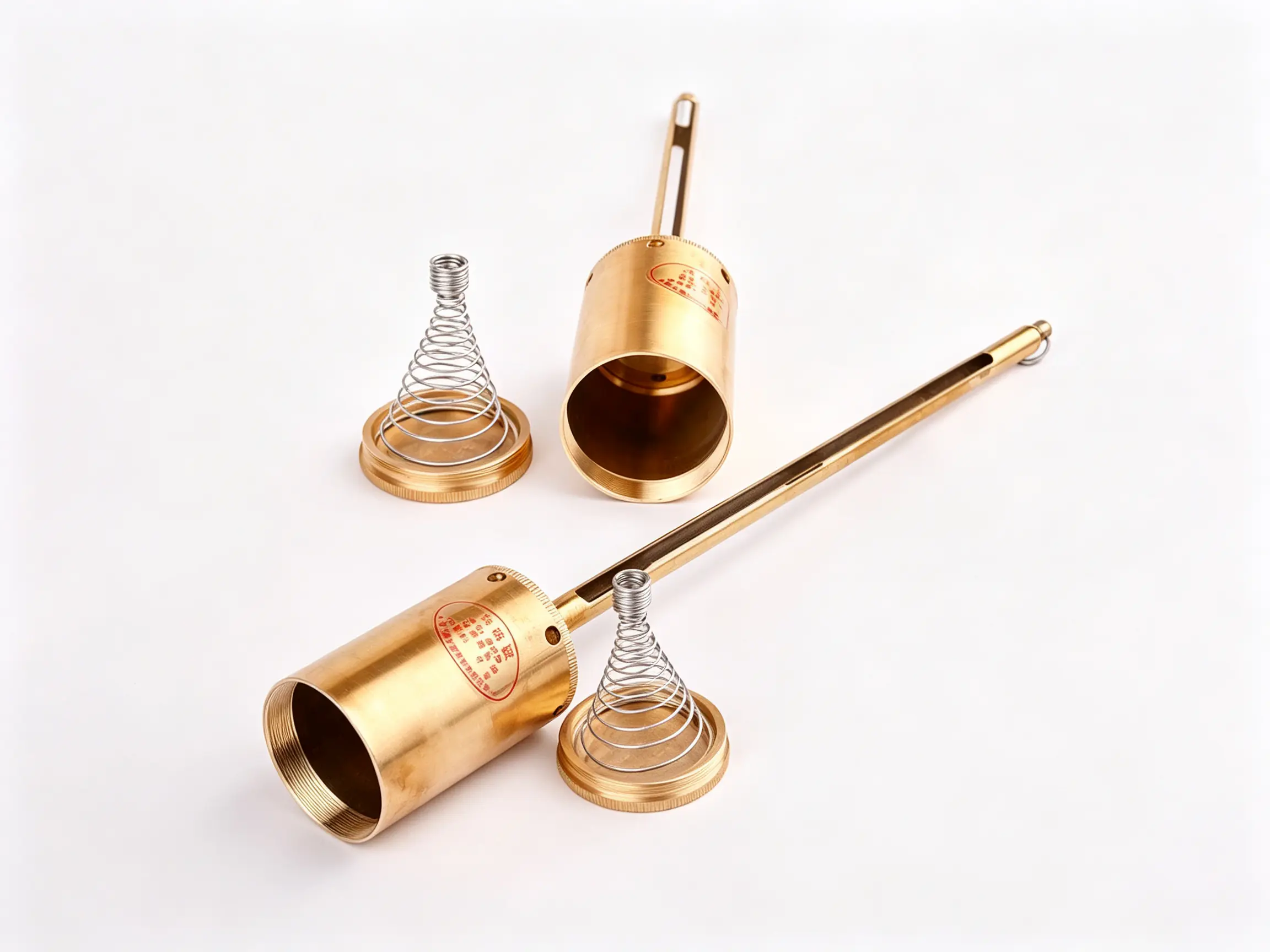
The measuring cup is the main component that directly contacts the oil.
Common products use brass. Brass has good corrosion resistance and machinability and has been widely used in petroleum product measuring tools.
Different petroleum thermometer cup specifications use different cup capacities and dimensions.
3.2 Slotted Metal Rod
The metal rod is used to connect and operate the measuring cup.
Some designs use a slotted structure that can accommodate thermometer installation and facilitate measurement operations.
3.3 Petroleum Glass-Stem Thermometer
The thermometer is responsible for measuring the actual oil temperature.
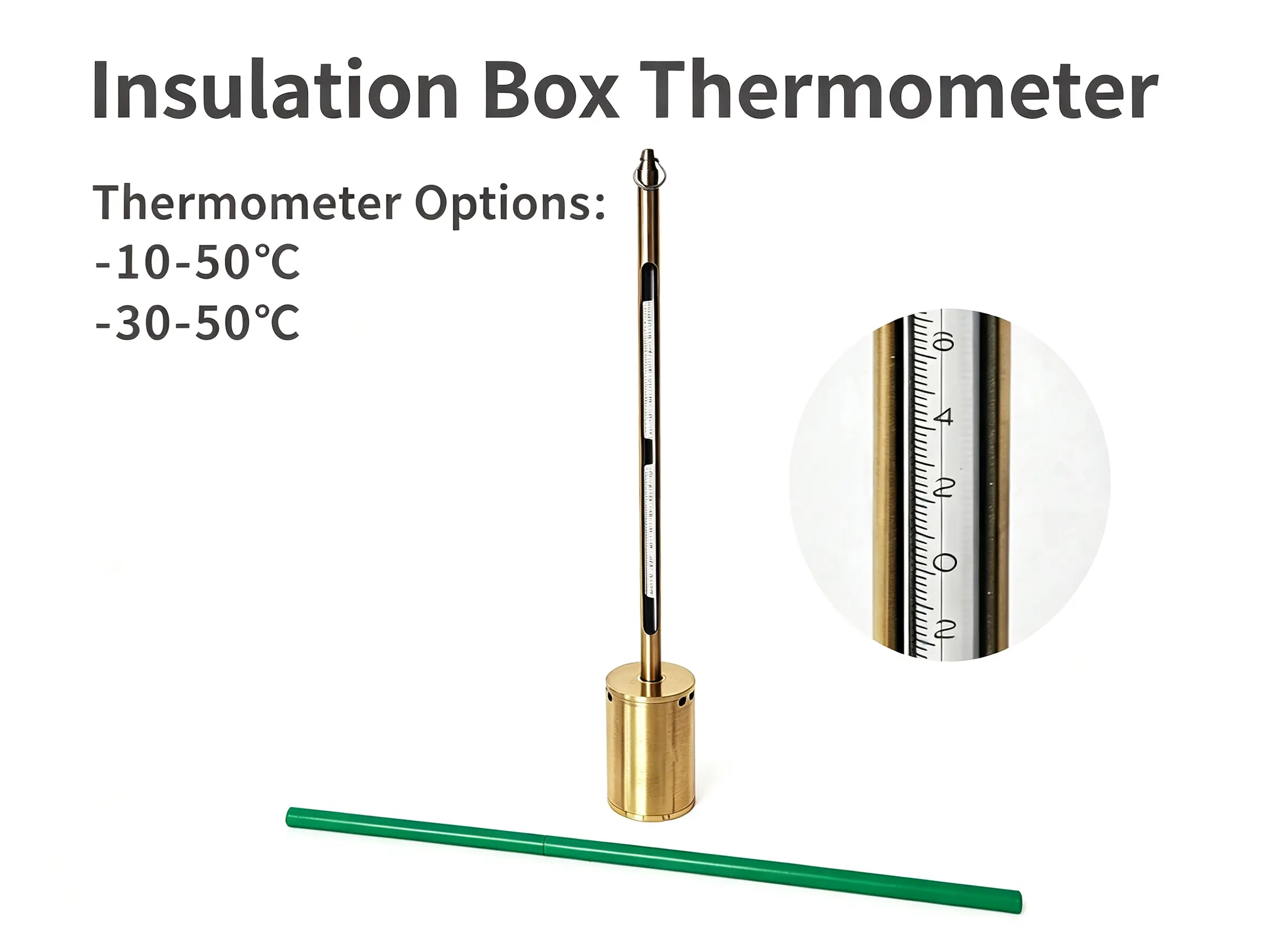
Different measuring cup capacities usually require petroleum glass-stem thermometers of different lengths, so not all thermometers can be used interchangeably.
A common thermometer graduation is 0.2°C.
3.4 Suspension Ring
The suspension ring is used to connect a suspension rope, operating rod, or other lifting structure, allowing the operator to lower the thermometer cup into the oil tank and lift it out.
4. Petroleum Thermometer Cup Specifications
There are four main petroleum thermometer cup specifications. Different capacities are suitable for different applications, and the corresponding thermometer lengths are also different.
The main specifications are 70 ml, 120 ml, 200 ml, and 250 ml. Selection mainly depends on the tank type, oil viscosity, and operating application.
| Capacity | Diameter | Total Length | Compatible Thermometer | Graduation | Application |
|---|---|---|---|---|---|
| 70 ml | 50 mm | 380 mm | 350 mm | 0.2°C | Underground gasoline/diesel storage tanks, most common |
| 120 ml | 50 mm | 390 mm | 350 mm | 0.2°C | Small/medium tanker trucks, diesel tank measurement |
| 200 ml | 50 mm | 410 mm | 400 mm | 0.2°C | Medium/large storage tanks, slightly higher-viscosity oil |
| 250 ml | 60 mm | 430 mm | 400 mm | 0.2°C | Heavy oil, viscous oil, large vertical storage tanks |
For daily inventory measurement at fuel stations, the 70 ml brass thermometer cup is preferred because it is suitable for most underground horizontal storage tanks.
For underground fuel tanks, the selection of measuring equipment should also match the tank structure and measurement method.
5. How to Use a Petroleum Thermometer Cup for Oil Temperature Measurement?
The petroleum thermometer cup operation should follow a standardized procedure to ensure that the temperature measurement data is reliable and usable.
Step 1: Check the Tools
Before operation, check that the thermometer cup has no deformation, damage, or oil blockage.
Check that the thermometer scale is clear, the glass has no cracks, and the reading is normal.
Step 2: Install the Thermometer
Insert the petroleum thermometer smoothly into the slotted protective rod and secure it properly.
Make sure the measuring probe corresponds completely to the center of the cup without displacement or looseness.
Step 3: Slowly Lower the Equipment
Secure the rope to the top suspension ring and slowly lower the thermometer cup into the oil tank at a uniform speed.
Avoid lowering it too quickly, which may impact the tank bottom or disturb the oil inside the tank.
Step 4: Reach the Standard Measurement Position
According to the measurement requirements, lower the equipment to the specified measurement depth in the oil tank.
Do not position it too shallow or too deep, ensuring that the measurement position meets the required procedure.
Step 5: Allow the Temperature to Stabilize
Leave the thermometer cup in the oil for sufficient time so that the oil inside the cup, the thermometer, and the oil in the tank can reach temperature equilibrium and eliminate the initial temperature difference.
Step 6: Lift the Equipment Smoothly
After stabilization, lift the thermometer cup vertically and smoothly.
Avoid shaking the cup to prevent oil from spilling and to reduce temperature loss inside the measuring environment.
Step 7: Read and Record the Temperature Quickly
Read the temperature immediately after the equipment leaves the oil surface and record the measurement for subsequent oil volume calculations and inventory records.
6. What Should You Pay Attention to When Reading a Petroleum Thermometer Cup?
The reading process is the final step in ensuring measurement accuracy. If the details are not properly controlled, the previous measurement operations may not produce reliable data.
6.1 Control the Reading Time
According to the measurement requirement, the thermometer cup must be read within 10 seconds after leaving the oil surface.
The greater the temperature difference between the oil and surrounding environment, the faster the temperature may change. Delayed reading can therefore cause measurement errors.
6.2 Keep the Cup Vertical
Keep the thermometer cup vertical during reading.
Do not tilt or invert it, as this may cause oil inside the cup to spill and change the measurement environment around the thermometer.
6.3 Keep the Correct Viewing Angle
Keep your eyes level with the top of the mercury column when reading the thermometer.
Avoid looking from above or below to reduce visual reading errors.
6.4 Maintain Reading Precision
Read the decimal value first and then the integer value.
The final reading should be accurate to 0.1°C to meet the required measurement precision.
6.5 Avoid Environmental Interference
In strong wind, direct sunlight, low temperatures, or severe cold conditions, the reading should be completed more quickly.
Extreme environmental conditions can accelerate heat exchange and may affect the measurement result.
7. Why Is Brass Commonly Used for Petroleum Thermometer Cups?
Brass is one of the commonly used materials for petroleum product measuring tools.
7.1 Reduced Spark Risk
Petroleum products are flammable, so the compatibility between tool materials and the operating environment needs to be considered.
Brass is widely used in petroleum measuring tools and can reduce the risk of sparks under certain metal collision and friction conditions.
However:
Brass material does not mean complete explosion-proof certification, and using brass does not completely eliminate explosion risks at the site.
Actual operation must still comply with the safety management requirements of fuel stations, oil depots, and other hazardous areas.
7.2 Corrosion Resistance
The measuring cup needs to remain in contact with gasoline, diesel, and other petroleum products.
Therefore, corrosion resistance is an important consideration when selecting the material.
7.3 Machinability
Brass has good machinability and can be processed into a measuring cup structure with stable dimensions.
8. Five Common Petroleum Thermometer Cup Measurement Errors
Error 1: Using a Regular Thermometer Directly
A regular thermometer placed directly into an oil tank may be affected by the surrounding environment during measurement.
For applications requiring standardized petroleum temperature measurement procedures, the appropriate measuring tool and operating method should be used.
Error 2: Lifting Before the Temperature Stabilizes
If the thermometer has not had sufficient contact with the oil and the temperature has not stabilized, the reading may not represent the actual product temperature.
Error 3: Using the Wrong Measurement Position
Different positions inside a tank may have different temperatures.
The specified measurement position should therefore be followed according to the applicable measurement procedure.
Error 4: Waiting Too Long After Lifting
After leaving the oil, the thermometer is affected by the surrounding environment.
The temperature should therefore be read promptly.
Error 5: Using an Incompatible Thermometer
For example, using an incompatible thermometer with a 400 mm thermometer cup may affect installation, measurement, and reading.
The thermometer length and graduation should match the specific measuring cup.
9. Petroleum Thermometer Cup FAQ
Q1. What is the difference between a petroleum thermometer cup and a regular thermometer?
A regular thermometer is used to measure temperature.
A petroleum thermometer cup is an auxiliary measuring tool that keeps a certain amount of oil around the thermometer during measurement and lifting, helping reduce the influence of air on the temperature reading.
Q2. Can a petroleum thermometer cup be used for underground fuel tanks?
Yes. Petroleum thermometer cups are commonly used for manual temperature measurement in underground fuel tanks.
The actual measurement method depends on the tank structure, gauging opening, measurement position, and site procedure.
Q3. Can any thermometer be used with the cup?
It is not recommended to use any thermometer randomly.
The thermometer should match the specific cup. Some specifications use a 350 mm thermometer, while others use a 400 mm thermometer.
A common graduation is 0.2°C.
Q4. How often should the thermometer be calibrated?
The specific calibration interval depends on the frequency of use, company metrology management requirements, applicable metrology rules, and instrument requirements.
There is no single universal calibration interval applicable to every situation.
10. Conclusion
Accurate oil measurement requires careful control of every detail. The small brass petroleum thermometer cup is a basic tool for oil temperature measurement and petroleum product trade transfer.
Proper specification selection and standardized operation can help reduce temperature-related volume measurement errors and reduce inventory losses and trade disputes.
If you need petroleum thermometer cups, the appropriate capacity can be selected according to the storage tank type and oil viscosity.
We also provide related fuel station equipment and components for different project requirements.