
How to Choose the Right Fuel Dispenser for a Gas Station Project
News 2026年 8月 24日 35
Choosing the right fuel dispenser is an important decision when building or upgrading a gas station.
A fuel dispenser is not simply selected by appearance or price. The correct model should match the station’s fuel types, number of nozzles, expected fueling demand, underground piping system, power supply, pump configuration and local operating requirements.
A suitable fuel dispenser can improve fueling efficiency, simplify installation and reduce long-term maintenance problems.
This guide explains the main factors to consider when selecting a fuel dispenser for a gas station project.
1. Start With the Number of Fuel Types
The first question is:
How many different fuels will the station dispense?
Common fuel types include:
- Gasoline
- Diesel
- Premium gasoline
- Regular gasoline
- Other locally required fuel grades
Different fuel types normally require separate product lines and corresponding dispensing nozzles.
For example, a station selling three gasoline grades and diesel may require multiple product selections on each dispenser.
Therefore, fuel type should be determined before selecting the dispenser configuration.
What to confirm:
- Number of fuel products
- Number of product grades
- Whether gasoline and diesel are both required
- Whether future fuel expansion is planned
2. Choose the Right Number of Nozzles
The number of nozzles is one of the most important specifications when choosing a fuel dispenser.
A dispenser may be configured with different numbers of nozzles depending on the number of fuel products and the station’s traffic requirements.
For example:
- 2 nozzles — suitable for simple fueling configurations
- 4 nozzles — suitable for smaller stations
- 6 nozzles — suitable for multi-product stations
- 8 nozzles — suitable for stations requiring several fuel products
More nozzles allow more fuel products to be available from one dispenser, but they also increase the equipment configuration and installation requirements.
For a high-volume station, an eight-nozzle dispenser may provide greater flexibility.
3. Consider the Required Fueling Flow Rate
Flow rate directly affects fueling efficiency.
A typical fuel dispenser may use different flow-rate ranges depending on its configuration, pump type and application.
For example, some conventional fuel dispensing systems operate around:
5–50 L/min
while higher-flow configurations may reach approximately:
5–80 L/min
The correct flow rate should not simply be selected based on the maximum possible value.
Instead, consider:
- Expected customer traffic
- Fueling frequency
- Number of dispensers
- Number of nozzles
- Underground piping size
- Submersible pump capacity
- Required fueling speed
A high-flow dispenser also requires the upstream fuel supply system to be capable of providing the required flow.
4. Match the Dispenser With the Underground Fuel System
The fuel dispenser works as part of a complete fuel delivery system.
A typical underground system includes:
Underground Storage Tank → Submersible Pump → Underground Fuel Pipe → Fuel Dispenser → Nozzle
The dispenser therefore needs to match the upstream equipment.
Before placing an order, confirm:
- Tank capacity
- Submersible pump type
- Pump flow rate
- Pump head
- Pipeline diameter
- Pipeline length
- Number of dispensers
- Number of simultaneous fueling operations
For example, if several dispensers are supplied by one submersible pump, the pump capacity and pipeline design should be checked before selecting the dispenser.
This is especially important for large stations with multiple fueling positions.
5. Suction Pump or Submersible Pump?
Fuel dispensers can be used with different fuel supply configurations.
Suction System
In a suction system, the dispenser incorporates a pumping unit that draws fuel from the underground storage tank.
This configuration can be suitable for certain smaller or conventional installations.
Submersible Pump System
In a submersible system, the pump is installed inside or at the tank and pushes fuel through the underground pipeline toward the dispenser.
Submersible pump systems are widely used for stations requiring multiple dispensers or higher fuel delivery capacity.
The choice between the two systems depends on:
- Tank configuration
- Pipeline layout
- Number of dispensers
- Required flow rate
- Station size
- Local engineering requirements
The dispenser and fuel supply system should therefore be designed as one system rather than selected separately.
6. Check the Power Supply
Electrical requirements must be confirmed before ordering a fuel dispenser.
Depending on the dispenser design, the equipment may use different electrical configurations.
Common requirements include:
- AC 220V
- AC 380V
- Single-phase power
- Three-phase power
The required voltage should match the dispenser’s electrical configuration and the station’s power supply.
For projects using submersible pumps, the dispenser and pump power requirements should also be considered together.
Before production, the buyer should provide:
- Local voltage
- Frequency
- Phase
- Electrical standards
- Hazardous-area requirements
This can prevent electrical compatibility problems during installation.
7. Consider Gasoline Vapor Recovery
If the station requires vapor recovery, the dispenser should be configured accordingly.
A vapor recovery system may include:
- Vapor recovery nozzles
- Vapor recovery hoses
- Vapor recovery piping
- Vapor recovery valves
- Underground vapor lines
- Monitoring or control equipment
For a new gas station project, vapor recovery requirements should be confirmed during the equipment selection stage rather than added after installation.
The dispenser, underground piping and vapor recovery system should be compatible with each other.
8. Accuracy and Measurement Performance
Fuel dispensers are metering equipment, so measurement accuracy is another important purchasing factor.
When comparing different models, buyers should check:
- Measurement accuracy
- Repeatability
- Flow meter type
- Calibration method
- Display resolution
- Electronic control system
For commercial fueling applications, stable measurement performance is important for both station operators and customers.
The dispenser should also comply with the metrology and certification requirements applicable to the target market.
9. Installation Dimensions Matter
A fuel dispenser may have different dimensions depending on the number of nozzles and internal configuration.
Before ordering, confirm:
- Overall dimensions
- Inlet and outlet connections
- Pipeline connection position
- Electrical cable entry
- Foundation dimensions
- Maintenance access
- Distance between dispensers
The dispenser should fit the planned island layout.
This is particularly important when replacing an existing dispenser because the new machine needs to fit the existing foundation and pipeline connections.
10. Choose the Dispenser According to the Station Type
Different gas stations have different requirements.
Small Gas Station
A smaller station may prioritize:
- Compact design
- Simple configuration
- Lower investment
- Easy maintenance
A 2-, 4- or 6-nozzle configuration may be sufficient depending on the fuel products.
Medium-Sized Gas Station
A medium station may require:
- Multiple fuel grades
- Higher fueling capacity
- Several fueling positions
- Vapor recovery
- More flexible dispenser configurations
High-Volume Gas Station
A high-traffic station may require:
- Multiple dispensers
- Eight-nozzle configurations
- Higher flow rates
- Multiple submersible pumps
- Larger underground piping systems
- More advanced monitoring and control
Therefore, there is no single “best” fuel dispenser for every gas station.
11. What Information Should You Send a Fuel Dispenser Supplier?
If you are requesting a quotation, providing complete project information can significantly speed up the selection process.
We recommend providing:
| Project Information | Example |
|---|---|
| Fuel types | Gasoline + Diesel |
| Fuel grades | 92 / 95 / 98 |
| Number of dispensers | 4 |
| Nozzles per dispenser | 8 |
| Required flow rate | 5–50 L/min |
| Tank capacity | 30 m³ / 40 m³ |
| Pump system | Submersible pump |
| Local voltage | 380V / 50Hz |
| Vapor recovery | Required / Not required |
| Country | Nigeria / Kenya / Indonesia etc. |
With this information, the supplier can recommend a more suitable dispenser configuration instead of providing a generic quotation.
Ready to choose your fuel dispenser?
Send us your project specifications and target market. We can recommend a suitable configuration and provide a quotation.
12. Fuel Dispenser Options for Different Projects
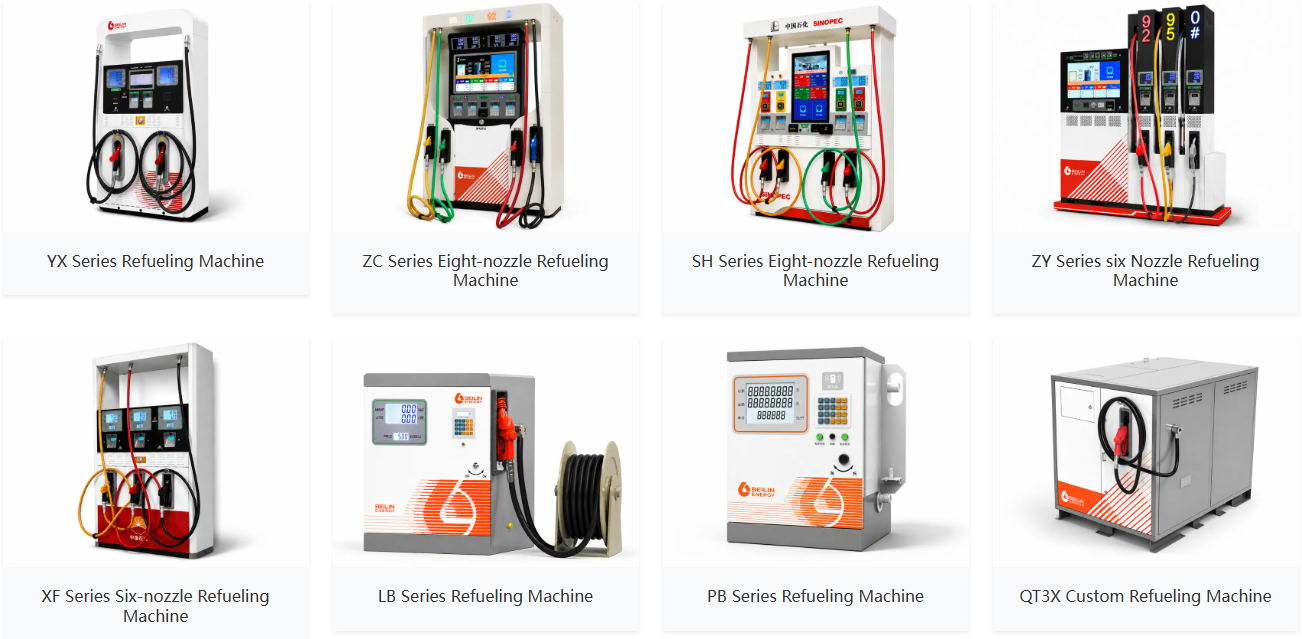
Our fuel dispenser range includes different configurations for different gas station applications.
The current product range includes YX Series, ZC Series Eight-nozzle, SH Series Eight-nozzle, ZY Series Six-nozzle, XF Series Six-nozzle, LB Series, PB Series and QT3X Custom Refueling Machine.
For customers who already have a station layout or equipment list, the dispenser can be selected according to the required nozzle configuration, fuel products, flow rate and electrical requirements.
13. Need Help Selecting a Fuel Dispenser?
Choosing a fuel dispenser is easier when the complete fuel station system is considered together.
If you are building a new gas station, replacing existing dispensers or purchasing equipment for multiple stations, you can send us your project requirements.
Please provide:
- Number of dispensers
- Number of nozzles
- Fuel types
- Tank capacity
- Pump type
- Required flow rate
- Local voltage
- Vapor recovery requirements
- Installation country
We can help you evaluate the suitable fuel dispenser configuration and provide a quotation based on your project requirements.