
Gas Station Submersible oil pump Selection Guide: Flow Rate, Power, Voltage and Dispenser Matching
News 2026年 8月 14日 51
A Submersible oil pump (STP) is one of the key components in a modern underground fuel dispensing system.
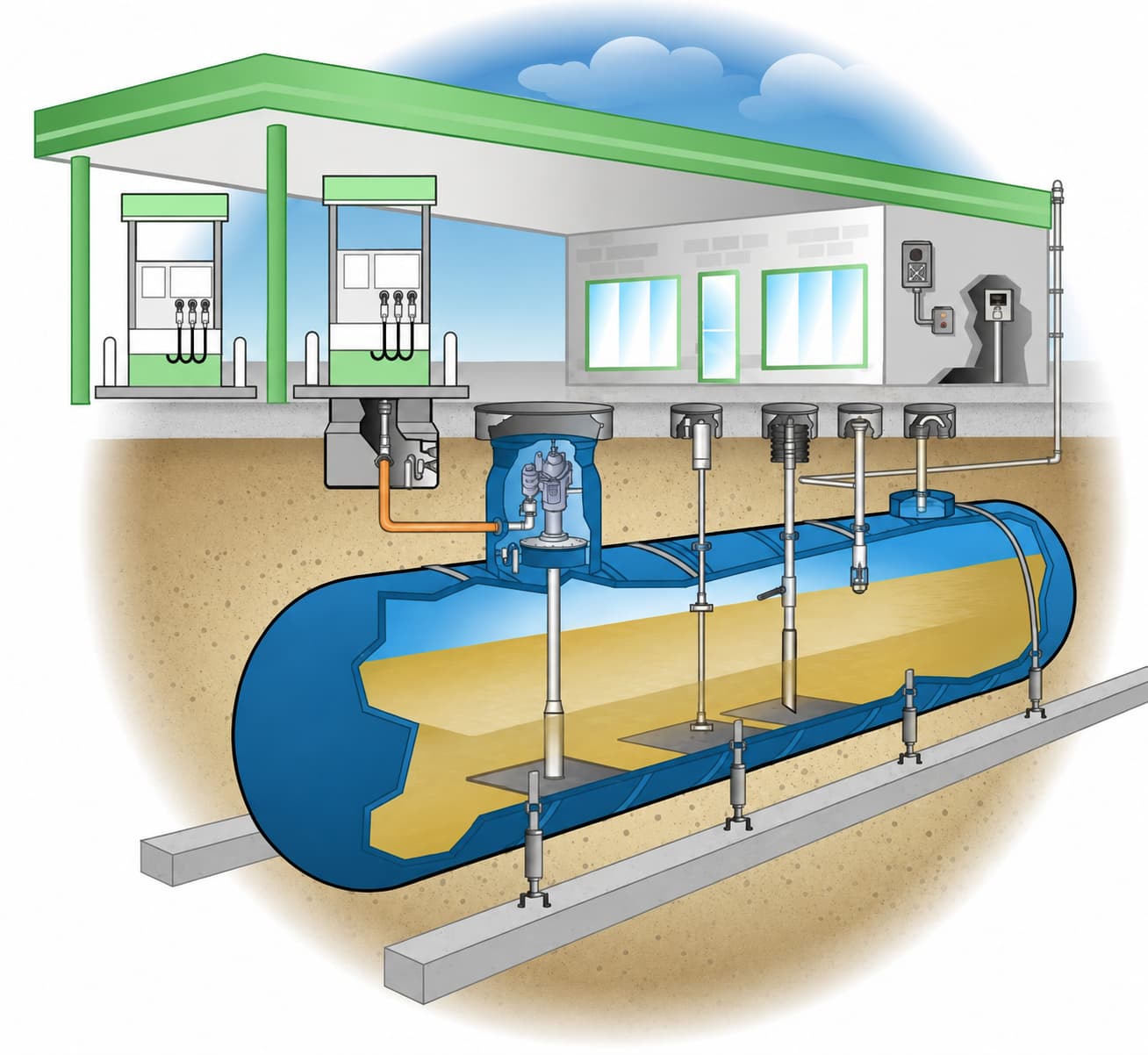
Installed inside the underground fuel tank, the pump delivers fuel through underground piping to one or more fuel dispensers.
The most important question is not simply:
“How many horsepower does the pump have?”
A proper selection should consider:
- Required fuel flow rate
- Number of dispensers and nozzles
- Expected simultaneous fueling
- Tank depth
- Pipeline length and diameter
- Pressure requirements
- Motor power
- Voltage
- Fuel type
According to GB 50156-2021, gas stations are encouraged to use a system in which one Submersible oil pump supplies multiple dispensers or nozzles.
1. What Is a Gas Station Submersible oil pump?
A Submersible oil pump is installed inside the underground fuel tank and uses positive-pressure delivery to send fuel to the dispenser.
A typical system is:
Underground Fuel Tank → Submersible oil pump → Fuel Pipeline → Fuel Dispenser → Nozzle
Compared with a suction-type dispenser system, a Submersible oil pump system is particularly suitable for stations with:
- Underground tanks
- Longer fuel pipelines
- Multiple dispensers
- Multiple fueling positions
GB 50156-2021 notes that the submersible-pump arrangement provides positive-pressure fuel delivery and is generally less affected by a low tank position or longer piping.
A complete underground fuel system usually includes the underground fuel tank, submersible oil pump, fuel piping and fuel dispenser. If you are planning a complete station system, you can also learn more about our [Gas Station Fuel Dispenser] solutions.
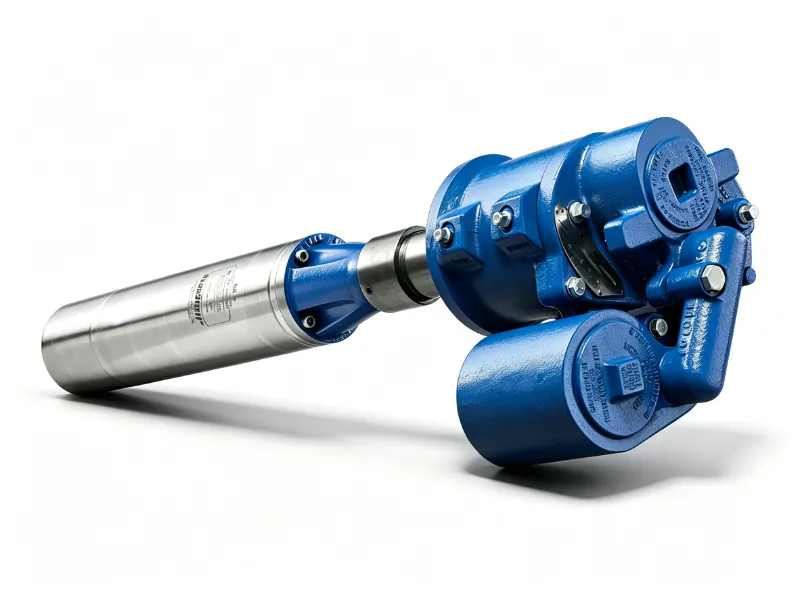
2. How Do You Select the Pump Flow Rate?
Flow rate is usually expressed as:
L/min — liters per minute
The required pump capacity depends on the expected demand of the connected dispensers.
A simple starting point is:
Required Flow ≈ Number of Simultaneously Active Nozzles × Flow per Nozzle
For example:
| Simultaneously Fueling Nozzles | Assumed Flow per Nozzle | Approx. Required Flow |
|---|---|---|
| 1 | 40 L/min | 40 L/min |
| 2 | 40 L/min | 80 L/min |
| 3 | 40 L/min | 120 L/min |
| 4 | 40 L/min | 160 L/min |
These are engineering examples, not GB 50156-2021 mandatory values.
The actual pump should be selected from its pump performance curve, considering pressure, piping losses and the dispenser’s actual flow requirement.
For gasoline dispensers, GB 50156-2021 specifies that the flow rate of a gasoline nozzle should not exceed 50 L/min.
3. How Many Fuel Dispensers Can One Submersible oil pump Supply?
This is one of the most common questions from gas station equipment buyers.
The answer is:
There is no universal “one pump = X dispensers” rule.
It depends on:
- Pump flow capacity
- Pump pressure
- Number of nozzles
- Expected simultaneous fueling
- Pipeline diameter
- Pipeline length
- Elevation difference
- Dispenser flow rate
GB 50156-2021 specifically recommends the one-pump-to-multiple-dispensers/nozzles arrangement.
For example, a pump may supply:
1 pump → 2 dispensers → 4 nozzles
or:
1 pump → 3 dispensers → 6 nozzles
But this does not mean the pump automatically has enough capacity.
The correct question is:
How many nozzles may operate simultaneously, and what flow rate does each nozzle require?
4. Example: Matching Pump Flow to Multiple Nozzles
Assume a project has:
- 3 fuel dispensers
- 2 nozzles per dispenser
- Maximum nozzle flow: 40 L/min
- Maximum expected simultaneous fueling: 3 nozzles
The estimated simultaneous demand is:
3 × 40 = 120 L/min
Therefore, a pump with a rated flow around 120 L/min at the required operating pressure would be a starting point for evaluation.
However, selecting a pump rated at exactly 120 L/min may not provide sufficient operating margin.
The final selection should consider the pump’s performance curve and the pressure loss of the entire piping system.
5. How to Choose Pump Power: HP vs. kW
Submersible oil pump motor power is commonly expressed in:
- HP — horsepower
- kW — kilowatt
The basic conversion is:
1 HP ≈ 0.746 kW
Therefore:
| Pump Power | Approx. Motor Power |
|---|---|
| 0.75 HP | 0.56 kW |
| 1 HP | 0.75 kW |
| 1.5 HP | 1.12 kW |
| 2 HP | 1.49 kW |
| 3 HP | 2.24 kW |
| 5 HP | 3.73 kW |
For example:
1.5 HP ≈ 1.12 kW
and
3 HP ≈ 2.24 kW
But higher HP does not automatically mean a better pump.
Pump power must be matched with:
- Required flow
- Required pressure/head
- Pipeline resistance
- Number of active fueling positions
- Pump efficiency
A pump should therefore be selected from its flow-pressure performance curve, rather than by horsepower alone.
6. 220V or 380V: Which Voltage Should You Choose?
The required voltage depends on the pump motor and the station’s electrical system.
Common configurations include:
220V
Generally used for suitable single-phase applications.
Advantages may include:
- Simple power supply
- Suitable for certain smaller systems
380V
Commonly used for three-phase industrial equipment.
Advantages may include:
- Suitable for higher-power motors
- Better suited to larger station electrical systems
- Three-phase motor operation
However, voltage should never be selected simply according to pump power.
Before ordering a pump, confirm:
- Local power supply
- Single-phase or three-phase system
- Motor rated voltage
- Frequency
- Explosion-proof certification requirements
- Control panel requirements
For international projects, this is especially important because electrical standards differ between markets.
7. How Does Tank Depth Affect Pump Selection?
Tank depth affects the hydraulic conditions of the system.
The pump must provide enough pressure to overcome:
- Pipeline friction
- Pipe fittings and elbows
- Elevation differences
- Dispenser pressure requirements
- Other system losses
The pump selection should therefore be evaluated together with the underground tank and piping configuration. For more information, see our guide to [underground fuel tank installation and layout].
A simplified relationship is:
Required Pump Head = Static Head + Friction Loss + Equipment Pressure Requirement
Therefore, two gas stations with the same number of dispensers may require different pumps if their underground piping systems are different.
For example:
Project A
- Short pipeline
- Large pipe diameter
- Small elevation difference
may require less pump head.
Project B
- Long pipeline
- Smaller pipe diameter
- More elbows
- Greater elevation difference
may require greater pump head.
8. Why Pipeline Diameter Matters
Pump selection cannot be separated from piping design.
A simplified system is:
Tank → Pump → Main Pipeline → Branch Pipeline → Dispenser
If the pipeline is too small for the required flow, pressure loss increases.
This can result in:
- Lower dispenser flow
- Longer fueling time
- Increased pump operating load
- Uneven flow between dispensers
Therefore, when selecting a Submersible oil pump, the supplier should know:
- Pipe diameter
- Pipeline length
- Number of branches
- Number of elbows
- Number of dispensers
- Required flow rate
9. Important Installation Dimension Inside the Tank
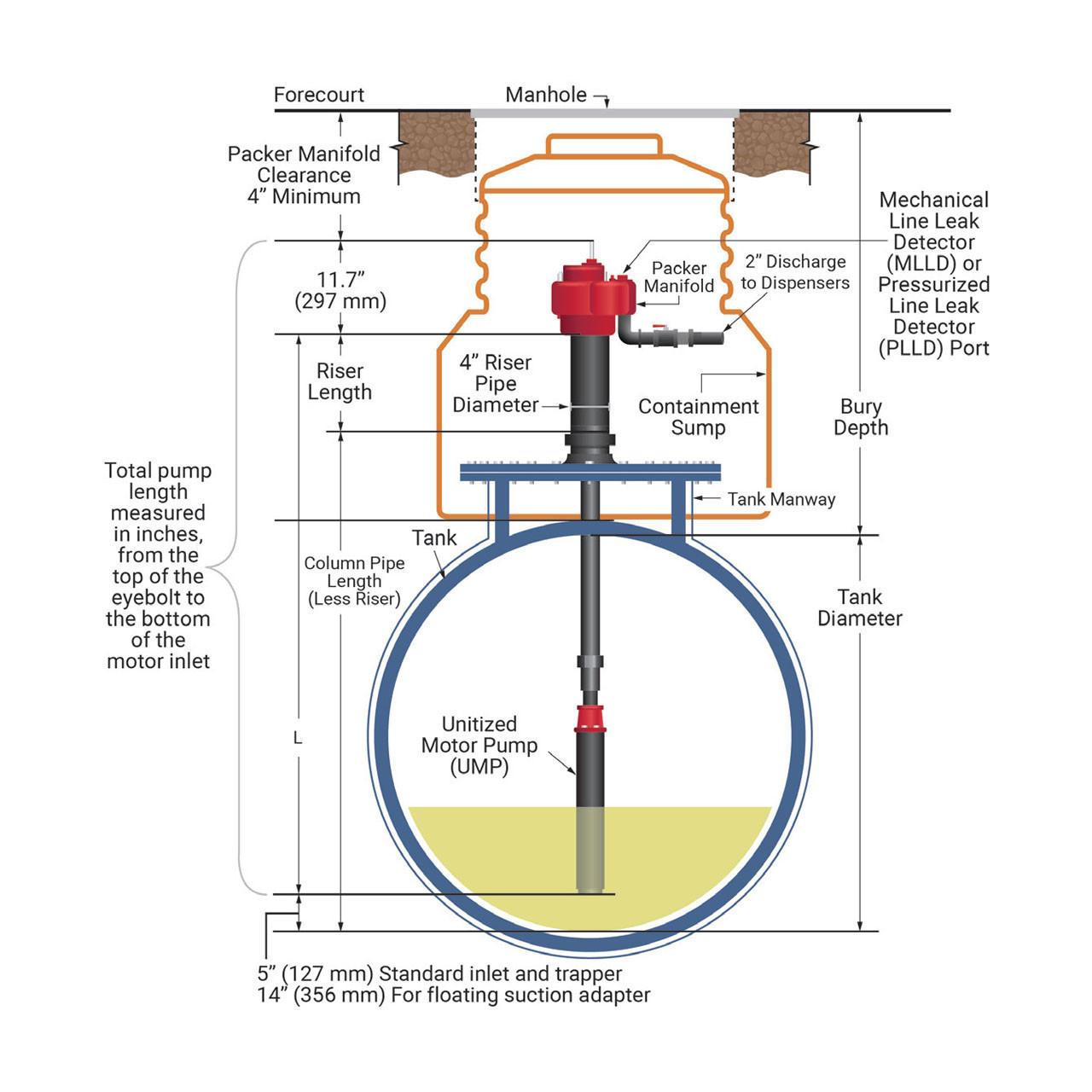
According to GB 50156-2021, the Submersible oil pump inlet should be 150–200 mm above the tank bottom.
Simplified:
Submersible oil pump
│
↓
Pump Inlet
│
│ 150–200 mm
↓
────────────────────────
Tank Bottom
────────────────────────
This is an important dimension when matching the pump length and installation assembly with the underground fuel tank.
The pump installation opening is also located on the tank manhole cover in the arrangement specified by GB 50156-2021.
10. Fixed-Speed vs. Variable-Speed Submersible oil pumps
There are two common approaches.
Fixed-Speed Pump
The pump operates at a fixed speed.
Advantages:
- Simple control
- Straightforward installation
- Suitable for many conventional stations
However, when several nozzles operate simultaneously, the available pump capacity must be shared among the active fueling positions.
Variable-Speed Pump
The pump speed can be adjusted according to demand.
Advantages may include:
- More consistent flow
- Better response to changing demand
- Potential energy savings during low-demand periods
For example, one manufacturer of variable-speed fueling systems states that its 2 HP systems can provide 38 L/min for up to 8 fueling positions under specified system conditions, while 4 HP systems can provide the same per-position flow for up to 12 positions. These are manufacturer-specific performance figures, not universal sizing rules.
This distinction is important when comparing products.
11. Quick Submersible oil pump Selection Checklist
Before requesting a quotation, prepare the following information:
| Parameter | Example |
|---|---|
| Fuel Type | Gasoline / Diesel |
| Tank Capacity | 30 / 40 / 50 m³ |
| Tank Depth | Project-specific |
| Number of Dispensers | 2–4 |
| Number of Nozzles | 4–8 |
| Simultaneous Nozzles | 2–4 |
| Required Flow | 40–50 L/min per nozzle |
| Pipeline Length | Project-specific |
| Pipeline Diameter | Project-specific |
| Motor Power | 1.5 / 2 / 3 / 5 HP |
| Voltage | 220V / 380V |
| Frequency | 50Hz / 60Hz |
| Pump Type | Fixed / Variable Speed |
With this information, the supplier can select a pump much more accurately.
12. What Information Should You Send to a Pump Supplier?
If you are requesting a quotation, you do not need to know the exact pump model first.
Send the supplier:
1. Tank capacity
2. Tank diameter and depth
3. Number of dispensers
4. Number of nozzles
5. Expected simultaneous fueling positions
6. Required flow rate
7. Pipeline length and diameter
8. Local voltage and frequency
9. Fuel type
10. Required certifications
A professional supplier can then evaluate the required flow, head, motor power and configuration.
Looking for the Right Submersible Pump?
Tell us your:
- Tank capacity
- Number of dispensers
- Number of nozzles
- Required flow rate
- Pipeline length
- Pipeline diameter
- Voltage and frequency
- Fuel type
Conclusion
Selecting a gas station Submersible oil pump is not simply a matter of choosing 1.5 HP, 2 HP or 3 HP.
A proper selection should match:
Flow Rate + Pressure/Head + Pipeline + Dispenser Demand + Tank Conditions + Electrical Supply
The most important figures to remember are:
- ≤50 L/min — maximum gasoline nozzle flow specified by GB 50156-2021
- 150–200 mm — Submersible oil pump inlet above tank bottom
- 1 HP ≈ 0.746 kW
- 40–50 L/min/nozzle — useful engineering reference range for many conventional dispensers, but actual project requirements vary
- One pump can supply multiple dispensers/nozzles — a configuration encouraged by GB 50156-2021, provided the pump and piping are properly sized
The best pump is not necessarily the most powerful pump. It is the pump that provides the required flow and pressure under the actual operating conditions of the station.
Need Help Selecting a Submersible oil pump?
Send us your tank capacity, tank depth, number of dispensers, required flow rate, pipeline length, voltage and frequency, and we can help evaluate a suitable Submersible oil pump configuration.
Need a Submersible Pump for Your Gas Station?
We supply submersible pumps and related gas station equipment for different underground fuel storage and dispensing systems.
FAQ
Can one Submersible oil pump supply multiple fuel dispensers?
Yes. GB 50156-2021 recommends the one-pump-to-multiple-dispensers/nozzles configuration. The actual number depends on pump capacity, simultaneous demand and piping design.
Is 2 HP enough for a gas station?
Not necessarily. Motor power alone cannot determine suitability. The pump’s flow-pressure curve and the complete piping system must be evaluated.
What is 1.5 HP in kW?
1.5 HP is approximately 1.12 kW.
Should I choose 220V or 380V?
Choose according to the pump motor specification and the project’s local electrical supply. Do not select voltage based on HP alone.
How high should the Submersible oil pump inlet be above the tank bottom?
GB 50156-2021 specifies 150–200 mm for the Submersible oil pump inlet above the tank bottom.
What information does a supplier need to select a pump?
At minimum: tank conditions, fuel type, number of dispensers/nozzles, simultaneous demand, required flow, piping information, voltage and frequency.