Submersible Pump vs Suction Pump: Why Modern Gas Stations Choose Submersible Systems
News 2026年 8月 31日 89
When building or upgrading a fuel station, one critical decision can affect fuel delivery stability, fueling speed, maintenance, and future expansion: should you use a submersible pump system or a suction pump system?
Although suction pumps are still used for tiny station projects, 90% of new professional gas stations worldwide adopt submersible pump solutions for better performance and higher reliability, especially in high-temperature tropical regions such as Africa, Southeast Asia, and South Asia.
But does that mean a submersible system is always the right choice?
Not necessarily.
The best system depends on your station size, number of dispensers, pipeline distance, required flow rate, electrical configuration, and future expansion plans.
This guide explains the key differences between suction and submersible fuel delivery systems and helps gas station owners, contractors, and equipment buyers choose the right solution.
1. Suction Pump vs. Submersible Pump: How Do They Work?
The biggest difference between the two systems is where the pump is installed and how fuel is delivered from the underground tank to the fuel dispenser.
Suction Pump — Fuel Is Pulled From the Tank
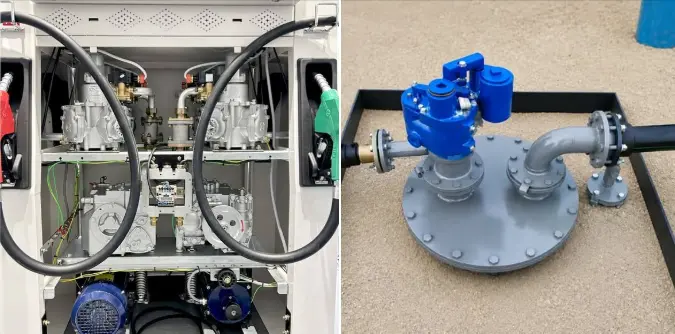
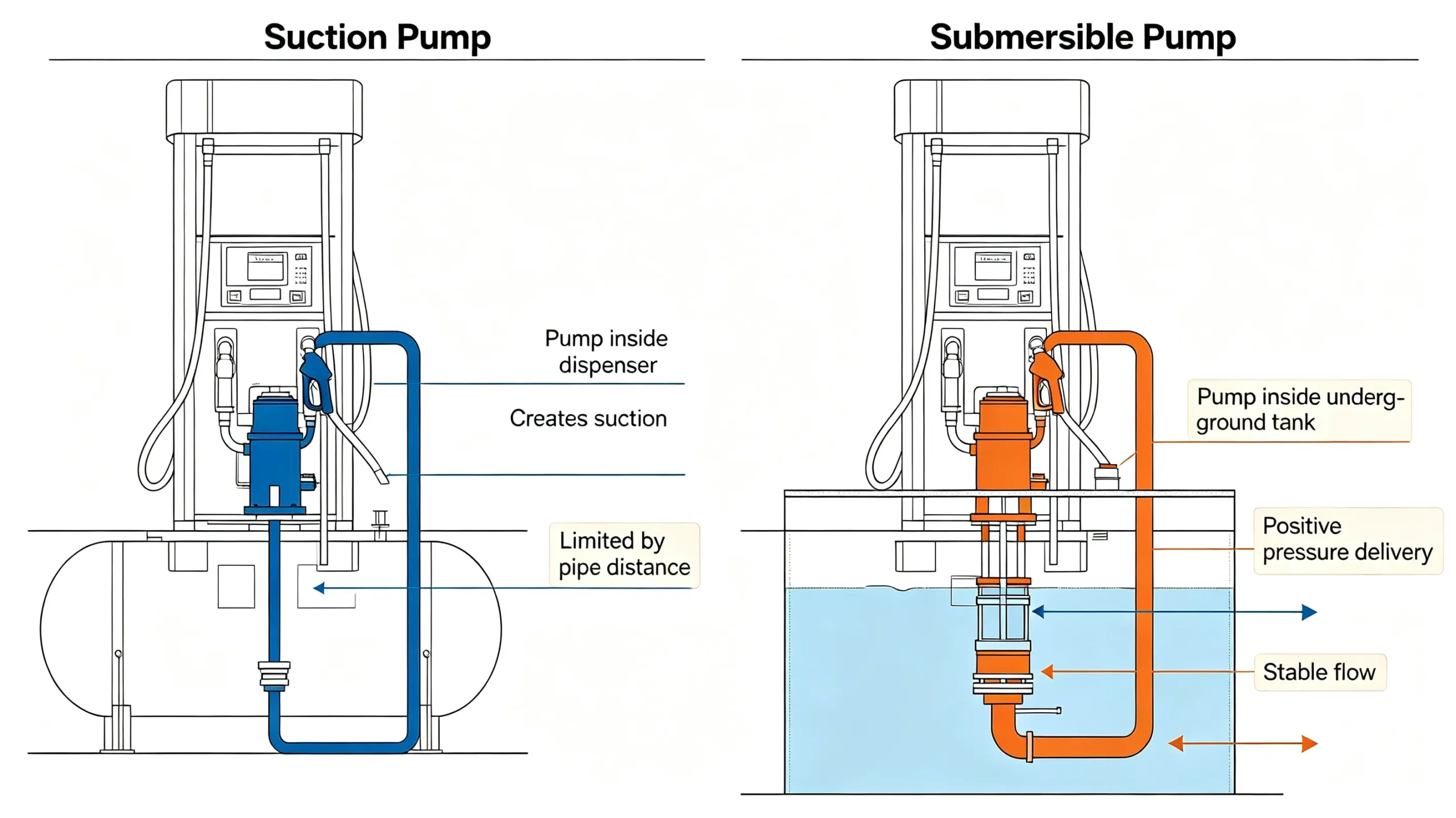
A suction pump is installed inside the fuel dispenser.
It creates negative pressure and pulls fuel from the underground storage tank through the product piping.
The basic fuel delivery path is:
Underground Fuel Tank → Product Piping → Suction Pump → Fuel Dispenser → Nozzle
This configuration can be suitable for smaller fuel stations where the underground tank is relatively close to the dispenser and the required fuel demand is limited.
However, the system relies on suction performance. As suction distance, pipeline resistance, temperature, and system complexity increase, maintaining stable fuel delivery becomes more challenging.
Submersible Pump — Fuel Is Pushed From the Tank
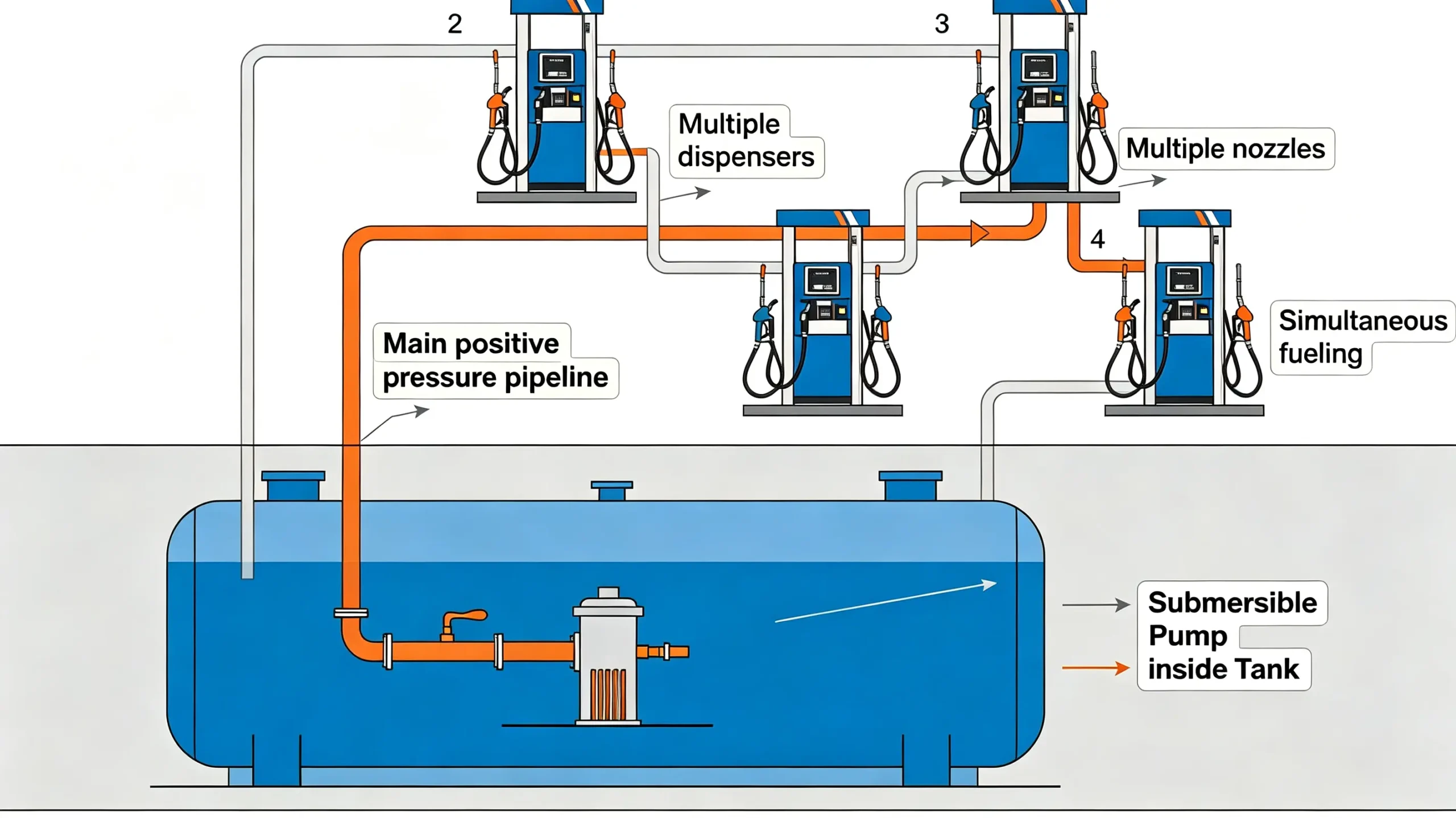
A submersible pump is installed inside the underground fuel tank, where it remains submerged in fuel.
Instead of pulling fuel toward the dispenser, the pump creates positive pressure and pushes fuel through the product piping.
The basic system is:
Submersible Pump → Product Piping → Fuel Dispenser → Nozzle
This configuration is widely used for commercial fuel stations because it can support multiple dispensers and longer product piping layouts.
It also allows the main fuel pump motor to remain outside the fuel dispenser cabinet, which can simplify the dispenser-side mechanical configuration.
2. Suction vs. Submersible: Quick Comparison
Before choosing a system, it is useful to compare the two configurations directly.
| Feature | Suction Pump System | Submersible Pump System |
|---|---|---|
| Pump location | Inside fuel dispenser | Inside underground tank |
| Fuel delivery principle | Negative pressure / suction | Positive pressure |
| Typical application | Small and low-demand stations | Commercial and higher-demand stations |
| Multiple fueling positions | More limited | Better suited |
| Long product piping | More challenging | More flexible |
| Pump motor location | Inside dispenser | Inside underground tank |
| Initial equipment cost | Generally lower | Generally higher |
| Future expansion | More limited | Better suited |
| Dispenser-side mechanical components | More | Fewer |
The important point is that neither system should be selected based on pump price alone.
The complete fuel delivery system should be considered, including the tank, pump, piping, valves, filters, dispensers, nozzles, electrical supply, and expected fueling demand.
3. Why Submersible Pumps Are Better for Tropical Markets
For gas stations operating in hot climates, fuel delivery stability becomes especially important.
Countries such as Nigeria, Kenya, Vietnam, Indonesia, Pakistan, and other tropical or high-temperature markets may experience challenging operating conditions.
① Zero Vapor Lock in High Temperature
Suction pumps rely on negative pressure.
In hot climates, gasoline can vaporize more easily inside the product piping. This can contribute to vapor lock, slow fuel delivery, intermittent flow, or even fuel supply interruption.
Submersible pumps deliver fuel using positive pressure.
This greatly reduces the dependence on suction conditions and helps provide more stable fuel delivery.
The flow rate remains consistent in 40℃+ hot weather, making the system suitable for demanding high-temperature operating environments.
For stations operating in hot regions, this is one of the major reasons why submersible systems are often preferred.
Planning a new gas station? Contact us with your tank capacity, number of dispensers, and required flow rate to discuss the right fuel delivery configuration.
4. Multi-Nozzle Fueling: Why Pump Capacity Matters
A fuel station is not only about the pump itself.
The pump must be matched with the number of dispensers, number of nozzles, expected simultaneous fueling demand, and required flow rate.
A suction pump typically supports 1 to 2 nozzles, while a large commercial station may require several fueling positions operating during peak hours.
A submersible system can be designed to supply 4–8 fuel nozzles working at the same time.
This makes it more suitable for busy commercial stations where several vehicles may need to refuel simultaneously.
However, the actual number of dispensers or nozzles that one pump can support should always be determined by the pump’s rated flow, piping design, pressure loss, product type, and simultaneous-use requirements.
Don’t Choose the Pump Separately From the Dispenser
This is an important point for a complete fuel station project.
The pump, dispenser, piping, nozzle, filter, valve, and electrical system should be treated as one integrated system.
The pump capacity should be matched with the required dispenser flow rate and the expected number of simultaneous fueling positions.
For example, a higher-flow dispenser does not automatically mean that a higher-capacity pump is required in every situation. The actual system must be hydraulically matched.
5. Long-Distance Pipeline Layout
The distance between an underground fuel tank and a fuel dispenser can significantly affect system design.
The complete dispenser layout should therefore be considered together with tank location, product piping, traffic flow, and required safety distances.
Suction pumps have a strict distance limit.
When the tank is over 25–30 meters away from dispensers, suction pumps cannot work normally.
As the pipeline becomes longer, the system must overcome additional friction losses and other resistance.
Submersible pumps use positive pressure to push fuel from the underground tank toward the dispenser.
This makes them more suitable for longer product piping and more flexible station layouts.
For large fuel stations, this can be an important advantage because underground tanks, dispensers, traffic lanes, and buildings cannot always be arranged close together.
6. Maintenance and Reliability
Another important difference is where the pump motor is installed.
With a suction system, the main pump is located inside the fuel dispenser.
This means the dispenser cabinet contains additional mechanical components that require inspection and maintenance.
With a submersible system, the pump is installed inside the underground storage tank.
The fuel dispenser itself can therefore have fewer major mechanical pumping components.
Submersible pumps are also surrounded by fuel, which helps transfer heat away from the motor during operation.
For commercial stations with high daily fueling volumes, separating the pump function from the dispenser can simplify the overall equipment configuration.
7. Initial Cost vs. Long-Term Operating Cost
One reason some small station owners choose suction systems is the lower initial equipment cost.
For a very small station with:
- Few fueling positions
- Short product piping
- Low daily fuel demand
- Limited expansion plans
a suction system can be a practical solution.
However, the lowest initial price does not always mean the lowest long-term cost.
For medium and large commercial stations, a submersible system can provide several advantages:
- Better support for multiple dispensers
- More flexible underground piping layouts
- Reduced dependence on suction conditions
- Easier future expansion
- Better suitability for high-throughput stations
- Less mechanical pumping equipment inside the dispenser
Therefore, project owners should compare total system cost, rather than comparing only the purchase price of the pump.
8. Electrical Supply: 220V vs. 380V
Electrical configuration is another important part of fuel station equipment selection.
Depending on the dispenser model and system configuration, fuel station equipment may use AC 220V or AC 380V power supplies.
The correct selection depends on:
- Local electrical standards
- Available power supply
- Dispenser configuration
- Pump motor requirements
- Total station electrical load
- Number of dispensers
- Control system requirements
For example, your fuel dispenser range includes different models and configurations, so the electrical configuration should be confirmed according to the specific project rather than selecting 220V or 380V only by dispenser size.
For an international project, it is important to confirm the local voltage, frequency, phase configuration, grounding requirements, and motor specifications before final equipment selection.
9. How to Choose the Right System for Your Gas Station
So, which system should you choose?
Choose a Suction Pump System When:
A suction system may be suitable when:
- The station is small
- There are only a few fueling positions
- Product piping is relatively short
- Fuel demand is low
- The project has a limited initial budget
- Future expansion is not a major requirement
Choose a Submersible Pump System When:
A submersible system is generally more suitable when:
- The station has multiple dispensers
- Several nozzles may operate simultaneously
- Product piping is relatively long
- The station has high daily fuel demand
- The project requires future expansion
- Stable fuel delivery is a priority
- The station operates in a hot climate
For most new commercial stations with multiple dispensers and future expansion plans, a submersible pump system is the more flexible solution.
10. Match the Pump With the Right Fuel Dispenser
Choosing a pump is only one part of a complete fuel station project.
The pump must work together with the fuel dispenser, flow meter, solenoid valve, nozzle, hose, piping, valves, electrical system, and underground storage tank.
A mismatch between these components can result in:
- Insufficient flow
- Excessive pressure loss
- Unstable fueling
- Slow dispensing
- Increased maintenance requirements
- Difficult future expansion
For this reason, the fuel dispenser should be selected together with the complete underground fuel delivery system.
Our fuel dispenser range includes YX Series, ZC Series, SH Series, ZY Series, XF Series, LB Series, PB Series, and QT3X Custom Refueling Machine, providing different configurations for different fuel station applications.
The right combination depends on your required flow rate, number of nozzles, pump configuration, voltage, pipeline layout, and station capacity.
Need help matching a submersible pump with the right fuel dispenser? Contact us with your station layout, required flow rate, number of nozzles, and local power supply.
Final Recommendation
The decision between a suction pump and a submersible pump should not be based simply on which pump is cheaper.
A small station with short piping and limited fueling demand may benefit from a suction system.
A commercial station with multiple dispensers, longer pipelines, high traffic, and future expansion requirements will generally benefit more from a submersible pump system.
Before purchasing equipment, evaluate:
Station size → Tank capacity → Pump flow → Pipeline length → Number of dispensers → Number of simultaneous nozzles → Electrical supply → Future expansion
A properly matched fuel delivery system can improve operational stability and make future station expansion much easier.
Planning a New Gas Station or Upgrading an Existing One?
Send us your tank capacity, dispenser quantity, required flow rate, pipeline distance, and local power supply. Our team can help you evaluate the appropriate fuel dispenser and underground fuel delivery configuration.