
6-Nozzle vs. 8-Nozzle Fuel Dispenser: Which Is Right for Your Gas Station?
News 2026年 8月 27日 75
Choosing the right fuel dispenser configuration is an important decision when building a new gas station or upgrading an existing fueling station.
One of the most common questions is whether to use a 6-nozzle or 8-nozzle fuel dispenser.
The answer depends mainly on the number of fuel products, required fueling positions, station layout, expected traffic and overall fuel delivery system.
An 8-nozzle dispenser is not automatically better than a 6-nozzle dispenser. The right choice is the configuration that matches the actual requirements of the gas station.
This guide explains the differences between 6-nozzle and 8-nozzle fuel dispensers and the key factors to consider before purchasing.
1. What Is a 6-Nozzle Fuel Dispenser?
A 6-nozzle fuel dispenser is designed to provide up to six dispensing nozzles within one dispenser configuration.
Depending on the dispenser design, these nozzles can be configured for different fuel products.
For example, a station may need to dispense:
- Gasoline
- Diesel
- Different gasoline grades
A 6-nozzle configuration can therefore provide multiple fuel options while maintaining a relatively compact dispenser arrangement.
It may be suitable for small to medium-sized gas stations or projects where the number of fuel products and dispensing positions is moderate.
However, the actual configuration should always be determined according to the project requirements and applicable local regulations.
2. What Is an 8-Nozzle Fuel Dispenser?
An 8-nozzle fuel dispenser provides up to eight dispensing nozzles in one dispenser configuration.
The additional nozzles can provide greater flexibility when a station needs to handle multiple fuel products or provide more fueling options from a single dispenser.
An 8-nozzle configuration may be considered for:
- Medium to large gas stations
- Stations selling multiple fuel products
- Locations with higher fueling demand
- Projects requiring more dispensing flexibility
However, more nozzles also mean that the fuel supply, piping, electrical system and overall dispenser configuration need to be properly designed.
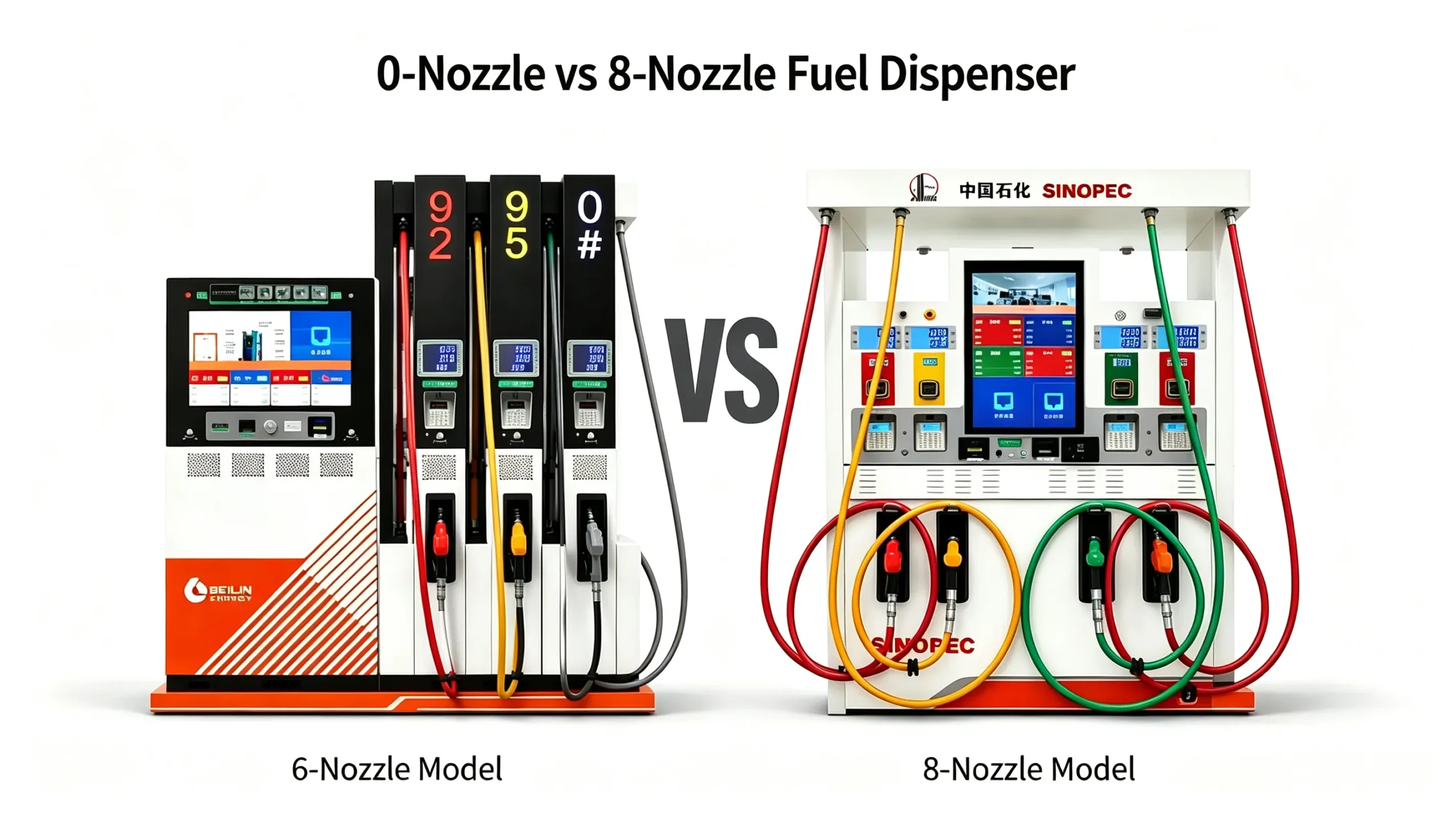
3. 6-Nozzle vs. 8-Nozzle Fuel Dispenser
The main difference is the number of available nozzles and the flexibility of the dispenser configuration.
| Feature | 6-Nozzle Dispenser | 8-Nozzle Dispenser |
|---|---|---|
| Number of nozzles | Up to 6 | Up to 8 |
| Fuel product flexibility | High | Higher |
| Configuration flexibility | High | Higher |
| Equipment complexity | Relatively lower | Relatively higher |
| Suitable applications | Small to medium projects | Medium to large or multi-product projects |
| Space requirements | Usually lower | May be higher |
| Piping connections | Generally fewer | Generally more |
| Initial equipment cost | May be lower | May be higher |
These are general selection considerations rather than universal rules.
The final choice should be based on the complete station design.
4. Does More Nozzles Mean a Higher Fueling Speed?
Not necessarily.
The number of nozzles and the flow rate are two different specifications.
For example, an 8-nozzle dispenser does not automatically deliver fuel faster than a 6-nozzle dispenser.
Actual fueling performance can depend on:
- Fuel dispenser flow rate
- Submersible pump capacity
- Underground piping
- Pipe diameter
- Pipe length
- Filters
- Valves
- Nozzle performance
- Fuel product
- Simultaneous fueling demand
This is why the dispenser should be considered together with the complete fuel delivery system.
If you want to understand how flow rate affects fuel dispenser performance, see our guide on fuel dispenser flow rate.
5. How Does Fuel Product Quantity Affect Nozzle Selection?
The number of fuel products is one of the most important factors when selecting a multi-nozzle dispenser.
For example, a station may sell:
- Regular gasoline
- Premium gasoline
- Diesel
- Other fuel grades
If more fuel products need to be available at the same fueling position, a dispenser with more nozzles may provide greater configuration flexibility.
However, the number of nozzles should not be increased simply because a larger configuration is available.
The dispenser should be designed around the actual fuel products that the station will sell.
6. 6 Nozzles or 8 Nozzles: Which Is Better for a Small Gas Station?
For a small gas station with fewer fuel products and moderate traffic, a 6-nozzle configuration may be sufficient.
A simpler configuration can help avoid unnecessary equipment complexity and may provide a more practical solution for the available site space.
However, if the station sells multiple fuel grades or is expected to expand its fuel product range, an 8-nozzle configuration may provide additional flexibility.
The best approach is to consider both the current requirements and possible future expansion.
7. Which Configuration Is Better for a Busy Gas Station?
For a busy gas station with multiple fuel products and higher customer demand, an 8-nozzle dispenser may provide more flexibility.
It can allow more fuel products to be available at the same dispenser configuration.
However, the number of nozzles alone does not determine the overall throughput of a station.
The complete system should also be considered, including:
- Number of dispensers
- Number of nozzles
- Fuel dispenser flow rate
- Submersible pump capacity
- Underground piping
- Tank capacity
- Expected simultaneous fueling
A station with more nozzles but an undersized fuel delivery system may not achieve the expected performance.
Not sure whether your station needs a 6-nozzle or 8-nozzle dispenser? Send us your fuel products and station requirements, and we can help evaluate the suitable configuration.
8. How Do Nozzle Quantity and Underground Piping Work Together?
Each additional fuel product or dispensing configuration may require additional fuel supply connections.
Therefore, the underground piping system needs to be designed together with the dispenser configuration.
A typical fuel delivery path is:
Underground Storage Tank → Submersible Pump → Underground Fuel Piping → Fuel Dispenser → Nozzle
When designing the system, engineers should consider:
- Number of fuel products
- Number of dispensers
- Pipe diameter
- Pipe length
- Number of branches
- Pump capacity
- Expected simultaneous demand
This is particularly important for larger stations with multiple dispensers.
For more information about underground fuel delivery systems, see our article on underground fuel piping.
9. How Does the Submersible Pump Affect a 6-Nozzle or 8-Nozzle Dispenser?
The dispenser configuration and the submersible pump system should be properly matched.
A submersible pump needs to provide sufficient flow and pressure for the connected dispensing system.
For example, if several nozzles are expected to operate at the same time, the pump and piping system need to be evaluated based on the expected simultaneous demand.
This means that an 8-nozzle dispenser does not necessarily require a pump capable of supplying the maximum rated flow to all eight nozzles simultaneously.
The actual pump selection depends on the complete system design.
For projects using a submersible turbine pump system, you can also read our guide to submersible fuel pumps.
10. What About Space and Station Layout?
The physical layout of the gas station is another important factor.
Before selecting a 6-nozzle or 8-nozzle dispenser, consider:
- Available space
- Number of fueling positions
- Vehicle circulation
- Distance between dispensers
- Underground piping layout
- Tank location
- Maintenance access
- Safety requirements
An 8-nozzle dispenser may provide more fuel product options, but the additional configuration should fit the planned fueling island and overall station layout.
The dispenser should therefore be selected before finalizing the equipment layout, while maintaining coordination with the other parts of the fuel station system.
11. 6-Nozzle vs. 8-Nozzle: A Simple Selection Guide
A simple approach is:
Choose a 6-Nozzle Configuration When:
- The station has a moderate number of fuel products
- The project has moderate fueling demand
- Space is relatively limited
- A simpler configuration is preferred
- Future fuel product expansion is not a major requirement
Consider an 8-Nozzle Configuration When:
- The station sells multiple fuel products
- More fuel options are required at the same dispenser
- The station has higher expected demand
- Greater configuration flexibility is needed
- Future expansion is being considered
Again, these are general guidelines.
The actual dispenser configuration should be confirmed based on the project design and local requirements.
12. What Other Specifications Should Be Checked?
Nozzle quantity is only one part of fuel dispenser selection.
Before placing an order, the following specifications should also be confirmed:
Flow Rate
Check the required flow rate in L/min.
For example:
- 40 L/min
- 50 L/min
- Higher flow configurations where applicable
Fuel Products
Confirm which fuel products will be dispensed.
Pumping System
Determine whether the project uses:
- Submersible turbine pumps
- Self-priming fuel dispensers
Power Supply
Confirm:
- Voltage
- Phase
- Frequency
Metering Accuracy
Check the required fuel measurement accuracy.
Vapor Recovery
Determine whether vapor recovery is required and how it will connect with the dispenser.
Explosion Protection and Local Standards
The dispenser and electrical system should meet the applicable requirements of the destination country and project.
13. 6-Nozzle and 8-Nozzle Fuel Dispensers for Different Projects
There is no single dispenser configuration that is suitable for every gas station.
For example:
Small Station
A 6-nozzle dispenser may provide sufficient flexibility for a station with fewer fuel products.
Medium Station
Either a 6-nozzle or 8-nozzle configuration may be suitable depending on fuel products and station layout.
Large or Multi-Product Station
An 8-nozzle configuration may provide greater flexibility when multiple fuel products need to be available.
The final configuration should be based on the complete project requirements rather than station size alone.
14. Our Multi-Nozzle Fuel Dispenser Options
We provide different fuel dispenser configurations for different gas station applications.
Our product range includes models with different nozzle configurations, flow rates and power requirements.
For projects requiring multiple fuel products, our SH Series and ZC Series can be considered among the available multi-nozzle configurations.
The exact model should be selected according to:
- Number of nozzles
- Fuel products
- Flow rate
- Pumping system
- Power supply
- Vapor recovery requirements
- Destination country
- Applicable standards
15. What Information Should You Provide When Requesting a Fuel Dispenser?
If you are unsure whether your project needs a 6-nozzle or 8-nozzle dispenser, providing basic project information can help determine a suitable configuration.
Please provide:
- Number of fuel dispensers
- Required nozzle quantity
- Fuel products
- Required flow rate
- Fuel tank capacity
- Submersible pump information
- Underground piping information
- Power supply
- Vapor recovery requirements
- Project location
- Gas station layout, if available
With this information, the dispenser configuration can be evaluated together with the overall fuel delivery system.
Need Help Choosing Between a 6-Nozzle and 8-Nozzle Fuel Dispenser?
The best fuel dispenser is not necessarily the one with the most nozzles.
The right configuration should match your:
Fuel products + nozzle requirements + flow rate + pumping system + underground piping + station layout + expected demand
If you are planning a new gas station or upgrading an existing station, send us your project requirements.
Our team can help evaluate a suitable fuel dispenser configuration for your project.