
Complete Fuel Dispenser System Design for Gas Stations: Configuration, Pump Selection & Safety
News 2026年 9月 3日 95
Introduction
Have you ever wondered what it really takes to build a reliable fuel‑dispenser system for your gas station?
Many new‑build and renovation projects run into costly delays simply because buyers select dispensers first, without planning the full system. A fuel dispenser never works alone. It must pair correctly with underground tanks, pumps, piping, safety devices and control systems.
This practical guide walks you through complete fuel‑dispenser system design, equipment configuration, pump matching and scenario‑based planning. It is made for gas‑station owners, contractors, distributors and project developers, to help you pick a well‑matched, long‑lasting fuel‑dispensing solution.
1. What Is a Complete Fuel Dispenser System?
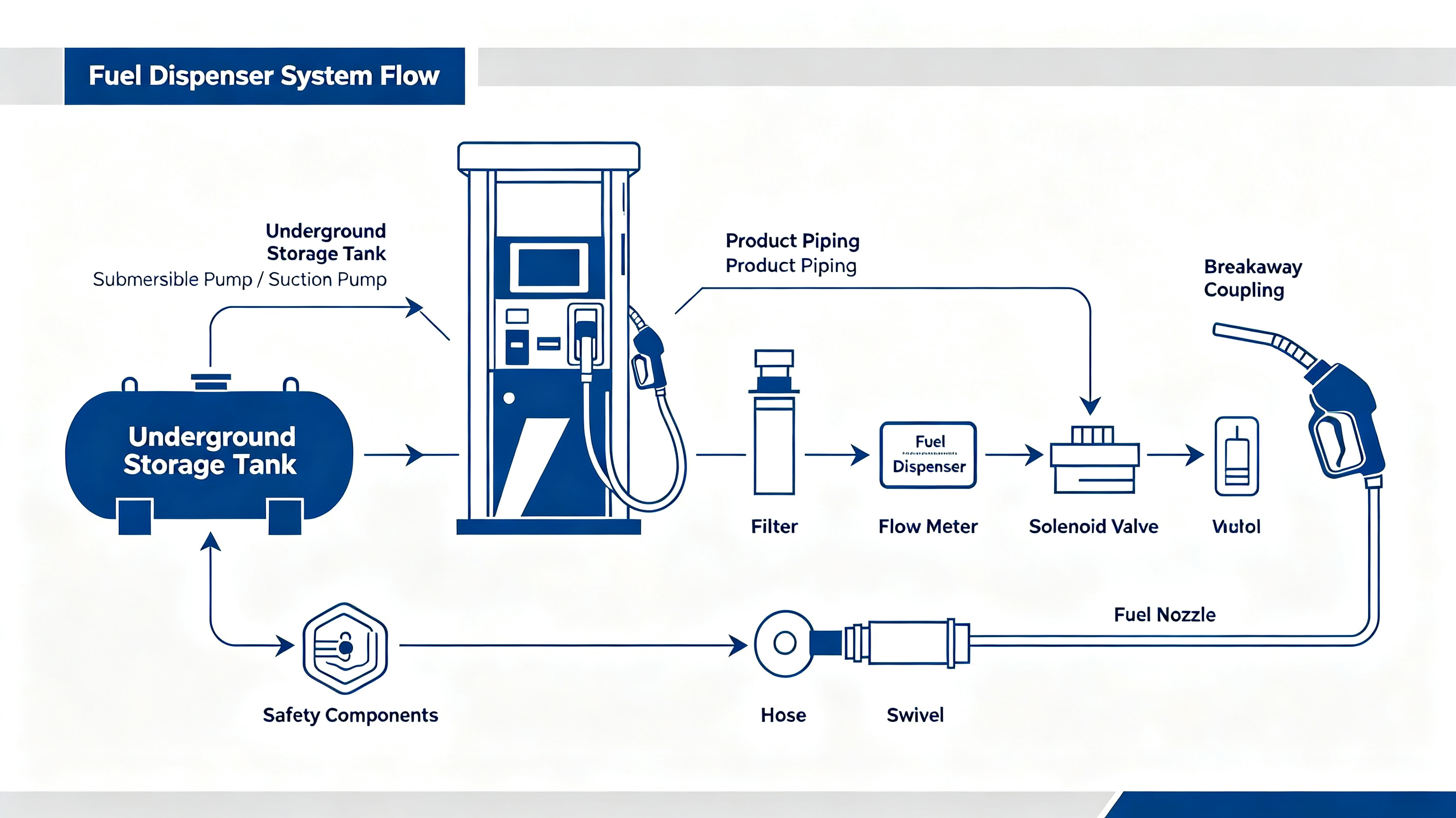
A complete fuel dispenser system is an integrated fuel delivery and dispensing system that transfers fuel from underground storage tanks to vehicles while controlling fuel flow and measuring the quantity dispensed.
A typical system can be represented as:
Underground Storage Tank
↓
Submersible Pump or Suction Pump
↓
Product Piping
↓
Safety and Isolation Components
↓
Fuel Dispenser
↓
Filter
↓
Flow Meter
↓
Solenoid Valve
↓
Hose
↓
Swivel
↓
Breakaway Coupling
↓
Fuel Nozzle
Depending on the project, the system may also include:
- Vapor recovery system
- Emergency shut-off system
- Grounding and bonding system
- Lightning protection
- Leak detection
- Station management system
- Payment interface
- Remote monitoring
The final configuration should be determined according to the fuel type, number of fueling positions, expected demand, site layout, local regulations, and equipment specifications.
2. Main Components of a Gas Station Fuel Dispenser System
2.1 Underground Fuel Storage
The underground storage tank is the starting point of the fuel delivery system.
Tank monitoring and inventory measurement are also important parts of underground fuel storage management. A gas station level gauge can help monitor fuel levels and support inventory management.
The tank stores different fuel products and connects to the pump and product piping system.
The design should consider:
- Tank capacity
- Number of tanks
- Fuel grades
- Fuel type
- Tank fittings
- Manhole configuration
- Pump installation
- Leak detection
- Secondary containment requirements
The storage system should be designed before finalizing the dispenser configuration because the number and type of fuel products directly affect the required number of dispenser connections.
2.2 Submersible Pump or Suction Pump
The pump transfers fuel from the underground tank to the dispenser.
There are two common arrangements:
Submersible Pump System
The submersible pump is installed inside the underground storage tank and pushes fuel through the product piping toward the dispensers.
This arrangement is commonly used for systems requiring centralized fuel supply to multiple dispensing positions.
Suction Pump System
The pump is integrated into the dispenser or its hydraulic system and draws fuel from the underground tank.
The choice between the two systems depends on:
- Station size
- Number of dispensers
- Pipeline configuration
- Required flow
- Pumping distance
- Elevation
- Maintenance requirements
- Local project conditions
For a detailed comparison, customers can also refer to your existing article on submersible pump vs. suction pump systems.
3. How to Determine the Fuel Dispenser Configuration
The dispenser should be configured according to the actual station requirements.
The main factors are:
- Fuel types
- Fuel grades
- Number of fueling positions
- Expected traffic
- Simultaneous fueling demand
- Required flow rate
- Pump configuration
- Site layout
3.1 Determine the Fuel Types
First determine what fuels the station will sell.
For example:
- Gasoline
- Diesel
- Other approved fuels depending on the market
Different fuel products may require separate product paths and dispenser configurations.
3.2 Determine the Number of Fuel Grades
A station selling multiple gasoline grades may require more product connections than a station selling only one gasoline grade and diesel.
Therefore:
Fuel grades → Product connections → Nozzles → Dispenser configuration
should be considered as one chain.
3.3 Determine the Number of Nozzles
Common dispenser configurations include:
- 2-nozzle
- 4-nozzle
- 6-nozzle
- 8-nozzle
The correct configuration depends on the number of fuel products and fueling positions.
More nozzles are not automatically better.
A dispenser should provide enough fueling options without creating unnecessary equipment cost or complexity.
4. How to Determine the Required Flow Rate
Fuel dispenser flow rate is another critical parameter when designing a fuel dispenser system.
The required flow rate should be considered together with:
- Fuel type
- Nozzle type
- Expected fueling speed
- Pump capacity
- Product piping
- Simultaneous operation
- Applicable local requirements
A high-flow dispenser cannot achieve its intended performance if the pump or piping system cannot supply the required fuel volume.
Similarly, excessive pump capacity may increase equipment and operating costs without providing a meaningful benefit for a low-demand station.
The correct approach is to evaluate:
Required fueling demand → Dispenser flow → Simultaneous operation → Piping loss → Pump operating point
before selecting the final equipment.
5. How to Match the Pump With the Fuel Dispenser
The pump and dispenser should be designed as one hydraulic system.
For a submersible pump system, pump selection should consider:
- Required flow
- Number of dispensers
- Number of fueling positions
- Simultaneous fueling demand
- Product piping length
- Pipe diameter
- Elevation difference
- Filters
- Valves
- Fittings
- Fuel characteristics
A simple comparison based only on horsepower is not enough.
For example, a higher-HP pump does not automatically provide better system performance if the piping configuration, operating point, or dispenser requirements are not properly matched.
The final pump should be selected according to the actual hydraulic requirements of the project.
Need Help Matching the Pump With Your Fuel Dispenser?
Pump capacity should be matched with the dispenser flow rate, piping configuration, and expected simultaneous demand.
Send us your tank capacity, dispenser quantity, required flow rate, pipeline length, and power supply. Our team can help you evaluate the appropriate pump and dispenser configuration for your project.
6. Fuel Dispenser System Electrical Configuration
Electrical requirements should be confirmed before equipment procurement.
The design should consider:
- Supply voltage
- Phase
- Frequency
- Motor power
- Control system
- Communication
- Grounding
- Emergency shut-off circuit
- Explosion-protection requirements
220 V and 380 V should not simply be treated as fixed rules for small and large stations.
The correct power configuration depends on the equipment model, motor design, local electrical supply, and project requirements.
Before purchasing equipment, confirm:
Voltage + Phase + Frequency + Motor Power + Control Requirements
with the equipment supplier.
7. Fuel Dispenser Safety Design
Safety should be integrated into the system from the beginning.
Depending on the project, the system may require:
- Emergency shut-off
- Shear valve
- Breakaway coupling
- Grounding and bonding
- Lightning protection
- Explosion-protected electrical equipment
- Leak detection
- Vapor recovery
- Spill prevention
- Fire protection equipment
The exact requirements depend on the fuel type, hazardous-area classification, local fire regulations, electrical standards, environmental requirements, and project location.
Site planning and safety distances should also be considered during the early design stage. See our guide to gas station location requirements for additional planning considerations.
There is no single worldwide safety standard that can be applied identically to every gas station.
A professional project should therefore identify the applicable local standards before equipment specifications are finalized.
8. Fuel Dispenser System Design for Different Applications
8.1 Small Community Gas Stations
A small station with relatively low traffic may require:
- 2-nozzle or 4-nozzle dispensers
- Standard-flow dispensing
- Gasoline and/or diesel
- Basic electronic control
- Suction or submersible pump system
- Required safety equipment
The objective is to create a reliable system without excessive equipment capacity.
8.2 Large Commercial Gas Stations
A larger commercial station may require:
- Multiple dispensers
- 6-nozzle or 8-nozzle configurations
- Multiple fuel grades
- Multiple fueling positions
- Submersible pump systems
- Higher-flow applications
- Centralized management
- Payment integration
- Vapor recovery
- Additional monitoring
The final configuration should be based on expected demand rather than simply selecting the largest available dispenser.
8.3 Existing Gas Station Renovation
Renovation projects require additional compatibility checks.
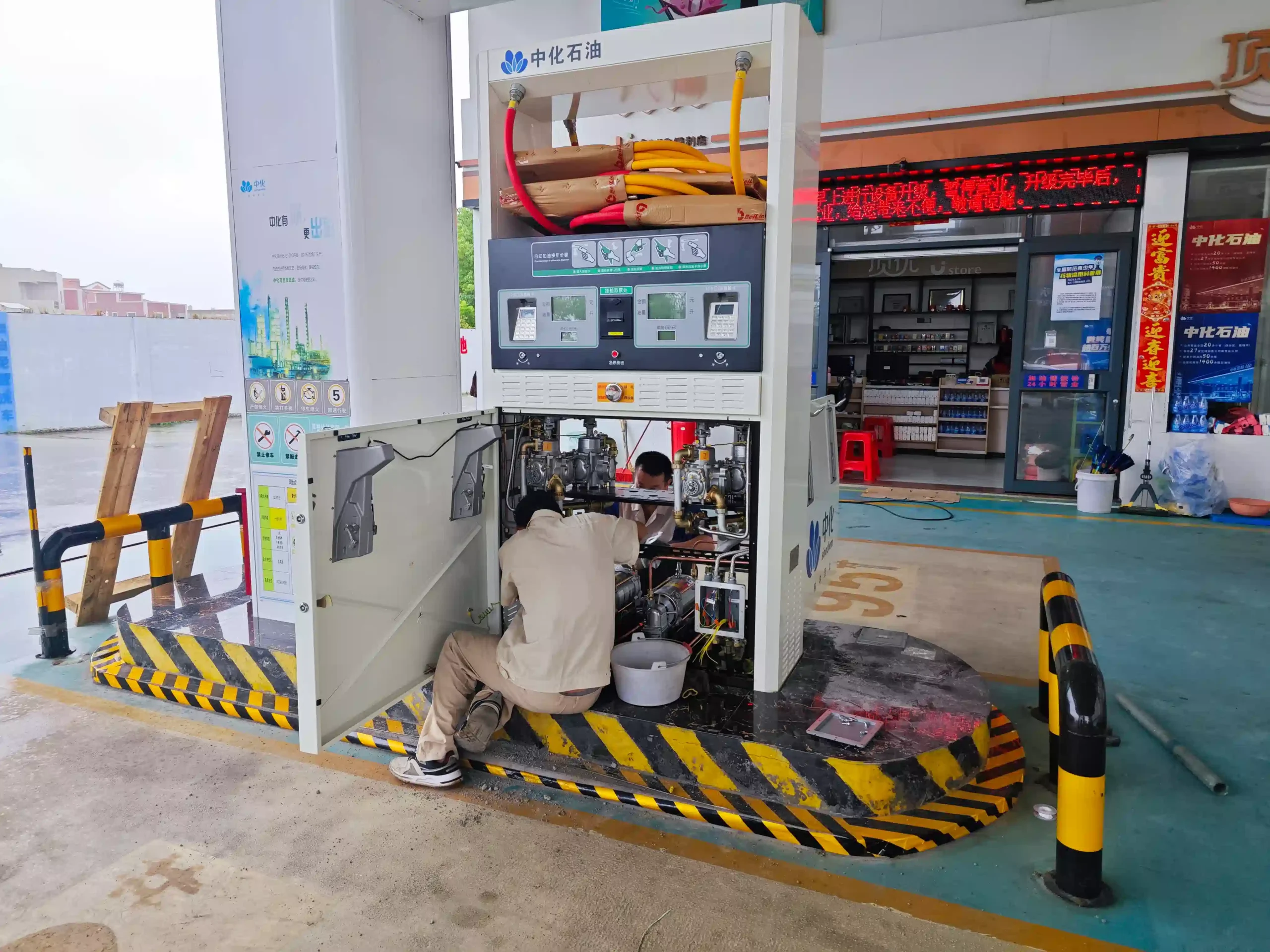
The dispenser layout should also be reviewed together with the existing fueling island, piping connections, vehicle access, and safety distances. For more information, see our guide to fuel dispenser installation layout requirements.
Before replacing a dispenser, inspect:
- Existing tanks
- Existing piping
- Pump system
- Electrical supply
- Vapor recovery
- Communication system
- Existing safety equipment
- Available installation space
A new dispenser should be compatible with the existing infrastructure or the required modifications should be identified before procurement.
9. How to Choose the Right Fuel Dispenser
Before selecting a specific dispenser model, confirm:
Fuel Type
What fuel will be dispensed?
Number of Fuel Grades
How many products need to be available?
Number of Nozzles
How many fueling options are required?
Flow Rate
What dispensing speed is required?
Pump Type
Will the station use a suction or submersible pump system?
Electrical Supply
What voltage, phase, and frequency are available?
Communication
Does the station require POS or centralized management?
Vapor Recovery
Does the project require vapor recovery equipment?
Certification
What certifications and approvals are required in the target market?
Once these parameters are confirmed, the appropriate dispenser model can be selected.
Explore our fuel dispenser range to compare different dispenser configurations for gas station applications.
10. Common Fuel Dispenser System Design Mistakes
Mistake 1: Choosing the Dispenser First
The dispenser should not be selected before understanding the complete fuel system.
Use this sequence:
Fuel Type → Fuel Grades → Fueling Positions → Flow → Pump → Piping → Dispenser
Mistake 2: Selecting the Pump Only by HP
HP is only one parameter.
The pump should be matched according to the complete hydraulic system.
Mistake 3: Ignoring Simultaneous Fueling Demand
The number of nozzles does not mean all nozzles will operate simultaneously.
The pump and piping should be designed according to realistic operating conditions.
Mistake 4: Ignoring Existing Infrastructure
This is particularly important during gas station renovation.
The new dispenser must be checked against the existing piping, pump, electrical system, vapor recovery, and communication system.
Mistake 5: Choosing Only by Purchase Price
The lowest equipment price does not always result in the lowest project cost.
Consider:
- Reliability
- Metering performance
- Spare parts
- Maintenance
- Technical support
- Compatibility
- After-sales service
11. What Information Is Needed for a Customized System?
For a customized fuel dispenser system, provide:
Project Information
- Country
- City
- New construction or renovation
- Number of dispensers
- Number of fueling positions
- Fuel types
- Fuel grades
- Tank capacity
Technical Information
- Suction or submersible system
- Required flow
- Pipeline length
- Pipeline diameter
- Voltage
- Frequency
- Communication requirements
- Vapor recovery requirements
Commercial Information
- Required quantity
- Delivery destination
- Installation support
- Spare parts
- Certification requirements
- After-sales requirements
With these details, the supplier can develop a more accurate equipment configuration and quotation.
12. Final Recommendation
A complete fuel dispenser system should not be designed around the dispenser alone.
The entire system should be coordinated:
Tank → Pump → Piping → Dispenser → Meter → Valve → Hose → Nozzle → Control → Safety
The right configuration depends on the fuel type, fuel grades, fueling positions, required flow, pump system, piping, electrical supply, site layout, local regulations, and long-term maintenance requirements.
If you are planning a new gas station, upgrading an existing station, or sourcing fuel dispensing equipment, send us your project information.
Xing Zhong Yuan Energy provides gas station equipment supply chain services, including equipment selection, customized fuel dispenser configuration, technical coordination, and after-sales support.
Contact our team for a customized fuel dispenser system solution and quotation.