
Fuel Dispenser Voltage: 220V vs. 380V, Which Should You Choose?
News 2026年 8月 29日 35
Choosing the correct power supply is an important part of selecting a fuel dispenser for a gas station project.
When purchasing fuel dispensers, buyers may encounter specifications such as AC220V and AC380V. However, voltage is only one part of the electrical requirements.
The correct choice depends on the local power grid, single-phase or three-phase supply, dispenser configuration, pumping system and applicable local requirements.
This guide explains the difference between 220V and 380V fuel dispensers and what buyers should confirm before placing an order.
1. What Voltage Does a Fuel Dispenser Use?
Fuel dispensers can be designed with different power supply configurations depending on the model and project requirements.
Common specifications may include:
- AC220V
- AC380V
- Different frequency requirements
- Single-phase or three-phase power
The exact power supply should always be confirmed according to the dispenser model and destination market.
For an international gas station project, buyers should not select a voltage only based on the country name. The actual electrical supply available at the project site should be confirmed.
2. What Is a 220V Fuel Dispenser?
A 220V fuel dispenser is designed to operate with a rated power supply of approximately 220V AC, depending on the specific model and electrical design.
A 220V configuration may be suitable when the project site provides the required single-phase or corresponding power supply.
Before ordering, buyers should confirm:
- Rated voltage
- Phase
- Frequency
- Total electrical load
- Connection requirements
- Local electrical standards
A 220V dispenser should be selected based on the actual electrical conditions of the project rather than simply because 220V is considered a common voltage.
3. What Is a 380V Fuel Dispenser?
A 380V fuel dispenser is designed for a rated power supply of approximately 380V AC according to the equipment configuration.
380V systems are commonly associated with three-phase industrial power supplies.
For a gas station project with multiple electrical loads, the overall electrical system may include:
- Fuel dispensers
- Submersible pumps
- Lighting
- Control systems
- Other gas station equipment
The electrical design should therefore consider the complete station rather than the dispenser alone.
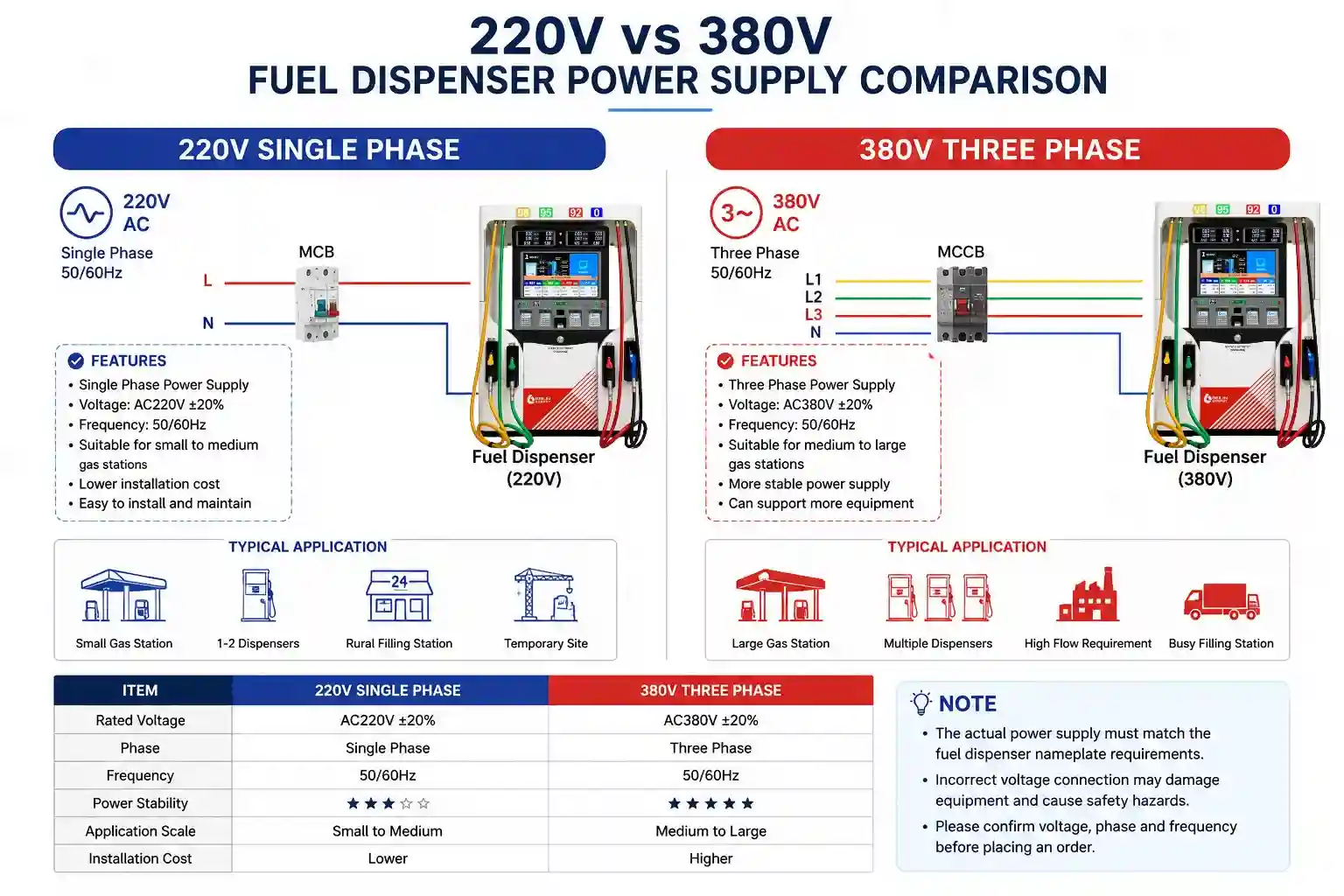
4. 220V vs. 380V Fuel Dispenser: What Is the Difference?
The main difference is the rated power supply and corresponding electrical configuration.
| Feature | 220V Fuel Dispenser | 380V Fuel Dispenser |
|---|---|---|
| Rated voltage | Approximately 220V AC | Approximately 380V AC |
| Typical phase | Often single-phase, depending on model | Typically three-phase |
| Electrical system | Lower-voltage configuration | Higher-voltage three-phase configuration |
| Site requirement | Must match available power supply | Must match available three-phase supply |
| Application | Depends on dispenser model and project | Depends on dispenser model and project |
| Selection factor | Voltage, phase and frequency | Voltage, phase and frequency |
The table is a general guide. The actual electrical configuration depends on the specific dispenser model.
5. Does 380V Mean a Fuel Dispenser Has a Higher Fueling Speed?
Not necessarily.
This is an important point for fuel dispenser buyers.
Voltage and fuel flow rate are different specifications.
For example, a dispenser operating at 380V does not automatically have a higher fuel flow rate than a dispenser operating at 220V.
Fueling performance is affected by factors such as:
- Flow meter capacity
- Fuel pump capacity
- Underground piping
- Pipe diameter
- Solenoid valve performance
- Nozzle performance
- Fuel supply pressure
- Simultaneous fueling demand
Therefore, buyers should evaluate power supply and flow rate separately.
For more information about flow rate, see our article on Fuel Dispenser Flow Rate.
Not sure which voltage and flow rate configuration is suitable for your project? Send us your site power information and requirements, and we can help evaluate the options.
6. Single-Phase vs. Three-Phase Power
One of the most important questions when selecting a fuel dispenser is not only the voltage, but also the phase.
Single-Phase Power
Single-phase power is commonly used for many types of electrical equipment.
If a fuel dispenser model is designed for single-phase operation, the project must provide the appropriate voltage, frequency and electrical connection.
Three-Phase Power
Three-phase power is widely used for industrial and commercial electrical systems.
A gas station may have multiple electrical loads operating at the same time, so the overall power distribution system needs to be properly designed.
The dispenser specification should therefore clearly state the required voltage and phase before installation.
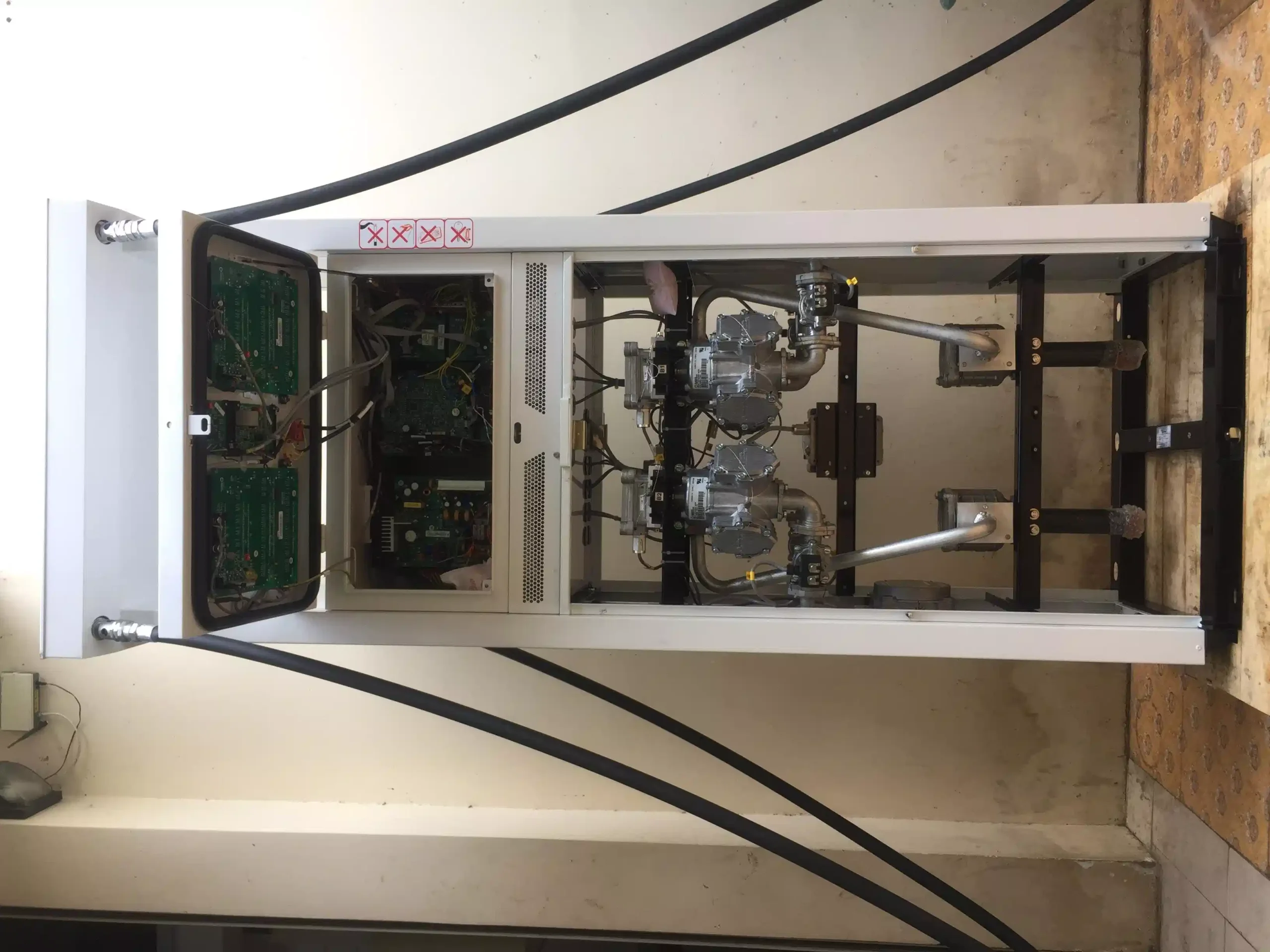
7. What Is the Difference Between Voltage and Power?
Voltage and power are not the same thing.
Voltage describes the electrical potential supplied to the equipment.
Power describes how much electrical energy the equipment uses or requires.
For example, a fuel dispenser may have a specified voltage such as:
AC220V
or:
AC380V
But the actual electrical load depends on the equipment configuration and components.
Therefore, when requesting a quotation, buyers should provide both the required voltage and other electrical information where available.
8. Can a 220V Fuel Dispenser Be Used on a 380V Supply?
Do not connect a fuel dispenser to a power supply that does not match its rated specification.
A dispenser designed for 220V should not simply be connected directly to a 380V supply.
Incorrect voltage can damage electrical components and create serious equipment and safety risks.
If the site power supply does not match the dispenser specification, the electrical design should be reviewed by qualified professionals and the appropriate solution should be confirmed before installation.
The same principle applies in reverse.
A 380V dispenser should not be directly connected to a 220V supply unless the equipment is specifically designed for that configuration.
9. What About 50Hz and 60Hz?
Voltage is not the only electrical parameter that matters.
Frequency should also be confirmed.
Common power frequencies include:
- 50Hz
- 60Hz
The equipment should be compatible with the power frequency available at the project site.
For international projects, buyers should therefore provide:
Voltage + Phase + Frequency
rather than providing voltage alone.
For example:
380V / 3 Phase / 50Hz
or:
220V / Single Phase / 50Hz
The exact specification should be confirmed with the equipment supplier before ordering.
10. How Does Fuel Dispenser Voltage Affect the Pumping System?
The dispenser’s electrical configuration should be considered together with the fuel supply system.
A typical fuel delivery system includes:
Underground Fuel Tank → Submersible Pump → Underground Fuel Piping → Fuel Dispenser → Nozzle
The dispenser, pump and electrical system should be properly coordinated.
The electrical configuration should also be considered together with the dispenser installation and layout.
For example, a project may use a submersible turbine pump to supply multiple fuel dispensers.
In this case, the pump power supply and dispenser power supply may involve different electrical requirements.
Therefore, the complete system should be reviewed before selecting the final equipment.
11. What Voltage Should You Choose for Your Gas Station?
There is no universal answer that 220V or 380V is always better.
The correct choice depends on the project.
Consider 220V When:
- The selected dispenser model supports 220V
- The site has the required 220V supply
- The electrical design supports the equipment
- The project requirements are compatible with the dispenser configuration
Consider 380V When:
- The selected dispenser model supports 380V
- The site has an appropriate three-phase supply
- The overall electrical design uses three-phase equipment
- The project requirements call for this configuration
The final decision should be based on the equipment specification and actual site conditions.
12. Fuel Dispenser Voltage Options in Our Products
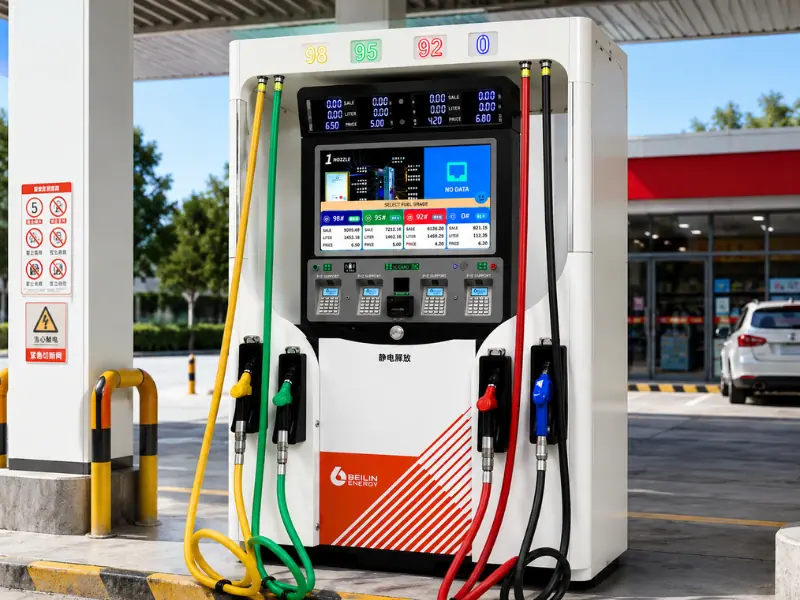
Our fuel dispenser range includes models designed for different gas station applications and power supply requirements.
For example, some of our dispenser specifications include:
AC220V ±20%
and:
AC380V ±20%
depending on the model and configuration.
Our fuel dispensers can be configured according to project requirements, including different nozzle quantities and fuel dispensing configurations.
For example, our ZC Series specifications can include an AC220V ±20% or AC380V ±20% power supply depending on the selected configuration.
The exact electrical specification should be confirmed before ordering.
13. What Information Should You Provide When Ordering a Fuel Dispenser?
For international gas station projects, we recommend providing the following information before requesting a quotation:
Electrical Requirements
- Voltage
- Phase
- Frequency
- Available site power
Fuel Dispenser Requirements
- Number of dispensers
- Number of nozzles
- Fuel products
- Required flow rate
- Vapor recovery requirements
Fuel Supply System
- Tank capacity
- Submersible pump information
- Underground piping
- Expected simultaneous fueling demand
Project Information
- Destination country
- Applicable standards
- Gas station layout
- New construction or replacement project
Providing these details helps the supplier recommend a suitable dispenser configuration.
14. Common Mistakes When Selecting Fuel Dispenser Voltage
Mistake 1: Choosing Voltage Based Only on Country
Different projects can have different electrical conditions.
Always confirm the actual site power supply.
Mistake 2: Looking at Voltage but Ignoring Phase
220V alone does not tell the supplier whether the project requires single-phase or another configuration.
Mistake 3: Assuming 380V Means Faster Fueling
Fuel flow rate depends on the fuel delivery system, not voltage alone.
Mistake 4: Ignoring Frequency
50Hz and 60Hz requirements should also be confirmed.
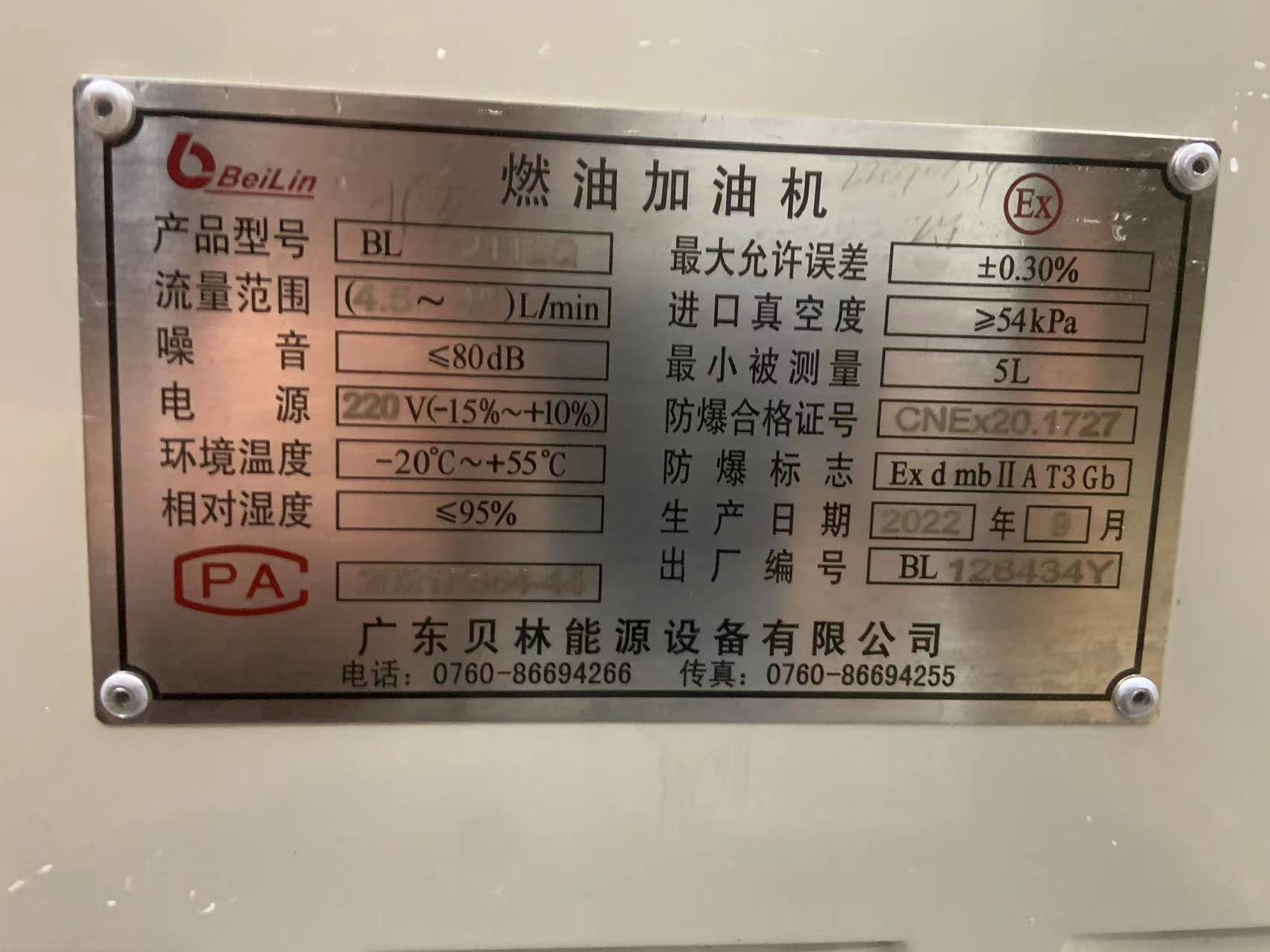
Mistake 5: Connecting Equipment Without Checking the Nameplate
Always verify the equipment’s rated electrical specifications before installation.
15. 220V vs. 380V: A Simple Selection Checklist
Before ordering a fuel dispenser, confirm:
1. What is the site voltage?
220V or 380V?
2. What is the phase?
Single-phase or three-phase?
3. What is the frequency?
50Hz or 60Hz?
4. What dispenser model are you purchasing?
Check the manufacturer’s electrical specification.
5. What is the required flow rate?
Confirm the required L/min.
6. What pumping system will be used?
Self-priming or submersible pump system?
7. What local standards apply?
Confirm electrical, safety and measurement requirements.
16. How We Can Help With Fuel Dispenser Selection
Selecting a fuel dispenser involves more than choosing a voltage.
The correct configuration should match:
Voltage + Phase + Frequency + Nozzle Quantity + Flow Rate + Fuel Products + Pumping System + Local Requirements
Our team can help evaluate the suitable fuel dispenser configuration according to your project requirements.
If you are not sure whether your project needs a 220V or 380V fuel dispenser, send us your site power information and dispenser requirements.
We can help you identify a suitable configuration before ordering.
Need Help Choosing a 220V or 380V Fuel Dispenser?
Tell us:
- Your destination country
- Required voltage
- Phase and frequency
- Number of nozzles
- Required flow rate
- Number of dispensers
Our team can help you evaluate a suitable fuel dispenser for your gas station project.